

On this page
Assigning oxidation numbers can feel like a maze of rules and exceptions. When you are stuck on a tough compound or polyatomic ion, it is tempting to just look up the final answer. But reading a solution does not teach you how to handle the next problem.
To actually learn the rules, you need to guess the answer, apply the rules yourself, and then find out exactly where your logic broke down. This is where Fermi's AI tutor becomes useful.
Why check oxidation numbers step by step?
When you work out the oxidation states yourself before checking the answer, you are using active learning. A meta-analysis of 225 studies found that undergraduate science students in traditional lecture classes had a 55% higher failure rate than those who learned actively (Freeman et al., 2014).
If you just ask an AI for the oxidation number of oxygen in a compound, it will give you a number. If you instead provide your own working and ask the AI to find the flaw, you force yourself to retrieve the rules from memory. You can use the Fermi Problem Library to work through the chemistry problem step by step, and the tutor will explain the reasoning rather than just printing an answer.
What are the rules for oxidation numbers?
The oxidation state is the hypothetical charge an atom would have if all its bonds to different atoms were fully ionic (IUPAC, 2016). To figure out these numbers without drawing every bond, chemists use a priority list of rules.
Here is the standard order:
Free elements (like O₂ or Na) have an oxidation state of 0.
The sum of all oxidation numbers in a neutral compound is 0. For an ion, the sum equals the total charge.
Group 1 metals are always +1, and Group 2 metals are always +2.
Fluorine is always -1.
Hydrogen is usually +1. (Exception: When bonded to metals in hydrides like NaH, it is -1).
Oxygen is usually -2.
Most of your homework questions can be solved just by following this list from top to bottom. But exams will deliberately test the exceptions, particularly for oxygen.
How to assign oxidation numbers in peroxides and superoxides?
Oxygen is tricky because it does not always take a -2 charge. The exceptions happen when oxygen bonds to itself or to very electropositive metals.
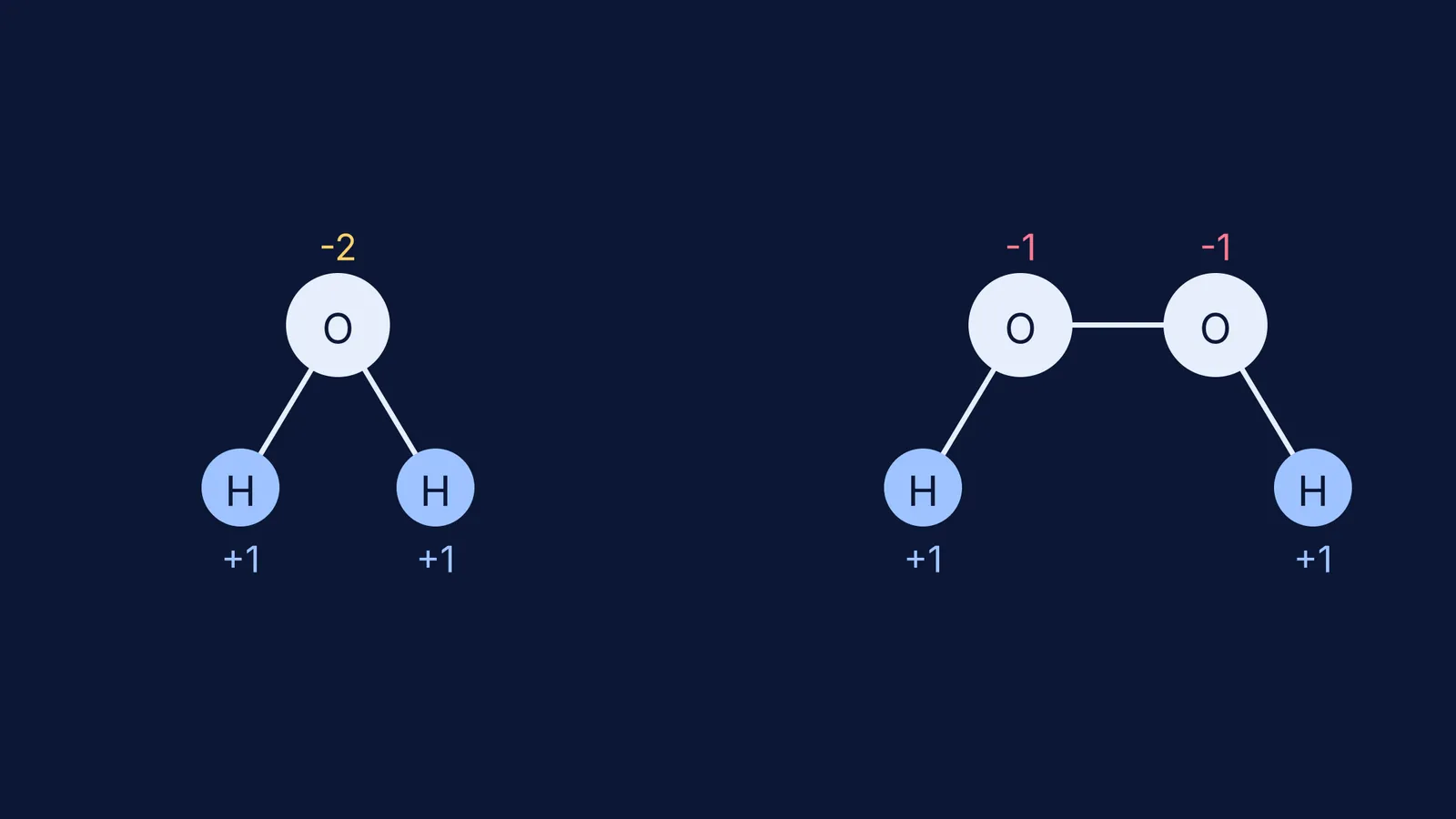
Peroxides In a peroxide like hydrogen peroxide (H₂O₂), two oxygen atoms share a bond. Because hydrogen is +1, the two hydrogens contribute +2 in total. For the molecule to be neutral, the two oxygens must contribute -2 in total. Therefore, the oxidation number of oxygen in a peroxide is -1.
Superoxides Superoxides like potassium superoxide (KO₂) are even stranger. Following rule 3, potassium (Group 1) is +1. To balance this, the two oxygens must contribute -1 in total. This means the oxidation number of oxygen in a superoxide is -1/2. Fractional oxidation numbers look wrong, but they are perfectly valid as an average charge across the oxygen atoms.
What happens when oxygen bonds with fluorine?
The rules state that fluorine is always -1 because it is the most electronegative element. When oxygen bonds with fluorine to form oxygen difluoride (OF₂), the normal rule for oxygen breaks down.
Because there are two fluorine atoms, they contribute -2 in total. For the molecule to remain neutral, the oxygen atom must take an oxidation state of +2. This is a rare case where oxygen has a positive oxidation number, and it often appears in multiple-choice questions to test whether you remember that fluorine's rule has higher priority than oxygen's rule.
How do you find the oxidation number of transition metals?
Unlike Group 1 and Group 2 metals, transition metals can have multiple oxidation states. You find their oxidation number by working backwards from the other elements in the compound.
For example, in potassium permanganate (KMnO₄), you need to find the oxidation state of manganese (Mn). Following the rules, potassium is +1 and the four oxygen atoms are -2 each. The four oxygens contribute -8 in total. The molecule is neutral, so the sum of the oxidation numbers must be zero. The potassium provides +1, which means the manganese must provide +7 to balance the -8 from the oxygen. Therefore, the oxidation state of manganese in KMnO₄ is +7.
How should you prompt an AI tutor for help?
When you hit a confusing molecule, do not ask the AI for the answer. Ask it to check your work. You can copy this script into your AI tutor:
"I need to find the oxidation numbers for the elements in KO₂. Here is my thinking:
Potassium is Group 1, so K = +1.
Oxygen is usually -2.
That gives +1 + 2(-2) = -3, but the molecule is neutral.
Where is my mistake? Do not solve it for me, just give me a hint about what I missed."
If you are reviewing for an exam, you might wonder, can you trust AI on inorganic chemistry exceptions? You can, as long as you use it to check your own work. You can also use this same active method to check your NCERT exercise answers with AI.


