

On this page
Here is the puzzle. Chlorine has the highest electron affinity of all the halogens, so it should grab electrons best. Yet fluorine is the stronger oxidising agent by a wide margin. The answer is to add up every step of the real reaction.
Why is F2 a stronger oxidant than Cl2 if chlorine gains electrons more easily?
Oxidising power in water is measured by the standard reduction potential, E°, of X2 + 2e⁻ → 2X⁻(aq). The standard electrode potential data table) lists E° = +2.87 V for F2/F⁻ and +1.36 V for Cl2/Cl⁻.
A higher E° means a stronger oxidising agent, so fluorine wins. Electron gain enthalpy describes only one step: a gaseous atom picking up an electron. A real oxidant starts as a molecule, X2, and ends as a hydrated ion, X⁻(aq), in solution. So three steps count, not one:
Break the X–X bond to get gaseous atoms (costs energy).
Add an electron to each atom (electron gain enthalpy, releases energy).
Surround the ion with water molecules (hydration enthalpy, releases energy).
Chlorine wins step 2 narrowly. Fluorine wins steps 1 and 3 by much more.
What does the energy cycle for F2 and Cl2 look like?
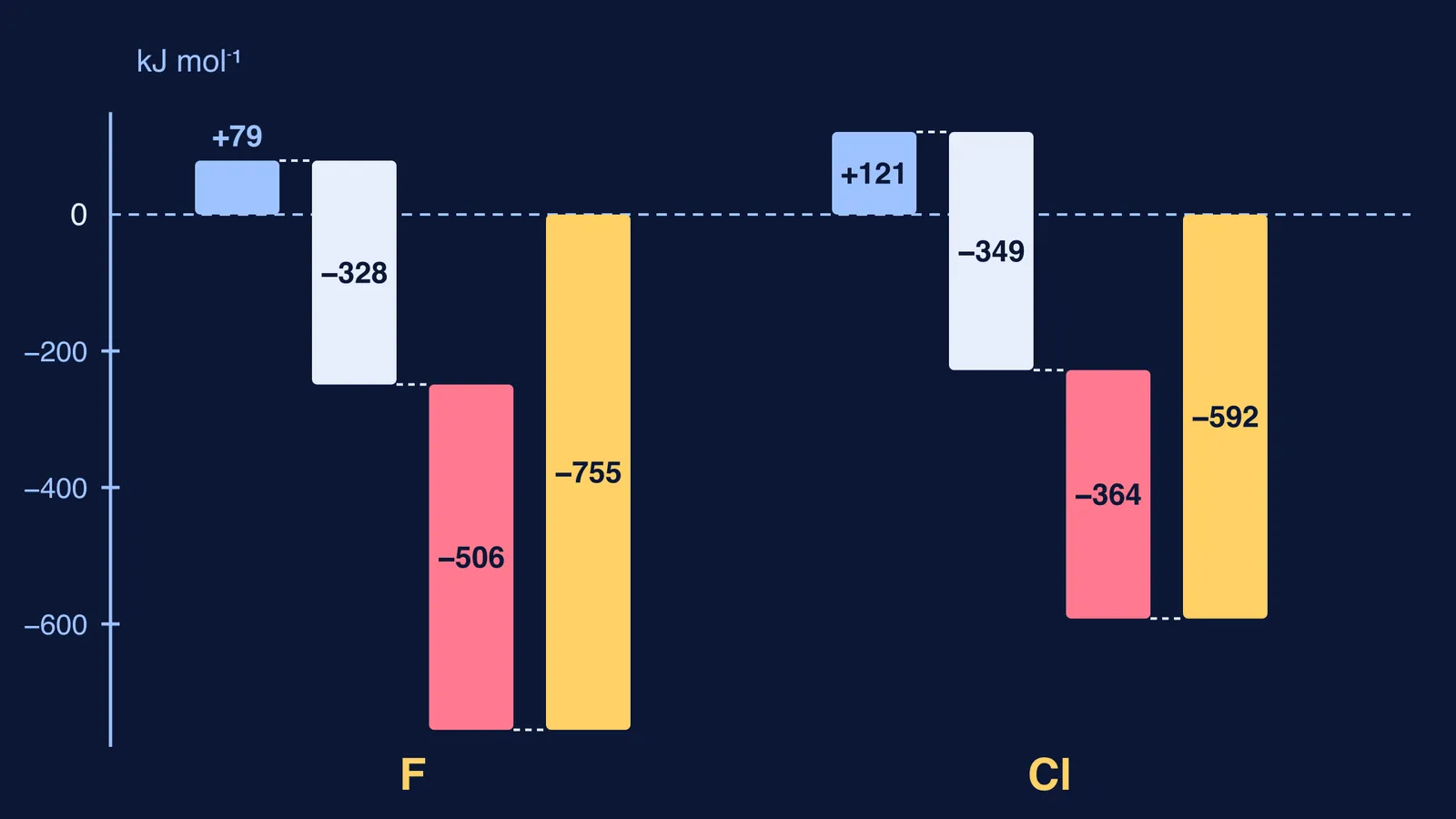
Here is the worked example, per mole of X⁻(aq) formed, using the values in Chemguide's comparison of the halogens as oxidising agents.
For fluorine:
Atomisation, ½F2(g) → F(g): +79 kJ/mol
Electron gain, F(g) → F⁻(g): −328 kJ/mol
Hydration, F⁻(g) → F⁻(aq): −506 kJ/mol
Total: 79 − 328 − 506 = −755 kJ/mol
For chlorine:
Atomisation, ½Cl2(g) → Cl(g): +121 kJ/mol
Electron gain, Cl(g) → Cl⁻(g): −349 kJ/mol
Hydration, Cl⁻(g) → Cl⁻(aq): −364 kJ/mol
Total: 121 − 349 − 364 = −592 kJ/mol
Chlorine's electron gain is only 21 kJ/mol more favourable. Fluorine saves 42 kJ/mol on atomisation and gains 142 kJ/mol more on hydration. The net result is that fluorine's overall change is 163 kJ/mol more exothermic, which matches its much higher E°.
The same cycle on Chemguide gives totals of −547 kJ/mol for bromine and −481 kJ/mol for iodine, so the order F2 > Cl2 > Br2 > I2 falls straight out of the sums. That is also why chlorine can push bromide and iodide out of solution, as our post on why chlorine displaces bromine and iodine from their salts shows.
Why is the F–F bond so weak and F⁻ hydration so strong?
The bond energy of F2 is 159 kJ/mol, well below 243 kJ/mol for Cl2, according to the data table in Wikipedia's article on the halogens. The F–F bond is very short, so the lone pairs on the two fluorine atoms sit close enough to repel each other and weaken the bond, as Chemguide's page on halogen properties explains. We cover this anomaly, and how exams test it, in why the F–F bond is weaker than Cl–Cl.
The hydration step is the biggest single difference. The Chemguide comparison gives the very high hydration enthalpy of the fluoride ion as the main reason: F⁻ is very small, so water molecules are pulled in close and held strongly.
The one step chlorine wins is electron gain: the halogen article notes that chlorine has the highest electron affinity of the group. If the sign convention for that number confuses you, read why electron gain enthalpy is written as negative.
How do you write this answer in a board or JEE exam?
Use this four-line template. It fits a short board answer and gives the reasoning behind a JEE assertion-reason question.
Define the test: oxidising power depends on the overall change ½X2(g) → X⁻(aq), measured by E°.
State the trap: Cl has a more negative electron gain enthalpy than F.
Give the two compensating factors: F2 has a lower bond dissociation enthalpy, and F⁻ has a much higher hydration enthalpy because it is small.
Conclude: these outweigh the electron gain term, so F2 has the highest E° and is the strongest oxidising agent.
Check yourself against these common slips:
Saying fluorine has the highest electron gain enthalpy. It does not; chlorine does.
Mixing up electronegativity (a property of a bonded atom) with electron gain enthalpy (an energy change for an isolated gaseous atom).
Forgetting hydration. Without it, the argument cannot explain the size of the gap in E°.
Writing "F–F bond is strong because F is small." It is weak, despite the small size.
If the link between enthalpy terms and E° still feels shaky, the Fermi Concept Library has its own lesson for every concept in chemistry, so you can fill the specific gap. To practise the reasoning, the Fermi Problem Library has worked problems with a step-by-step solver that explains the reasoning rather than printing an answer.


