

On this page
Halogen displacement reactions are classic examples of redox chemistry in Class 11 and Class 12 NCERT syllabuses, often appearing in both theoretical exams and practical viva questions. The core principle is straightforward: a more reactive halogen will displace a less reactive halogen from its halide solution. Because reactivity decreases as you move down Group 17 of the periodic table, fluorine is the most reactive, followed by chlorine, bromine, and finally iodine.
This reactivity trend means chlorine can confidently displace bromine and iodine from their salts, while bromine can only displace iodine. Understanding this order is crucial for predicting the outcomes of chemical reactions.
Why does chlorine displace bromine and iodine?
The ability of a halogen to displace another comes down to its oxidising power — its capacity to gain electrons. This power is quantified by the element's standard reduction potential. The higher the positive value of this potential, the stronger the oxidising agent.
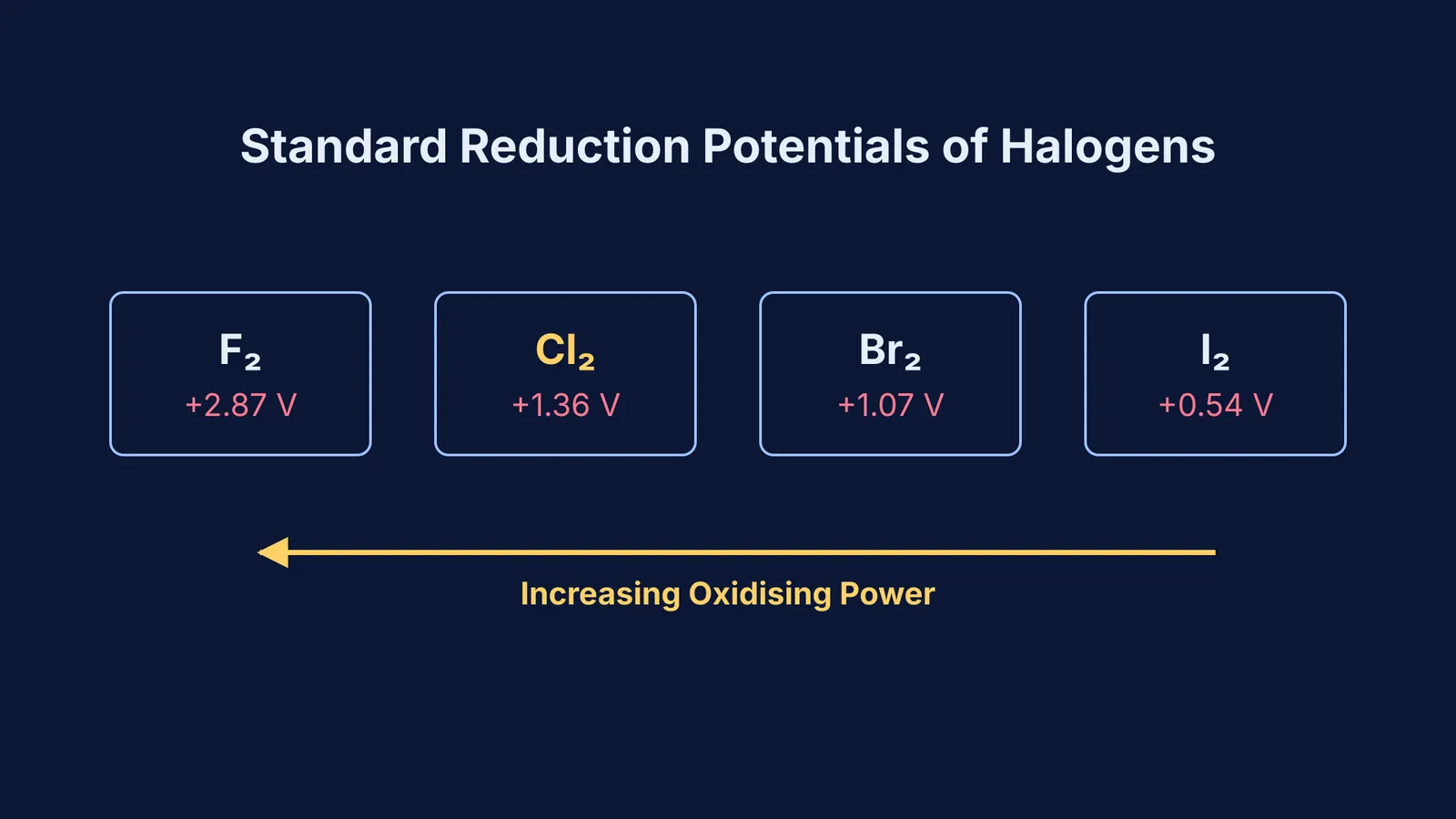
The standard reduction potentials) for the halogens at 25 °C are:
Fluorine (F₂): +2.87 V
Chlorine (Cl₂): +1.36 V
Bromine (Br₂): +1.07 V
Iodine (I₂): +0.54 V
Chlorine's reduction potential (+1.36 V) is higher than that of both bromine (+1.07 V) and iodine (+0.54 V). When chlorine gas is bubbled through a solution containing bromide ions (Br⁻), it pulls electrons away from them because it has a stronger affinity for those electrons. If you have gaps in your understanding of redox reactions, the Fermi Concept Library covers every concept in physics, chemistry, biology, mathematics and computing, each with its own lesson and its place in the map. The chlorine molecules are reduced to chloride ions (Cl⁻), while the bromide ions are oxidised to elemental bromine (Br₂).
We can break this down into two half-reactions:
Reduction (gain of electrons): Cl₂ + 2e⁻ → 2Cl⁻
Oxidation (loss of electrons): 2Br⁻ → Br₂ + 2e⁻
How do you write the displacement equations?
Redox reactions are best understood by writing the balanced ionic equations. When chlorine reacts with an aqueous potassium bromide (KBr) solution, the overall ionic equation is:
Cl₂ + 2Br⁻ → 2Cl⁻ + Br₂
Similarly, chlorine will oxidise iodide ions to form elemental iodine:
Cl₂ + 2I⁻ → 2Cl⁻ + I₂
However, if you add iodine to a solution of potassium chloride, no chemical reaction takes place. Iodine (+0.54 V) is a weaker oxidising agent than chlorine (+1.36 V), so it cannot take electrons away from the chloride ions. If you want to practice assigning oxidation states or balancing these ionic equations, the Fermi Problem Library has worked problems with a step-by-step solver that explains the reasoning rather than printing an answer.
How is the layer test used in the laboratory?
In the chemistry lab, halogen displacement is practically used to identify the presence of bromide and iodide ions through what is known as the "layer test". When chlorine water is added to a test tube containing an unknown halide salt, it displaces any bromine or iodine that might be present.
Because aqueous solutions of bromine and iodine can look similar (both can appear yellowish or brownish depending on concentration), an organic solvent such as carbon tetrachloride (CCl₄) or chloroform (CHCl₃) is added, and the mixture is shaken. Halogens are much more soluble in non-polar organic solvents than they are in water.
After shaking, the organic solvent separates and settles at the bottom of the test tube, taking on a distinct colour based on the dissolved halogen:
An orange or red layer indicates that bromine (Br₂) was displaced.
A violet or purple layer indicates that iodine (I₂) was displaced.
This simple visual test provides clear confirmation of the reactivity trend of Group 17, demonstrating in real time that oxidising power falls as you move down the group.
To explore more about how halogens behave in different chemical environments, you might review Interhalogen compounds: shapes of ClF3, BrF5 and IF7 for JEE or see how halogen exchange works in organic synthesis with the Finkelstein and Swarts reactions: making alkyl iodides and fluorides.


