

On this page
You learn early that bonds get weaker as atoms get bigger, so fluorine, the smallest halogen, should hold its pair together the hardest. It does not. Fluorine breaks two trends at once, both standard textbook exceptions, and the bond one has appeared in JEE Main. Here are the numbers, the reason, and a three-line answer for the exam hall.
Why is the F–F bond weaker than the Cl–Cl bond?
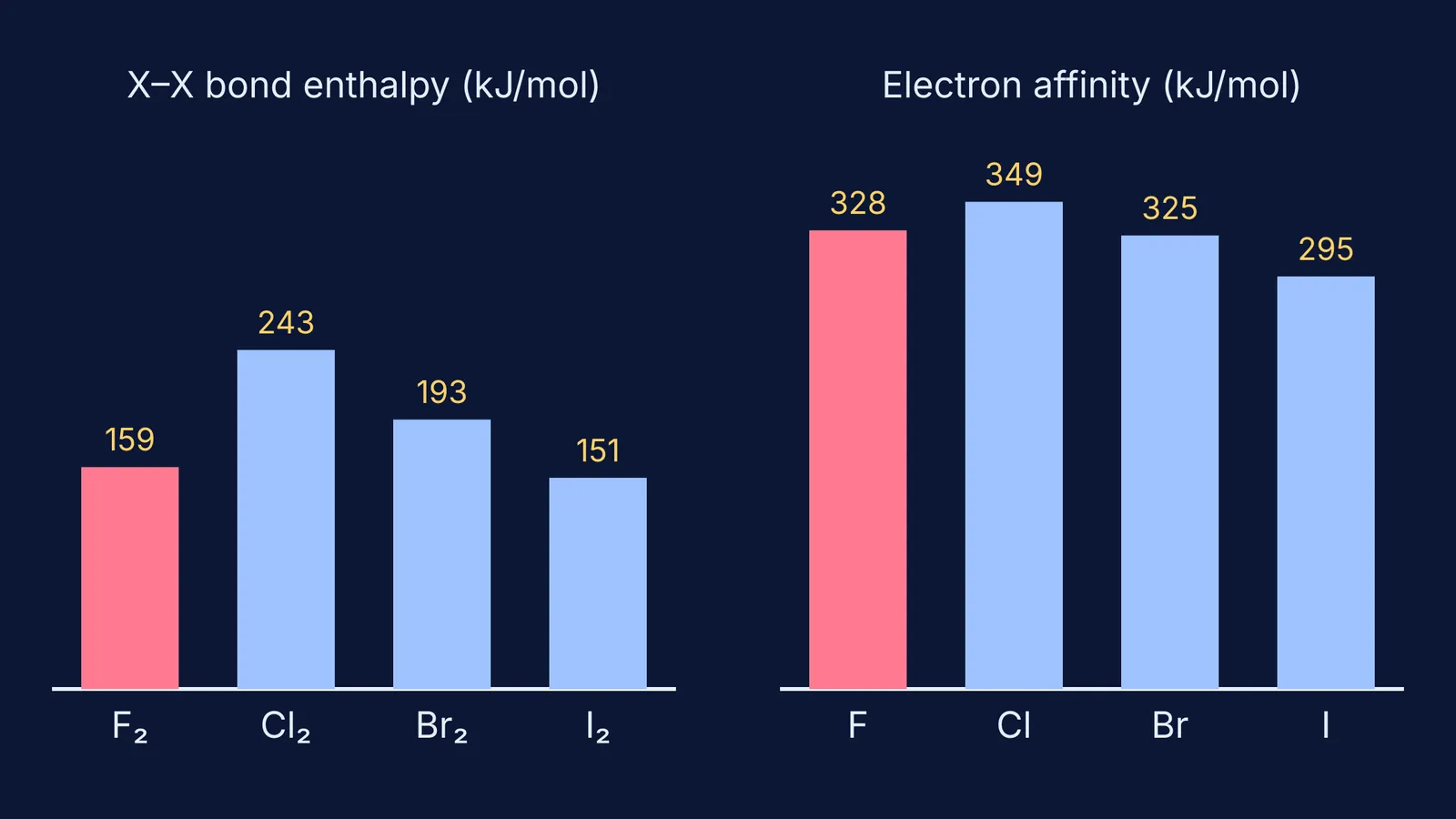
The bond enthalpy of X₂ is the energy needed to split one mole of gaseous X₂ into atoms: twice the enthalpy of formation of the gaseous atom minus that of gaseous X₂. Using CODATA values on the NIST Chemistry WebBook for atomic fluorine (79.38 kJ/mol) and atomic chlorine (121.30 kJ/mol), with F₂ and Cl₂ gas at zero as standard states, the values at 298 K are:
F–F: 2 × 79.38 = 158.8 kJ/mol
Cl–Cl: 2 × 121.30 = 242.6 kJ/mol
Br–Br: 2 × 111.87 − 30.91 = 192.8 kJ/mol, from NIST's Br atom and Br₂ gas values
I–I: 2 × 106.76 − 62.42 = 151.1 kJ/mol, from NIST's I atom and I₂ gas values
So the order is Cl₂ > Br₂ > F₂ > I₂, and fluorine comes third, not first.
The textbook reason is lone-pair repulsion. Each fluorine atom in F₂ carries three lone pairs, and the two atoms sit very close together. The F₂ bond length is 1.412 Å (NIST F₂ data), against 1.988 Å for Cl₂ (NIST Cl₂ data). At that distance the lone pairs on the two atoms repel strongly, cancelling part of the bonding energy. Chlorine's lone pairs sit in larger 3p orbitals, farther apart. From chlorine down to iodine the normal trend returns: bigger atoms, longer bonds, weaker overlap.
Why is chlorine's electron gain enthalpy more negative than fluorine's?
The same crowding shows up when an atom gains an electron. NIST lists the electron affinity of fluorine as 3.401 eV (NIST) and that of chlorine as 3.613 eV (NIST). The Faraday constant, 96 485 C/mol, turns 1 eV per atom into 96.485 kJ/mol, so fluorine releases about 328 kJ/mol and chlorine about 349 kJ/mol. Electron gain enthalpy is close to the negative of electron affinity, which gives about −328 kJ/mol for fluorine and −349 kJ/mol for chlorine.
The incoming electron enters fluorine's compact 2p subshell, already holding five electrons, so it is repelled more than one entering chlorine's roomier 3p subshell.
How does JEE Main ask about it?
A JEE Main paper from 25 February 2021 (Shift 2), as reproduced by Cracku, asked for "the correct order of bond dissociation enthalpy of halogens", with Cl₂ > Br₂ > F₂ > I₂ as the answer. Traps to expect:
An option that puts F₂ first, following the size trend.
An option that places F₂ second, below Cl₂ but above Br₂.
An assertion-reason pair whose reason is "fluorine is the most electronegative element", which does not explain the weak bond.
An electron gain enthalpy order that puts F above Cl.
Both anomalies come from small size and crowded electrons, so learn them together. Our guide to periodic trends and their exceptions covers other first-member exceptions, and small size is also why many fluorine atoms fit around one large central atom in interhalogen compounds such as ClF₃ and IF₇.
How do you write the answer in three lines?
For a two- or three-mark "explain why" question, use this frame, with the NIST-based values worked out above:
State the fact: "The F–F bond enthalpy (about 159 kJ/mol) is lower than that of Cl–Cl (about 243 kJ/mol)."
Give the cause: "F is very small, so the F–F bond is short and the lone pairs on the two atoms are close together."
Link cause to effect: "Strong repulsion between these lone pairs weakens the bond. Cl is larger, so this repulsion is smaller."
For electron gain enthalpy, change line 2 to "the added electron enters the small, crowded 2p subshell of F" and line 3 to "electron–electron repulsion reduces the energy released, so the value for Cl is more negative."
Test yourself without notes: which halogen has the strongest bond, which the weakest, and why is fluorine neither? If any part wobbles, the Fermi Concept Library gives each concept its own lesson and its place in the map, and the Fermi Problem Library has worked problems with a step-by-step solver that explains the reasoning rather than printing an answer.
Is lone-pair repulsion the whole story?
For exam answers, yes. In a 2009 paper in Nature Chemistry, Sason Shaik, David Danovich, Wei Wu and Philippe Hiberty argued that alongside covalent and ionic bonds there is a third family, charge-shift bonds, in which fluctuation of the electron pair plays the dominant role. They place bonds between two atoms of a compact, electronegative or lone-pair-rich element in this family (abstract, DOI). You do not need this for JEE; treat lone-pair repulsion as a model that gives the right answer, not the last word.
For how fluorine was first isolated, read about Henri Moissan and the isolation of fluorine in 1886.


