

On this page
When a neutral atom captures an extra electron, the process usually releases energy. But when you look up the value in a modern data table, the number has a negative sign. This often trips up students preparing for JEE and NEET: if the atom "wants" the electron, why is the energy change negative?
Why is electron gain enthalpy negative?
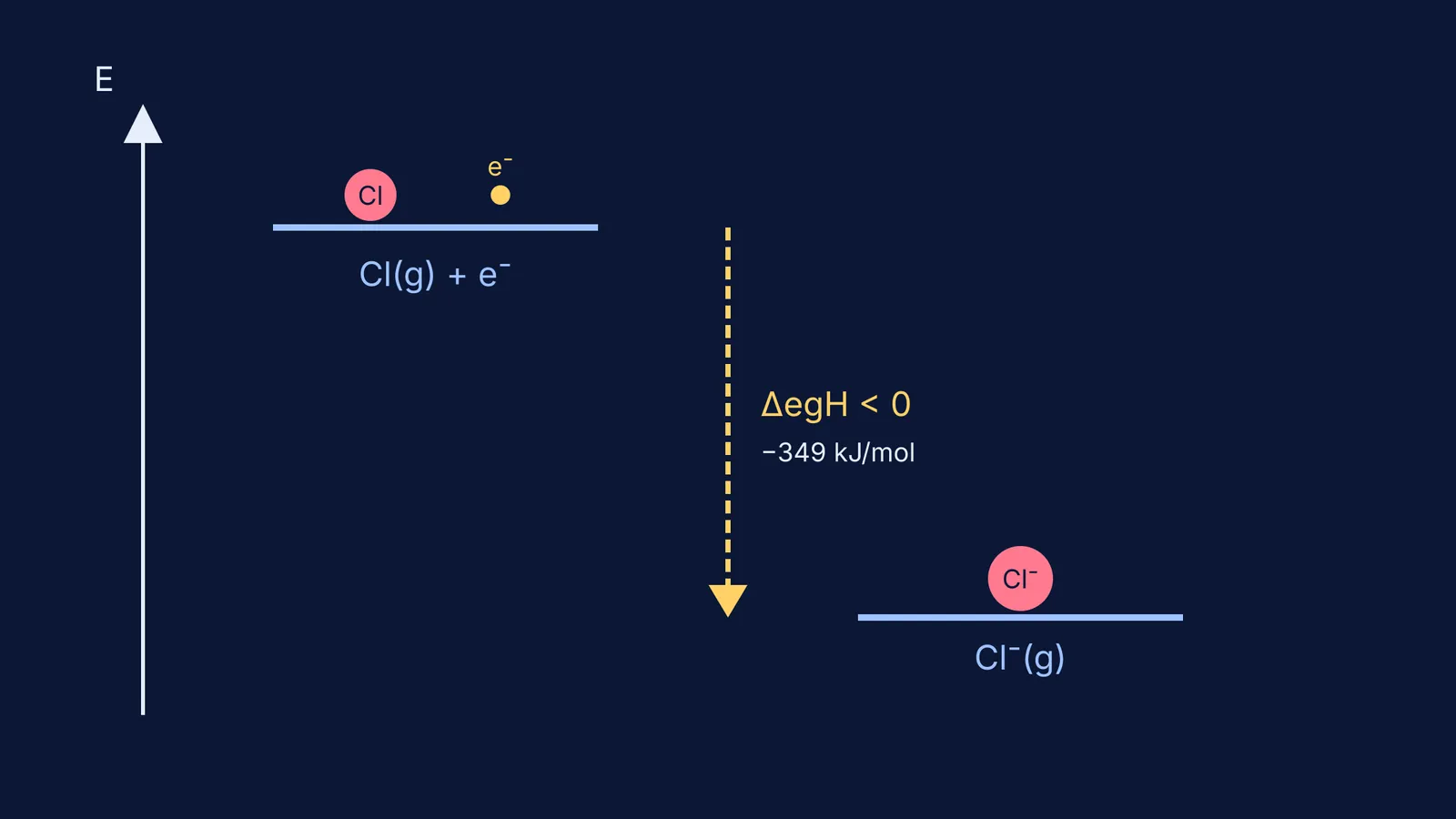
The sign convention comes directly from the laws of thermodynamics. When an electron approaches a neutral non-metal atom, it is attracted by the positive charge of the nucleus. This attraction lowers the potential energy of the system.
To reach this more stable, lower-energy state, the system must shed its excess energy into the surroundings as heat. Just as we track energy leaving the system during the free expansion of an ideal gas, we give this energy loss a negative sign. Electron gain enthalpy (ΔegH) is the enthalpy change that occurs when a neutral gaseous atom accepts an electron to form a negative ion (LibreTexts/Physical_Properties_of_Matter/Atomic_and_Molecular_Properties/Electron_Affinity)). For chlorine, the electron gain enthalpy is approximately −349 kJ/mol (LibreTexts/Physical_Properties_of_Matter/Atomic_and_Molecular_Properties/Electron_Affinity)).
The size of the atom also plays a major role in how much energy is released. You might expect fluorine to release the most energy when gaining an electron because it is at the top right of the periodic table. But chlorine actually releases more energy. This happens because fluorine is a very small atom. Its valence shell is already crowded with electrons. When a new electron tries to enter this small, crowded space, it experiences strong repulsion from the existing electrons, which lowers the net energy released compared to the slightly larger chlorine atom (LibreTexts/Physical_Properties_of_Matter/Atomic_and_Molecular_Properties/Electron_Affinity)).
When is electron gain enthalpy positive?
Not every atom releases energy when it gains an electron. The process becomes endothermic—meaning energy must be supplied, giving a positive ΔegH—in two common cases:
Noble gases: Elements like neon and argon already have a completely full, stable valence shell. To add an extra electron, you must force it into a new, higher-energy shell against the atom's natural stability.
Second electron gain: Adding one electron to oxygen to form O⁻ is exothermic. However, adding a second electron to form O²⁻ requires pushing a negatively charged electron towards an already negative ion. The strong electrostatic repulsion means you must supply energy, so the second electron gain enthalpy is always positive. For example, adding the first electron to oxygen releases 142 kJ/mol, but adding the second electron requires putting in 844 kJ/mol of energy because the new electron is being forced into a small, very electron-dense space (LibreTexts/Physical_Properties_of_Matter/Atomic_and_Molecular_Properties/Electron_Affinity)).
What is the difference between electron affinity and electron gain enthalpy?
Older textbooks, and many practising chemists, prefer the term "electron affinity" (EA). This measures the same physical event but from a microscopic perspective. Electron affinity can also be defined as the energy required to detach an electron from a singly charged negative ion (Wikipedia).
When an atom has a high tendency to gain an electron, it has a high, positive electron affinity. The thermodynamic enthalpy change is mathematically related but generally carries the opposite sign. A positive electron affinity of +349 kJ/mol translates to an electron gain enthalpy of −349 kJ/mol.
How do you read exam questions on electron gain enthalpy?
When you encounter these terms in an exam or a mock test, use this framework to translate them safely:
Spot the term: Check whether the question says "electron affinity" or "electron gain enthalpy".
Translate to heat flow: If it says enthalpy, apply thermodynamic rules. Negative means exothermic (it happens easily). Positive means endothermic (it is forced).
Compare like with like: While enthalpies of atomisation, sublimation and phase change deal with bulk materials and bonds, electron gain enthalpy deals with individual, isolated gaseous atoms.
Watch for the second electron: If the question involves forming an O²⁻ or S²⁻ ion, expect a positive enthalpy step in your Born-Haber cycle.
If you are confused by a chemistry textbook that mixes up these signs, the Concept Library holds every concept in physics, chemistry, biology, mathematics and computing, each with its own lesson and its place in the map. When you bring a problem set or a scanned assignment, Fermi's AI tutor works out what you already know, builds a plan for the session, and teaches through it — writing on a board, drawing the figure, running the simulation, and checking understanding as it goes. For dedicated numerical practice, the Fermi Problem Library provides worked problems with a step-by-step solver that explains the reasoning rather than printing an answer.


