On this page
The chemistry of Thénard's discovery fits on one line of a Class 11 notebook. It is also a good way to practise oxidation states, precipitation and volume strength at once.
Who discovered hydrogen peroxide?
Hydrogen peroxide was discovered by the French chemist Louis Jacques Thénard in 1818. In a 2018 letter to Nature, Two centuries since discovery of dawn-of-life molecule, Willem Koppenol and Helmut Sies write that Thénard discovered it "by reacting barium peroxide with strong acids". He called the new liquid eau oxygénée, which means "oxygenated water" (Wikipedia: Hydrogen peroxide).
According to his biography, Thénard was born on 4 May 1777 in La Louptière, in Champagne, the son of a farm worker. Trained by Louis Nicolas Vauquelin in Paris, before 1818 he had developed the pigment Thénard's blue (1799), taken over Vauquelin's chair at the Collège de France (1804) and written a four-volume chemistry textbook (1813–16). He died in Paris on 21 June 1857. His name is one of the 72 inscribed on the Eiffel Tower.
How did Thénard make hydrogen peroxide from barium peroxide?
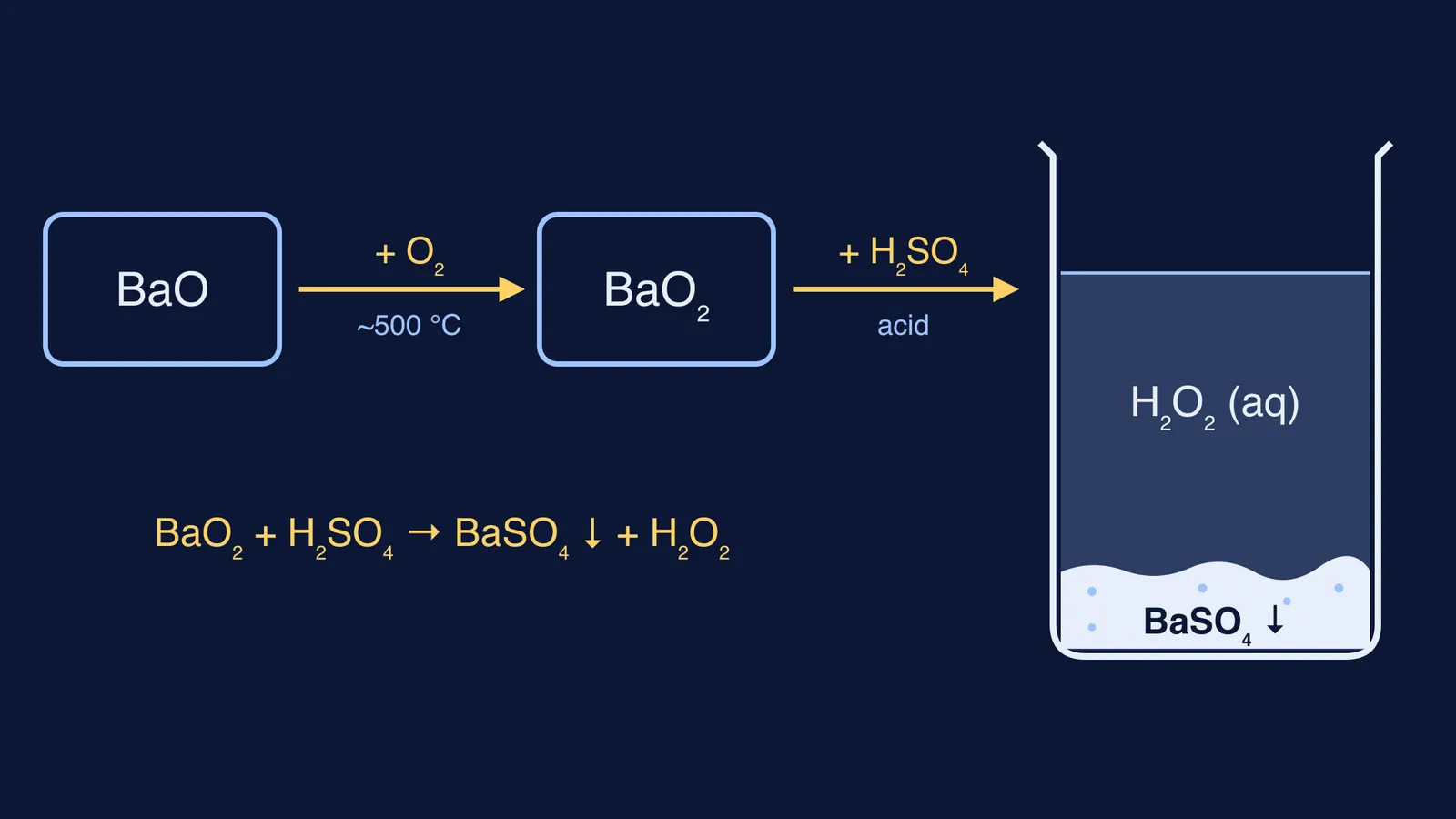
He started with barium peroxide, BaO₂, a solid that forms when barium oxide reacts with oxygen at around 500 °C (Wikipedia: Barium peroxide). Thénard recognised that it could be used to prepare a compound nobody had described before. A later, improved version of his method used hydrochloric acid and then sulfuric acid, so the barium settled out as barium sulfate. It was used from the end of the 19th century until the middle of the 20th (Wikipedia: Hydrogen peroxide).
The textbook form of the reaction appears in the NCERT Class 11 Chemistry unit on hydrogen (2019–20 edition):
BaO₂·8H₂O(s) + H₂SO₄(aq) → BaSO₄(s) + H₂O₂(aq) + 8H₂O(l)
Insoluble barium sulfate falls out as a white solid; filtering it off leaves dilute hydrogen peroxide. The same NCERT unit says the excess water is then removed by evaporation under reduced pressure.
Why does the reaction work? A worked example
Work through these four steps with a pencil.
Assign oxidation states. In BaO₂, barium is +2, so each oxygen is −1. In H₂O₂, hydrogen is +1, so each oxygen is again −1.
Ask whether this is a redox reaction. No element changes its oxidation state, so it is not. The peroxide group, two bonded oxygen atoms, moves from barium to hydrogen in one piece. See how to tell if a reaction is redox by tracking every element.
Find what drives the reaction. Insoluble BaSO₄ takes Ba²⁺ ions out of the solution, which pulls the reaction forward.
Find how much you need. Suppose you want 100 mL of a 3% solution, which is about 3.0 g of H₂O₂. That is 3.0 ÷ 34.0 = 0.088 mol. The ratio is 1:1, so you need 0.088 mol of BaO₂·8H₂O (molar mass 169.3 + 8 × 18.0 = 313.3 g/mol), or about 27.6 g.
When hydrogen peroxide breaks down, 2H₂O₂ → 2H₂O + O₂, oxygen at −1 goes both down to −2 and up to 0. That is a textbook case of disproportionation.
If step 1 felt shaky, the Fermi Concept Library covers every concept in chemistry, oxidation states included, each with its own lesson and its place in the map.
How strong is the hydrogen peroxide in your cupboard?
The NCERT unit says that a 30% solution is sold as "100 volume" hydrogen peroxide. That means 1 mL of it gives 100 mL of oxygen at STP. NCERT also says the commercially marketed sample is "10 volume", which is a 3% solution, or 30 g per litre. For more practice, see how to calculate the volume strength of hydrogen peroxide. The Fermi Problem Library has worked problems with a step-by-step solver that explains the reasoning rather than printing an answer.
Why is hydrogen peroxide still used as a bleach and antiseptic?
According to the CDC's guide to chemical disinfectants, hydrogen peroxide works by producing hydroxyl free radicals that can attack membrane lipids, DNA and other essential cell components.
The NCERT unit lists its everyday uses: a hair bleach, a mild disinfectant and an antiseptic sold as perhydrol. Industry uses it to bleach textiles, paper pulp, leather, oils and fats, and to treat domestic and industrial effluents. H₂O₂ breaks down slowly in light, and metal surfaces or traces of alkali speed this up, so NCERT says it is stored in the dark in wax-lined glass or plastic.
The Koppenol and Sies letter in Nature puts world production at about 5 million tonnes a year. Industry uses it as rocket fuel and as a "green" oxidant for treating wastewater and bleaching pulp and paper. Thénard's barium route is now obsolete (Wikipedia: Barium peroxide); the anthraquinone process, developed in the 1930s, is still used (Wikipedia: Hydrogen peroxide).
Next time you see a bottle marked 10 V, work backwards: write the oxidation states, then the grams per litre.