

On this page
Is this a redox reaction? You cannot answer by feel. Write an oxidation number above every atom on both sides, then look for one that changed. Here are the rules, a four-step check, and worked answers for the reaction types that cause most mistakes.
What makes a reaction a redox reaction?
NCERT's Class 11 chemistry textbook defines redox reactions as reactions "which involve change in oxidation number of the interacting species" (NCERT Class 11 Chemistry, Unit 7: Redox Reactions). Oxidation is an increase in oxidation number. Reduction is a decrease. The two always happen together: if one element goes up, something comes down.
This is wider than the Class 10 test (gain of oxygen, loss of hydrogen), which says nothing about 2Na + Cl₂ → 2NaCl. For the older version, see our explainer on oxidation and reduction using the oxygen and hydrogen rules.
How do you assign oxidation numbers quickly?
The NCERT chapter lists these rules:
An element on its own (Na, H₂, O₂, P₄, S₈) is 0.
An ion made of one atom carries its charge: Na⁺ is +1, Cl⁻ is −1.
Fluorine is −1 in all its compounds. Alkali metals are +1 and alkaline earth metals +2 in their compounds.
Hydrogen is +1, except in metal hydrides such as NaH and CaH₂, where it is −1.
Oxygen is −2, except in peroxides such as H₂O₂ (−1), superoxides such as KO₂ (−½), and compounds with fluorine (positive).
The numbers add up to zero in a neutral compound, or to the charge of an ion.
The last rule finds the unknown. In KClO₃: (+1) + Cl + 3(−2) = 0, so chlorine is +5. If oxidation number and valency keep blurring together, read the difference between oxidation number and valency.
A four-step check for any reaction
Write the correct formula for every reactant and product.
Write the oxidation number above every element on both sides, spectators included.
Compare element by element. Any change means redox. No change anywhere means not redox.
If it is redox, name what went up (oxidised) and what went down (reduced). An increase with no decrease means a wrong number somewhere.
Are all decomposition and combination reactions redox?
No. NCERT says directly that "all decomposition reactions are not redox reactions" and uses calcium carbonate as its example (NCERT Class 11 Chemistry, Unit 7). Four decompositions, checked element by element:
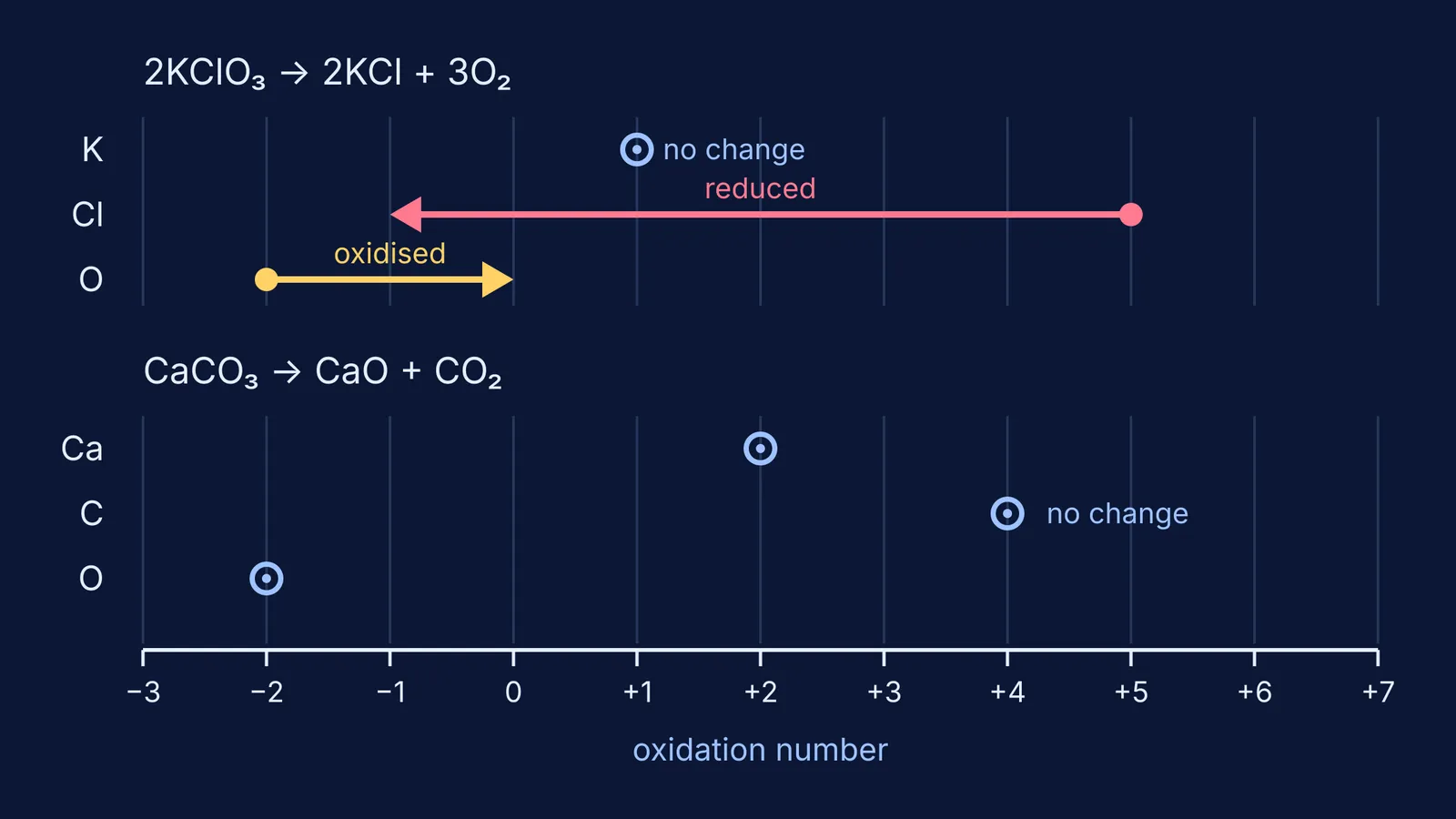
2KClO₃ → 2KCl + 3O₂. Cl goes from +5 to −1 (reduced), O from −2 to 0 (oxidised), K stays +1. Redox.
CaCO₃ → CaO + CO₂. Ca stays +2, C stays +4, O stays −2. Not redox.
2FeSO₄ → Fe₂O₃ + SO₂ + SO₃, from NCERT Class 10 Science, Chapter 1. Fe goes from +2 to +3, the S in SO₂ from +6 to +4. Redox, with no free element anywhere.
2H₂O₂ → 2H₂O + O₂. Oxygen starts at −1 and ends at both −2 and 0. One element is oxidised and reduced at once, which NCERT calls disproportionation.
Combination reactions work the same way. NCERT says at least one reactant must be an element for a combination to be redox, as in 3Mg + N₂ → Mg₃N₂ (Mg 0 to +2, N 0 to −3). The Class 10 quicklime reaction, CaO + H₂O → Ca(OH)₂, keeps Ca at +2, O at −2 and H at +1: not redox. Treat that as a shortcut, because counting still decides. SO₂ + H₂O₂ → H₂SO₄ joins two compounds, yet S rises from +4 to +6 and the peroxide oxygen falls from −1 to −2. Redox.
Is a double displacement reaction ever redox?
In a double displacement, ions usually swap partners and keep their charges. Take Na₂SO₄ + BaCl₂ → BaSO₄ + 2NaCl from NCERT Class 10 Science, Chapter 1: Na is +1, Ba +2, Cl −1, S +6 and O −2 on both sides. Not redox. Neutralisation, NaOH + HCl → NaCl + H₂O, is the same. Compare single displacement, Zn + CuSO₄ → ZnSO₄ + Cu, where Zn goes from 0 to +2 and Cu from +2 to 0. To tell the two types apart, read displacement vs double displacement reactions.
Practice: redox or not?
Run the four steps on each.
2Pb(NO₃)₂ → 2PbO + 4NO₂ + O₂
AgNO₃ + NaCl → AgCl + NaNO₃
2NO₂ + 2OH⁻ → NO₂⁻ + NO₃⁻ + H₂O
CaO + CO₂ → CaCO₃
Answers: (1) redox, N from +5 to +4 and O from −2 to 0; (2) not redox; (3) redox, N goes from +4 to both +3 and +5 (disproportionation); (4) not redox. NCERT's Problem 7.6 also treats (1) as a decomposition redox reaction and (3) as disproportionation.
If your verdict differs, the Fermi Problem Library has worked problems with a step-by-step solver that explains the reasoning rather than printing an answer, so you can spot the wrong number. If the rules feel shaky, the Fermi Concept Library gives each chemistry concept its own lesson.
Tonight, pick five reactions from your textbook and put a number over every element.


