

On this page
Recognizing how atoms rearrange themselves helps you predict what a reaction will produce. When you mix two substances, do they trade places, or does one simply push the other out of the way?
Understanding the difference between displacement and double displacement reactions tells you exactly what is happening in the test tube.
What is a displacement reaction?
A displacement reaction occurs when a more reactive element takes the place of a less reactive element in a compound. Think of it as one element kicking another out of its partnership.
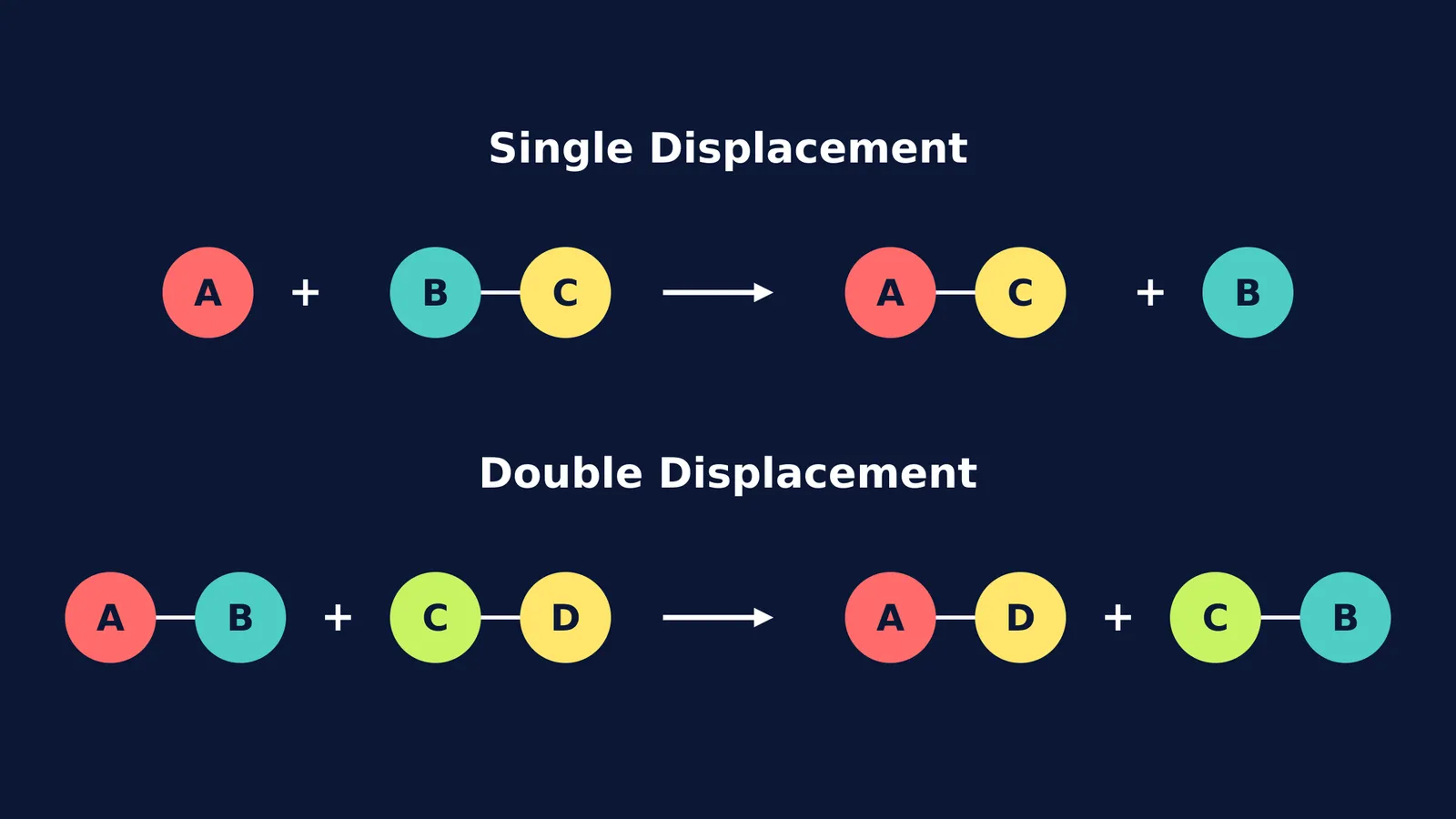
The general form of this reaction is: A + BC → AC + B
A classic example is placing a piece of zinc into a blue solution of copper sulphate. Zinc, copper, and other metals exist in a strict hierarchy called the reactivity series. Because zinc is higher on this series than copper, it has a stronger drive to form a compound. It forces the copper out of the sulphate compound.
If you watch this happen in a lab, the visual changes are striking. The blue colour of the solution gradually fades as colourless zinc sulphate forms, and a reddish-brown coating of solid copper metal is deposited on the zinc strip.
Zn + CuSO₄ → ZnSO₄ + Cu
You can use the electrochemical series to predict if a metal will displace another. If the lone metal is more reactive than the metal in the solution, the reaction happens. Dropping a copper wire into zinc sulphate does nothing, because copper is less reactive and cannot push zinc out.
Metals aren't the only elements that can trigger single displacement reactions. Non-metals, specifically halogens, also follow a reactivity trend. For instance, if you bubble chlorine gas through a colourless solution of sodium bromide, the more reactive chlorine displaces the bromine. The solution turns brown as liquid bromine is produced, leaving sodium chloride dissolved in the water. This demonstrates that displacement relies entirely on the elements' relative ability to attract electrons.
What is a double displacement reaction?
A double displacement reaction happens when the positive and negative ions of two different ionic compounds exchange places to form two entirely new compounds. Instead of one element taking over, two pairs of ions swap partners.
The general form looks like this: AB + CD → AD + CB
This type of reaction is usually driven by the formation of a precipitate (a solid that drops out of the solution), a gas, or water. When two clear solutions are mixed and suddenly become cloudy or opaque, you are almost always witnessing a precipitation reaction.
For example, consider the reaction between silver nitrate and sodium chloride. When you mix these two clear, aqueous solutions, the silver and sodium ions rapidly swap places. This swap forms sodium nitrate (which stays dissolved invisibly) and silver chloride. Silver chloride is a heavy, white solid precipitate that immediately clouds the water and eventually settles at the bottom of the beaker.
AgNO₃ + NaCl → AgCl + NaNO₃
Because it happens instantly as soon as the ions meet, a double displacement is often much faster to observe than the slow colour change of a single displacement.
While precipitation is the most visible type of double displacement, these reactions can also produce a gas or a stable molecule like water. When you mix hydrochloric acid and sodium hydroxide, the hydrogen and sodium ions swap. This forms sodium chloride and liquid water, effectively neutralizing the acid and the base. Even though you cannot see a solid forming, the underlying mechanism is still a double displacement because the two starting compounds fully exchanged their parts.
The main differences to look for
The easiest way to tell these two reactions apart is by looking at what goes into them, what comes out of them, and what physical rules drive them forward.
The reactants: A single displacement reaction always starts with one pure, uncombined element (like solid zinc) and one compound. A double displacement reaction starts with two aqueous ionic compounds.
The mechanism: In a single displacement, one element forcefully replaces another. In a double displacement, two compounds peacefully exchange their ions.
The driver: Single displacements happen because of differences in metal or non-metal reactivity. Double displacements typically happen because a new, insoluble solid (a precipitate) forms, removing ions from the solution.
A checklist for your exam
Exams frequently ask you to categorize a list of chemical equations. When you face a chemical equation in a test and need to classify it without doing the experiment, use this simple checklist:
Count the elements: Look at the left side of the arrow. Are there any uncombined, standalone elements (like Zn, Mg, or Cl₂)? If yes, you are almost certainly looking at a single displacement reaction.
Check the state symbols: Look at the small letters in brackets. Did two aqueous (aq) solutions react to form at least one solid (s) product on the right side? If yes, it is a double displacement precipitation reaction.
Trace the swap: Did one part of a molecule move to leave a lone element behind, or did two parts trade places to form two new compounds? Drawing a line from the metal on the left to its new partner on the right can reveal the pattern.
For a broader review of reaction categories, you can revise the types of chemical reactions in Class 10. If your equation involves complex electron transfers, the rules for balancing redox reactions will keep you from getting stuck. If you are struggling to predict the products of a tricky ion exchange, the Fermi Concept Library breaks down the chemistry behind these swaps to help you verify your balanced equations.


