

On this page
What are oxidation and reduction in terms of oxygen and hydrogen?
Under the CBSE Secondary Science curriculum (Code 086), chemical reactions in Class 10 are introduced through observable element transfers before moving to abstract electron bookkeeping. In classical terms, oxidation is the gain of oxygen or the loss of hydrogen by a substance. Reduction is the loss of oxygen or the gain of hydrogen by a substance.
Because mass is conserved, free oxygen or hydrogen does not appear or disappear on its own. When one reactant loses oxygen, another reactant accepts it. Oxidation and reduction occur simultaneously in the same reaction, making it an oxidation-reduction or redox reaction. These reactions explain familiar phenomena such as corrosion and rancidity in everyday life, where atmospheric oxygen oxidises exposed metals and stored food fats.
How do you identify what is oxidised and reduced in CuO + H2?
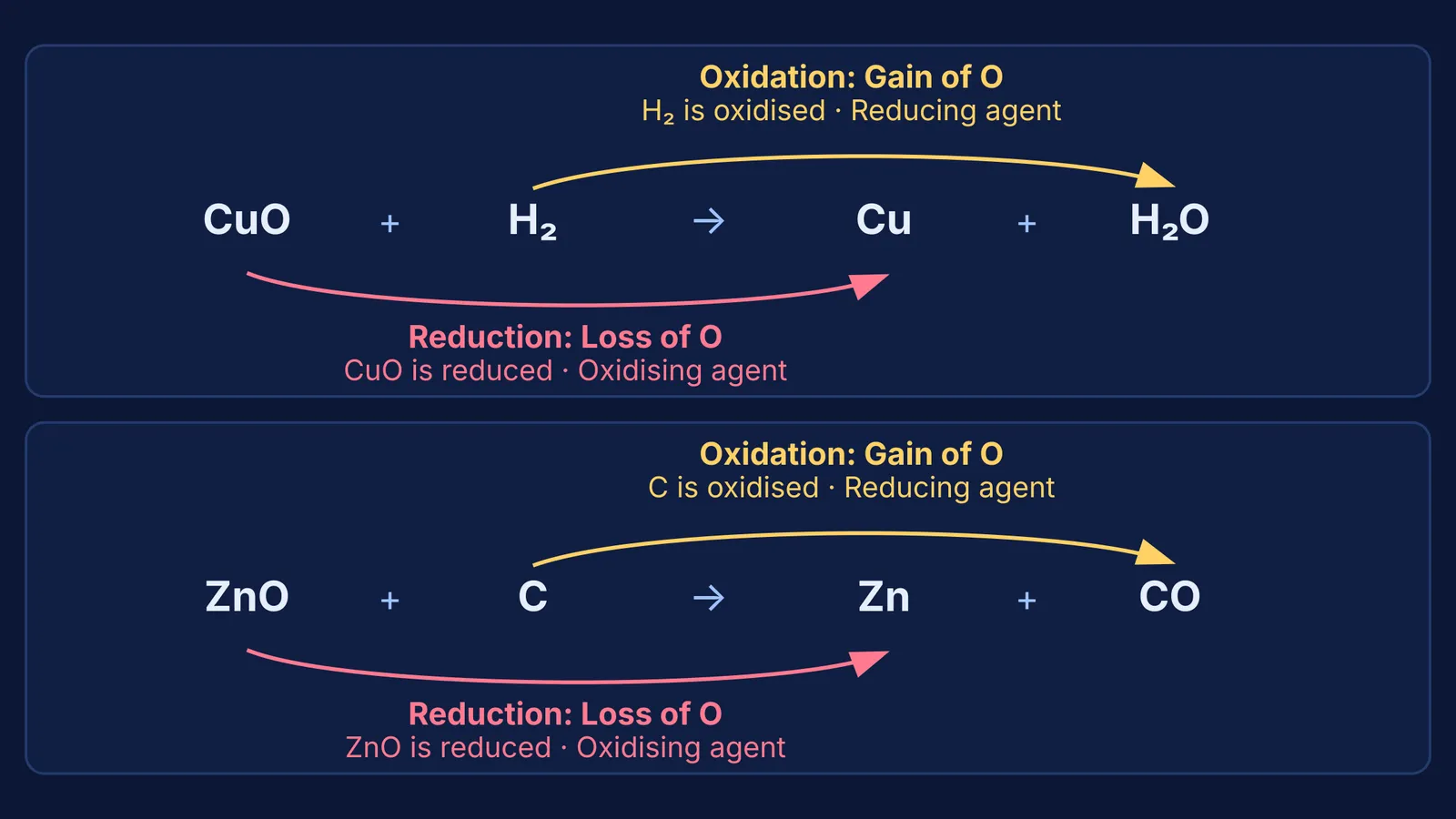
In Class 10 chemistry laboratory activities, heating brown copper powder in air forms black copper(II) oxide. Passing hydrogen gas over the heated black powder reverses the colour back to reddish-brown copper:
CuO + H₂ → Cu + H₂O
To determine what is oxidised and reduced, track the oxygen atom between reactants and products:
CuO becomes Cu: Copper(II) oxide loses oxygen. Because the loss of oxygen is reduction, CuO is reduced to Cu.
H₂ becomes H₂O: Hydrogen gas gains oxygen. Because the gain of oxygen is oxidation, H₂ is oxidised to H₂O.
Next, identify the two chemical agents:
Oxidising agent: CuO supplies the oxygen that oxidises hydrogen, so CuO is the oxidising agent.
Reducing agent: H₂ strips oxygen from copper oxide, so H₂ is the reducing agent.
How does carbon reduce zinc oxide in ZnO + C?
In metallurgy, carbon is used to extract metals from their ores. Heating zinc oxide with carbon produces zinc metal and carbon monoxide gas:
ZnO + C → Zn + CO
Tracing the oxygen transfer gives:
Zinc oxide (ZnO) loses oxygen to form zinc (Zn), so ZnO is reduced.
Carbon (C) gains oxygen to form carbon monoxide (CO), so C is oxidised.
Zinc oxide provides oxygen to carbon, making ZnO the oxidising agent.
Carbon removes oxygen from zinc oxide, making C the reducing agent.
This reaction underpins industrial blast furnaces, as explored in carbon reduction in metal extraction. In higher classes, students move beyond oxygen transfer to track electron transfer and calculate oxidation numbers from Lewis structures.
Why do students confuse the substance oxidised with the reducing agent?
Redox terminology creates a common trap for secondary students. In an investigation published in the *Journal of Research in Science Teaching*, researchers Pamela J. Garnett and David F. Treagust (Garnett & Treagust, 1992) interviewed 32 final-year chemistry students and identified widespread confusion when distinguishing substances oxidised or reduced from their respective agents. Many students mistakenly assume that the substance oxidised must be the oxidising agent.
The word "agent" means an entity that causes change in another substance. An oxidising agent causes another reactant to gain oxygen by giving up its own oxygen; consequently, the oxidising agent is reduced. Conversely, a reducing agent strips oxygen from another substance, causing itself to be oxidised.
When working through equations where multiple species exchange atoms, the Fermi Problem Library provides worked problems with a step-by-step solver that explains the reasoning rather than printing an answer. For foundational learning across secondary science, the Fermi Concept Library covers every concept in physics, chemistry, biology, mathematics and computing, each with its own lesson and its place in the map.
What four-step method solves CBSE redox questions?
Questions in the 80-mark Class 10 written paper frequently ask students to identify the four redox components in a reaction, as seen in official CBSE Class X Sample Question Papers. You can solve these systematically in four steps:
Underline the reactants: Ignore the products when naming agents so you do not accidentally write a product name.
Track the transfer: Connect each reactant to its corresponding product to see whether oxygen was gained or lost.
Label oxidised and reduced: The reactant gaining oxygen (or losing hydrogen) is oxidised; the reactant losing oxygen (or gaining hydrogen) is reduced.
Invert for the agents: The oxidised substance is the reducing agent; the reduced substance is the oxidising agent.
The same rules apply to reactions involving hydrogen transfers. For instance, when hydrogen sulphide reacts with chlorine (H₂S + Cl₂ → 2HCl + S), H₂S loses hydrogen and is oxidised, while Cl₂ gains hydrogen and is reduced. If you want guided feedback on chemical reactions, Fermi's AI tutor notices where a student is stuck and decides whether to explain, ask, or show.


