

On this page
Hydrogen peroxide bottles in a lab say "20 volume", not a molarity, and exam questions ask you to convert, decompose or titrate that label. Once you see where it comes from, every version uses the same few lines of working.
What does "20 volume" hydrogen peroxide mean?
Volume strength is the volume of oxygen gas, measured at STP, that one volume of the solution gives off when all the H₂O₂ in it decomposes.
The reaction behind the label is 2H₂O₂ → 2H₂O + O₂, as written in this LibreTexts chapter on reaction rates. Two moles of peroxide give one mole of oxygen. Everything else follows from that 2 : 1 ratio.
So 1 L of 20 volume H₂O₂ gives 20 L of O₂ at STP, and 1 mL gives 20 mL. The units cancel, which is why the label has no unit.
Where does the 11.2 come from?
One mole of an ideal gas occupies 22.414 L at 273.15 K and 101.325 kPa (1 atm), according to the NIST CODATA value; at 1 bar it is 22.711 L. Most textbook and exam questions round the first to 22.4 L.
Take 1 L of a solution with volume strength V:
Moles of O₂ released = V ÷ 22.4
Moles of H₂O₂ needed = 2 × (V ÷ 22.4) = V ÷ 11.2
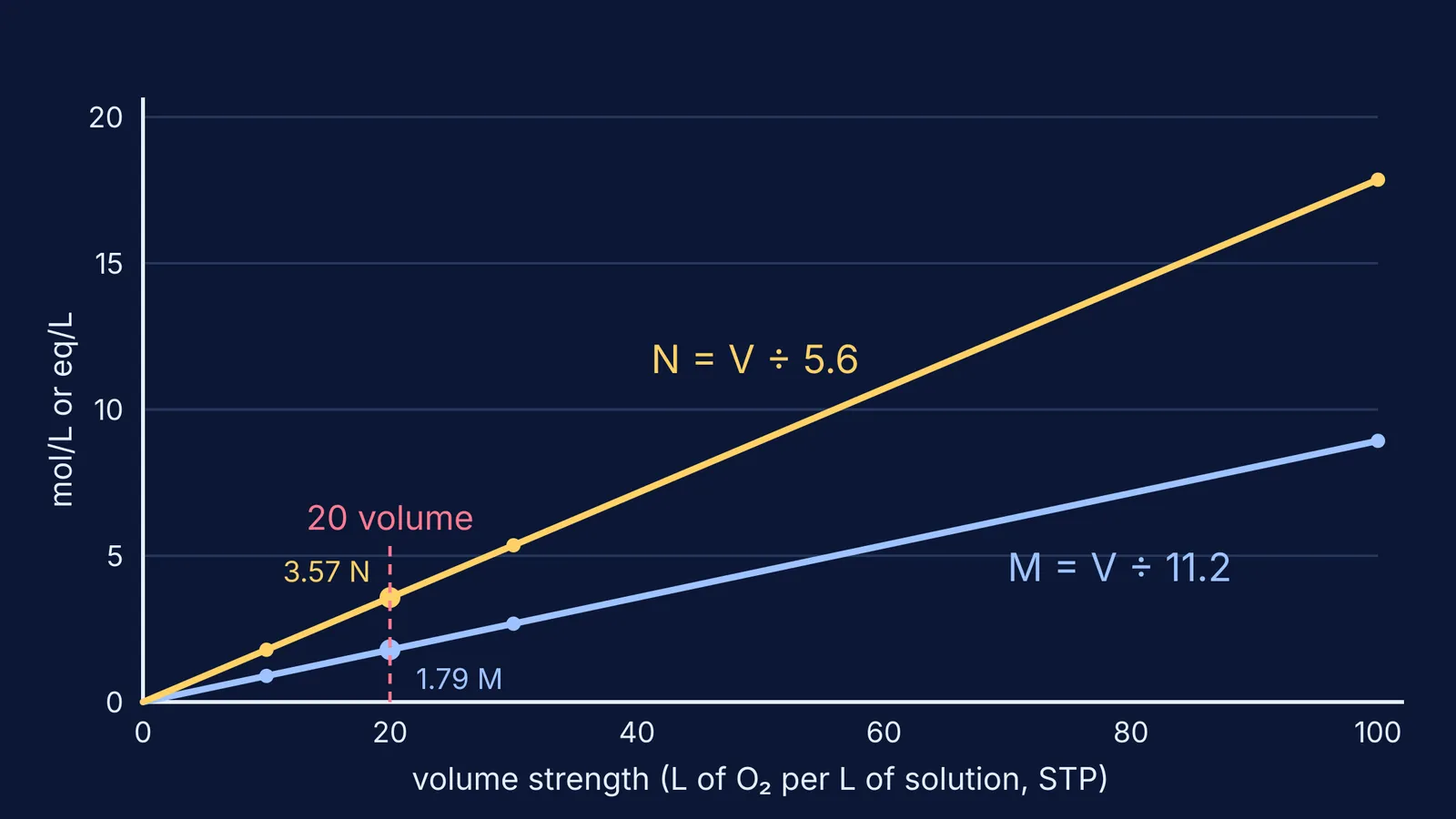
Since this is in 1 L, molarity M = V ÷ 11.2
The 11.2 is half of 22.4, because each mole of O₂ needs two moles of H₂O₂.
How do you convert volume strength to molarity and normality?
The n-factor of H₂O₂ is 2 either way: it loses 2 electrons per molecule becoming O₂, or gains 2 becoming water. So normality N = 2M = V ÷ 5.6.
To get grams per litre, multiply the molarity by the molar mass, which PubChem lists as 34.015 g/mol. For 20 volume H₂O₂, the three conversions are:
Molarity: 20 ÷ 11.2 = 1.79 M
Normality: 20 ÷ 5.6 = 3.57 N
Strength: 1.786 × 34.0 = 60.7 g/L, or about 6.1% w/v
The same steps give about 3.0% w/v for 10 volume and about 30% w/v for 100 volume. One shortcut runs both ways: 1 M H₂O₂ = 11.2 volume.
How do you solve decomposition questions?
Because the oxygen comes from the 2 : 1 decomposition reaction, volume strength scales with the amount of peroxide left, so most decomposition questions are ratio questions.
Oxygen from a sample: 50 mL of 20 volume H₂O₂ gives 50 × 20 = 1000 mL, or 1.0 L of O₂ at STP.
Partial decomposition: if a 20 volume bottle has lost a quarter of its H₂O₂, it is now 15 volume, which is 15 ÷ 11.2 = 1.34 M.
Dilution: 100 mL of 30 volume made up to 300 mL becomes 10 volume, because the same oxygen is now spread over three times the volume.
When a question mixes these steps, track moles of H₂O₂ at each stage, not the label. For a refresher on turning moles of gas into litres, see our post on finding gas volume from a reaction mass at STP.
How do you find volume strength from a KMnO₄ titration?
In acid, permanganate oxidises peroxide by 2MnO₄⁻ + 5H₂O₂ + 6H⁺ → 2Mn²⁺ + 5O₂ + 8H₂O, and the end point is the first faint pink that lasts, as this titration method page describes. Our post on why H₂SO₄ and not HCl is used in KMnO₄ titrations explains which acid to use.
A worked example: a student dilutes 10.0 mL of a bottle labelled 20 volume to 100 mL. They acidify a 10.0 mL portion of the diluted solution and titrate it with 0.0200 M KMnO₄. The titre is 35.0 mL.
Moles of MnO₄⁻ = 0.0200 × 0.0350 = 7.00 × 10⁻⁴ mol
Moles of H₂O₂ = 7.00 × 10⁻⁴ × 5/2 = 1.75 × 10⁻³ mol
Molarity of the diluted solution = 1.75 × 10⁻³ ÷ 0.0100 = 0.175 M
Molarity of the bottle = 0.175 × 10 = 1.75 M
Volume strength = 1.75 × 11.2 = 19.6 volume
Normality gives the same answer: KMnO₄ (n-factor 5) is 0.100 N, so 0.100 × 35.0 = N × 10.0 gives 0.350 N, then 3.50 N for the bottle and 3.50 × 5.6 = 19.6 volume. A fresh 20 volume bottle would have needed 35.7 mL, so this one has lost about 2% of its peroxide.
To see this titration used to follow decomposition over time, read our post on H₂O₂ decomposition kinetics with KMnO₄. If you keep picking the wrong ratio, the Fermi Problem Library has worked problems with a step-by-step solver that explains the reasoning rather than printing an answer. If the gap is in moles or n-factor itself, start with that lesson in the Fermi Concept Library.


