

On this page
Reaching the sharp pink end point in a redox titration means reading the colour change exactly when the reaction finishes. In a potassium permanganate (KMnO₄) titration, the medium must be strongly acidic so that the purple permanganate ion (MnO₄⁻) reduces completely to the colourless manganese(II) ion (Mn²⁺).
If the medium is neutral or weakly alkaline, the reaction stops halfway, forming a murky brown precipitate of manganese dioxide (MnO₂) that makes the end point impossible to see. However, you cannot just pick any strong acid from the laboratory shelf to provide the hydrogen ions (H⁺). The choice of acid is dictated by the redox chemistry in the flask.
Why dilute sulphuric acid is used in KMnO4 titration not HCl?
Dilute sulphuric acid (H₂SO₄) is the standard choice because it is stable against oxidation by potassium permanganate. The sulphate ion (SO₄²⁻) does not interfere with the redox reaction, ensuring that the KMnO₄ only reacts with the specific reducing agent (the analyte) you are trying to measure.
Hydrochloric acid (HCl), on the other hand, is completely unsuitable. As explained in the chemistry of potassium permanganate, it is a very powerful oxidising agent, and it will oxidise the chloride ions (Cl⁻) in HCl into chlorine gas (Cl₂).
This side reaction—2KMnO₄ + 16HCl → 2KCl + 2MnCl₂ + 8H₂O + 5Cl₂—consumes a significant portion of the KMnO₄ from the burette. Because the permanganate is reacting with both the analyte and the acid, you will record an incorrectly high reading, completely ruining the accuracy of your titration.
Nitric acid (HNO₃) is also avoided, but for the opposite reason. Nitric acid is itself a strong oxidising agent. If used, it would compete with the KMnO₄ to oxidise the analyte, meaning less KMnO₄ would be needed from the burette, leading to an incorrectly low reading. If you are struggling to balance these competing redox equations, the Fermi Problem Library has worked problems with a step-by-step solver that explains the reasoning rather than printing an answer.
Why oxalic acid is warmed in KMnO4 titration?
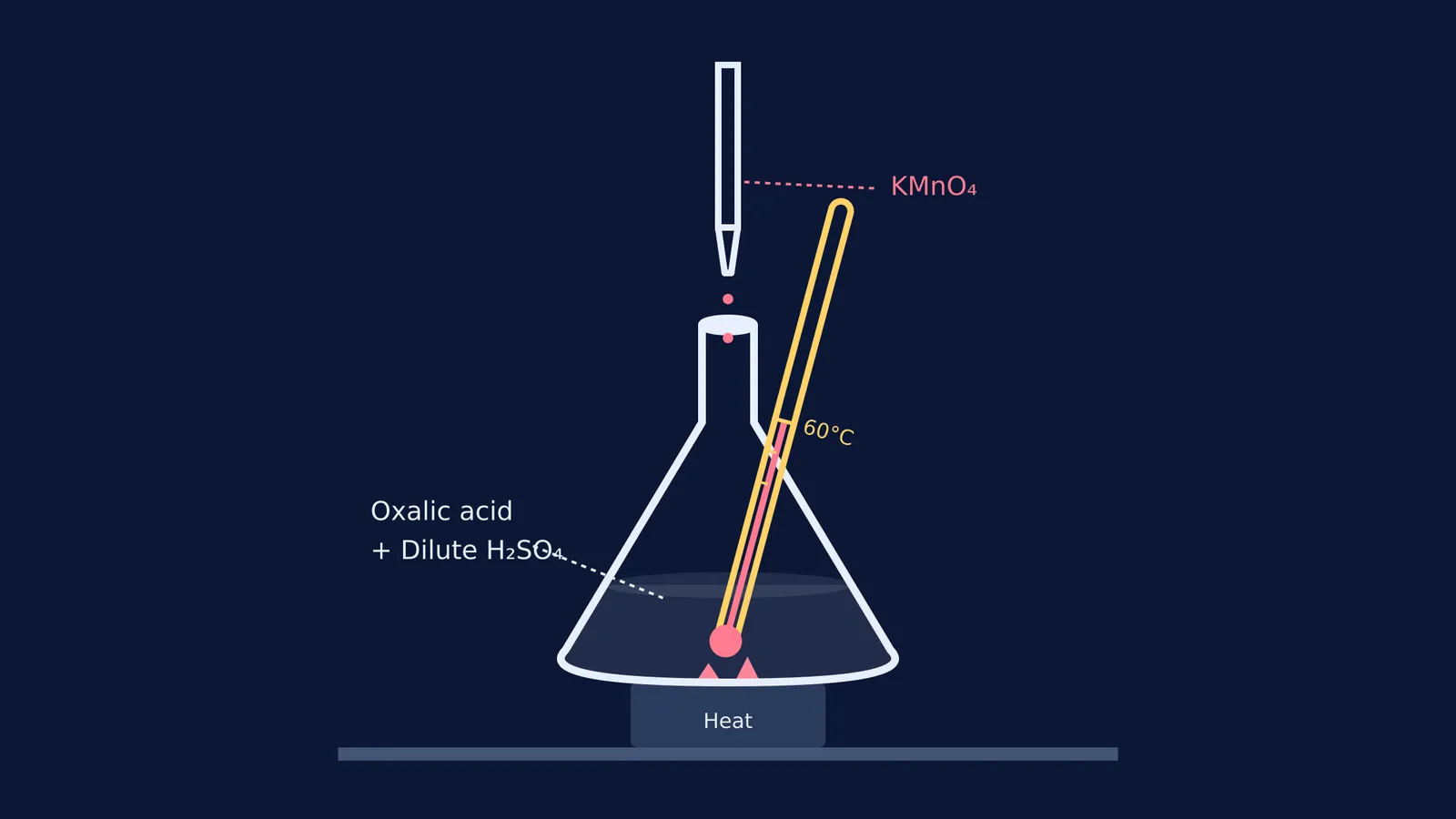
If your analyte is oxalic acid (H₂C₂O₄), the titration introduces another hurdle: it must be carried out hot. The flask is typically warmed to 60–70 °C (McBride 1912) (just until steam begins to rise) before the KMnO₄ is added.
At room temperature, the reaction between the permanganate ion and the oxalate ion (C₂O₄²⁻) is extremely slow. This sluggishness occurs because both ions are negatively charged and repel each other, creating a high activation energy barrier. Without heat, the purple drops of KMnO₄ would sit in the flask for a long time before turning colourless, making it impossible to find a sharp end point.
However, this reaction has a unique feature: it is autocatalytic. As the reaction slowly proceeds, it produces manganese(II) ions (Mn²⁺). These Mn²⁺ ions act as a catalyst for the reaction itself. Once enough Mn²⁺ has formed, the reaction rate speeds up dramatically.
Warming the flask provides the initial kinetic energy for the molecules to overcome their repulsion. It forces the first few drops of KMnO₄ to react quickly, generating the Mn²⁺ catalyst. After that, the reaction sustains a fast rate, and the end point appears as a crisp, permanent light pink.
Connecting the dots in redox chemistry
Understanding why a specific acid is chosen or why a flask must be heated moves you away from memorising practical steps and towards understanding the chemical systems at play. You can explore more of these connections in the Fermi Concept Library, which maps out every idea in chemistry and how they link together.
To see how these principles apply to calculating the final concentration, read our guide on n-factor and the equivalent concept in redox titrations. For a breakdown of the specific steps taken in the lab, see Titrating oxalic acid with KMnO4: the Class 12 practical. Finally, if you are comparing this to neutralisation, Acid-base titration curves: pH at each stage and choosing indicators shows how those endpoints differ from redox reactions.


