

On this page
In the laboratory, measuring the rate of a chemical reaction requires tracking how a reactant's concentration changes over time. For the decomposition of hydrogen peroxide, we cannot simply dip a sensor into the flask to read the concentration. Instead, we pull out samples at set intervals and titrate them.
By titrating the remaining hydrogen peroxide against potassium permanganate, we map the entire kinetics curve using nothing but a burette and a stopwatch.
Why titrate hydrogen peroxide with KMnO4?
Hydrogen peroxide (H₂O₂) decomposes into water and oxygen. We can track how much H₂O₂ is left by taking a small sample (an aliquot) from the reaction mixture at different times and immediately titrating it.
We use potassium permanganate (KMnO₄) because it is a strong oxidising agent that reacts predictably with H₂O₂ in an acidic medium:
2 KMnO₄ + 3 H₂SO₄ + 5 H₂O₂ → K₂SO₄ + 2 MnSO₄ + 8 H₂O + 5 O₂
For every two molecules of KMnO₄, five molecules of H₂O₂ are consumed. Because KMnO₄ has an intense purple colour, it acts as its own indicator. The moment all the H₂O₂ in the sample is used up, the next drop of KMnO₄ leaves a permanent faint pink colour in the flask.
Before the titration begins, the KMnO₄ solution is standardised because potassium permanganate is not a primary standard—it degrades slowly in light and reacts with organic traces in water. Once its exact molarity is known, the titration gives highly accurate volume readings. However, for a simple kinetic plot, the absolute molarity is not strictly necessary as long as the same KMnO₄ solution is used for all samples, because the volume ratio cancels out the concentration term.
The volume of KMnO₄ you run from the burette (the titre) is directly proportional to the amount of H₂O₂ that was left in that sample. You can read more about titration setups in Back titration: finding purity when direct titration fails.
What is the first order kinetics of H2O2 decomposition?
The decomposition of H₂O₂ is a first-order reaction. This means its rate depends linearly on the concentration of H₂O₂ present.
While hydrogen peroxide decomposes on its own, the reaction is extremely slow at room temperature. In the laboratory, a catalyst such as iron(III) chloride or manganese dioxide is usually added to speed up the process. Even with the catalyst present, the decomposition remains a first-order reaction with respect to H₂O₂, meaning the half-life of the reaction is constant regardless of how much H₂O₂ you started with.
For a first-order reaction, the integrated rate law connects the rate constant k, the time t, the initial concentration a, and the amount reacted x:
k = (2.303 / t) log (a / (a − x))
Here, a is the concentration at t = 0, and (a − x) is the concentration remaining at time t. If you are revising reaction orders, see Integrated rate law graphs: reading reaction order from straight lines.
How do you get k from the KMnO4 titration?
We do not need to convert our burette readings into molarity to find the rate constant. Because the titre volume V is directly proportional to the H₂O₂ concentration, we can substitute volumes directly into the rate equation.
Let V₀ be the volume of KMnO₄ required to titrate the sample taken at time t = 0. This volume is proportional to the initial concentration, a.
Let Vₜ be the volume of KMnO₄ required for the same-sized sample taken at time t. This volume is proportional to the remaining concentration, (a − x).
Substituting these into the first-order equation gives:
k = (2.303 / t) log (V₀ / Vₜ)
To find k graphically, we rearrange this to:
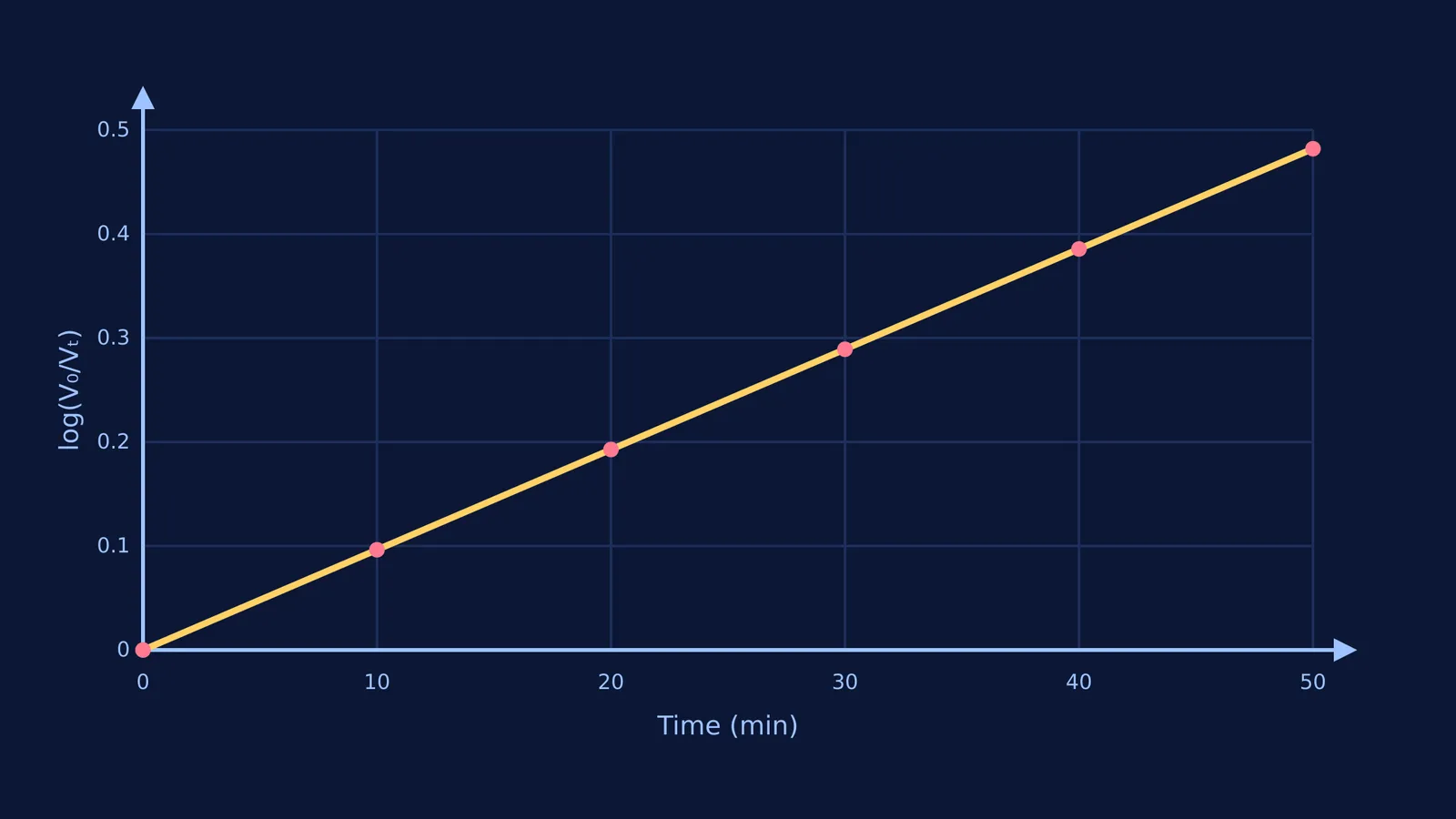
log (V₀ / Vₜ) = (k / 2.303) t
This matches the equation of a straight line, y = mx. If you plot log (V₀ / Vₜ) on the y-axis against time t on the x-axis, the points will form a straight line passing through the origin. The slope of this line is equal to k / 2.303. By measuring the slope, you can calculate the rate constant k = 2.303 × Slope.
If you are struggling to set up these graphs or derive the substitutions yourself, the Fermi Concept Library explains the mathematics behind chemical kinetics step-by-step.
An example of finding the rate constant
Suppose you start the decomposition of H₂O₂ (as in standard kinetics experiments) and titrate 10 mL samples with KMnO₄. At t = 0, you use 46.0 mL of KMnO₄ (V₀ = 46.0). After 20 minutes, the titre is 29.5 mL (Vₜ = 29.5).
Using the formula:
k = (2.303 / 20) log (46.0 / 29.5)
k = 0.11515 × log (1.559)
k = 0.11515 × 0.1928 = 0.0222 min⁻¹
If you repeat this at t = 40 minutes and find Vₜ = 18.9 mL, you get:
k = (2.303 / 40) log (46.0 / 18.9)
k = 0.05757 × log (2.433)
k = 0.05757 × 0.386 = 0.0222 min⁻¹
Because k is constant across different intervals, this confirms the reaction is first-order. You can practise interpreting rate data and extracting constants in the Fermi Problem Library.


