

On this page
The first step in any stoichiometry problem involving gases is knowing the volume one mole of gas occupies. Standard Temperature and Pressure (STP) is the reference point, but its definition changed in 1982.
Under the current International Union of Pure and Applied Chemistry (IUPAC) definition (273.15 K and 1 bar), the molar volume of an ideal gas is 22.7 L/mol.
Under the older definition (273.15 K and 1 atm), the molar volume is 22.4 L/mol.
Because 1 bar (100 kPa) is a slightly lower pressure than 1 atm (101.325 kPa), the gas expands slightly more, giving the 22.7 L figure. If you are preparing for Indian school boards or exams based on recent NCERT textbooks, use 22.7 L. If a past JEE or NEET question provides the gas constant R as 0.0821 L·atm/(mol·K), it expects 22.4 L.
How do you calculate the volume of gas produced from mass?
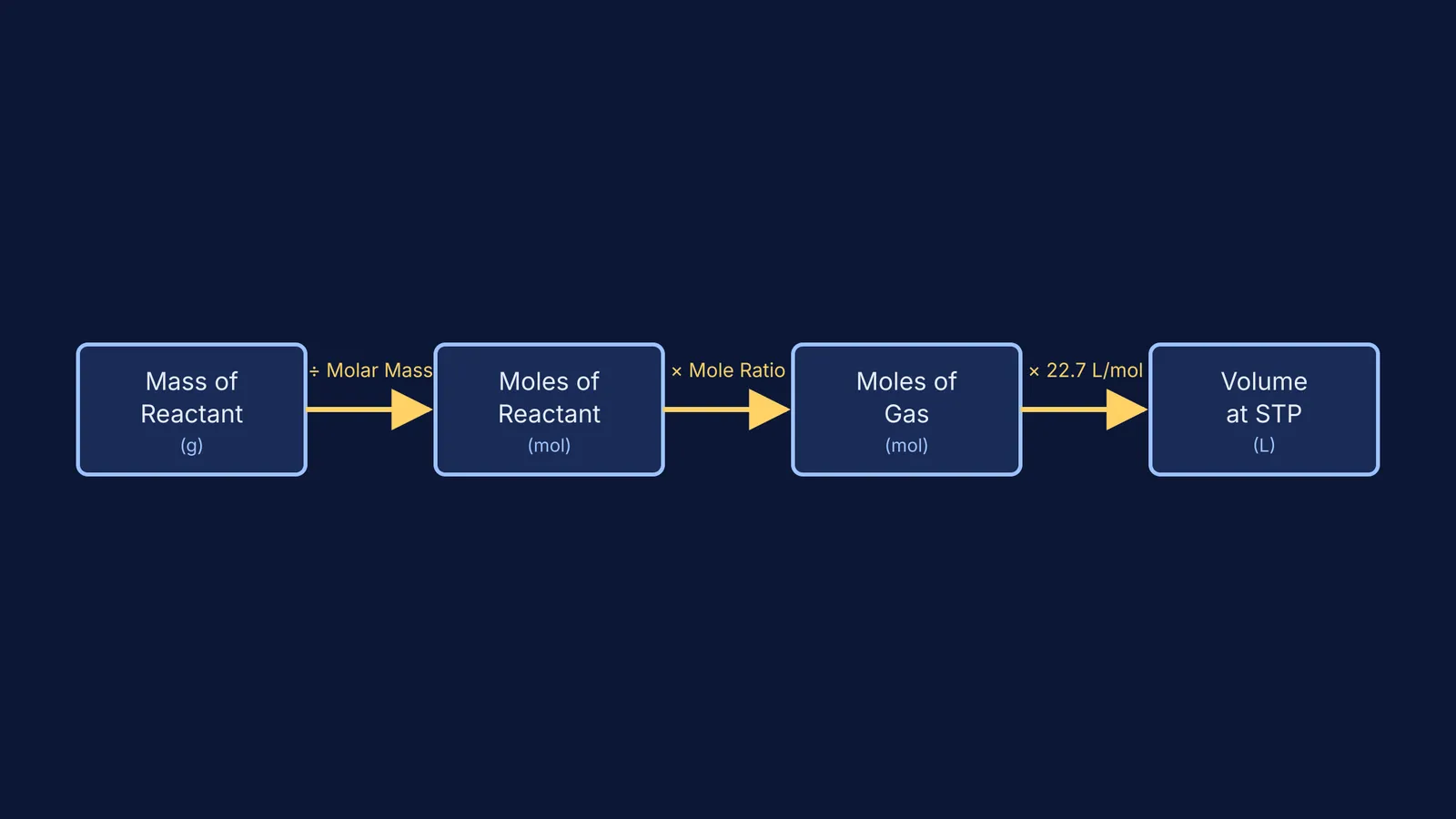
Converting a solid or liquid reactant into a gas volume takes three steps. You cannot go directly from grams to litres.
Mass to moles: Divide the mass of your starting material by its molar mass (g/mol).
Reactant moles to gas moles: Multiply by the stoichiometric ratio from the balanced chemical equation.
Gas moles to volume: Multiply the moles of gas by the molar volume at STP.
If you are stuck on setting up these ratios, the Fermi Concept Library maps out the rules of stoichiometry and walks you through balancing equations before you tackle numericals.
What volume of CO2 is produced by heating calcium carbonate?
When calcium carbonate (CaCO₃) is heated, it undergoes thermal decomposition. Let us find the volume of carbon dioxide produced at STP (using the 22.7 L/mol standard) when 50.0 g of CaCO₃ is completely decomposed.
The balanced equation is: CaCO₃(s) → CaO(s) + CO₂(g)
Find the molar mass of CaCO₃: 40.0 (Ca) + 12.0 (C) + 3 × 16.0 (O) = 100.0 g/mol.
Convert the 50.0 g mass to moles: 50.0 / 100.0 = 0.500 mol of CaCO₃.
The mole ratio of CaCO₃ to CO₂ is 1:1, so the reaction produces 0.500 mol of CO₂.
Multiply by the molar volume: 0.500 mol × 22.7 L/mol = 11.35 L.
If the question had used the older 1 atm standard, the answer would be 0.500 mol × 22.4 L/mol = 11.2 L.
How much hydrogen gas is produced from zinc and hydrochloric acid?
Zinc reacts with dilute hydrochloric acid to release hydrogen gas. How much hydrogen is produced at STP from 13.0 g of zinc?
The balanced equation is: Zn(s) + 2HCl(aq) → ZnCl₂(aq) + H₂(g)
The molar mass of zinc is 65.4 g/mol.
Moles of zinc = 13.0 g / 65.4 g/mol = 0.199 mol.
The mole ratio of Zn to H₂ is 1:1, meaning 0.199 mol of H₂ is produced.
Volume at STP = 0.199 mol × 22.7 L/mol = 4.52 L of H₂.
What if the mole ratio is not one to one?
The examples above had a simple 1:1 stoichiometric ratio, but many reactions produce more or fewer moles of gas than the starting reactant. When the coefficients in the balanced equation are different, the mole ratio step becomes critical.
Consider the thermal decomposition of potassium chlorate (KClO₃), a common laboratory method for generating oxygen gas. How much oxygen is produced at STP from 10.0 g of potassium chlorate?
The balanced chemical equation is: 2KClO₃(s) → 2KCl(s) + 3O₂(g)
Notice that 2 moles of solid KClO₃ produce 3 moles of oxygen gas. We apply our three steps as usual:
The molar mass of KClO₃ is 39.1 (K) + 35.5 (Cl) + 3 × 16.0 (O) = 122.6 g/mol. Divide the mass to find the moles: 10.0 g / 122.6 g/mol = 0.0816 mol of KClO₃.
Multiply by the mole ratio (3 moles of O₂ per 2 moles of KClO₃): 0.0816 mol × (3/2) = 0.1224 mol of O₂.
Multiply the moles of oxygen by the molar volume at STP: 0.1224 mol × 22.7 L/mol = 2.78 L of O₂.
This step shows why you must always balance the equation first. If you ignored the coefficients and assumed a 1:1 ratio, your final volume would be off by a factor of 1.5.
To build confidence with these conversions, try working through similar examples involving the average molar mass of a gas mixture or the free expansion of an ideal gas.


