On this page
Count your pulse. No nerve starts that beat. It begins in a small patch of heart muscle, and that one fact explains a common Class 11 exam question, how a transplanted heart works, and why your pulse jumps before a test.
What does myogenic mean for the heart?
A myogenic heart is one whose beat starts in its own muscle, not in a nerve. In its chapter Body Fluids and Circulation, NCERT Class 11 Biology says the heart's normal activities are "auto regulated by specialised muscles (nodal tissue), hence the heart is called myogenic."
That nodal tissue includes the sino-atrial node (SAN) in the right upper corner of the right atrium. NCERT calls nodal musculature "autoexcitable": it can generate action potentials "without any external stimuli." The SAN fires fastest, generating the most action potentials (70-75 per minute). Its rhythm sets the pace, so it is called the pacemaker. From there, the signal passes through the AV node, the bundle of His and the Purkinje fibres, which we trace step by step in how the SA node, AV node and Purkinje fibres time the heartbeat.
What is a neurogenic heart, and which animals have one?
In a neurogenic heart, the beat starts in nerve cells that then drive the heart muscle. A 2019 paper by Kodirov and colleagues in the Journal of Experimental Zoology notes that vertebrates and most invertebrates have myogenic hearts. The horseshoe crab Limulus polyphemus and a few other animals have a neurogenic rhythm.
In Limulus, the drive comes from a cardiac ganglion, a cluster of neurons on the heart. When Augustine, Fetterer and Watson (1982) treated the isolated heart with amines, the ganglion's bursting activity increased while the resting properties of the heart muscle stayed the same. The Kodirov paper adds a twist: even in Limulus, the heart rhythm is myogenic at embryonic stages.
Why does a transplanted heart keep beating?
A donor heart arrives with its own SA node but without its nerves. According to a 2016 review in the Journal of the American Heart Association by Awad and colleagues, transplant surgery cuts both the parasympathetic (vagus) fibres and the sympathetic fibres to the heart. The heart still beats because the pacemaker is in the muscle that was transplanted.
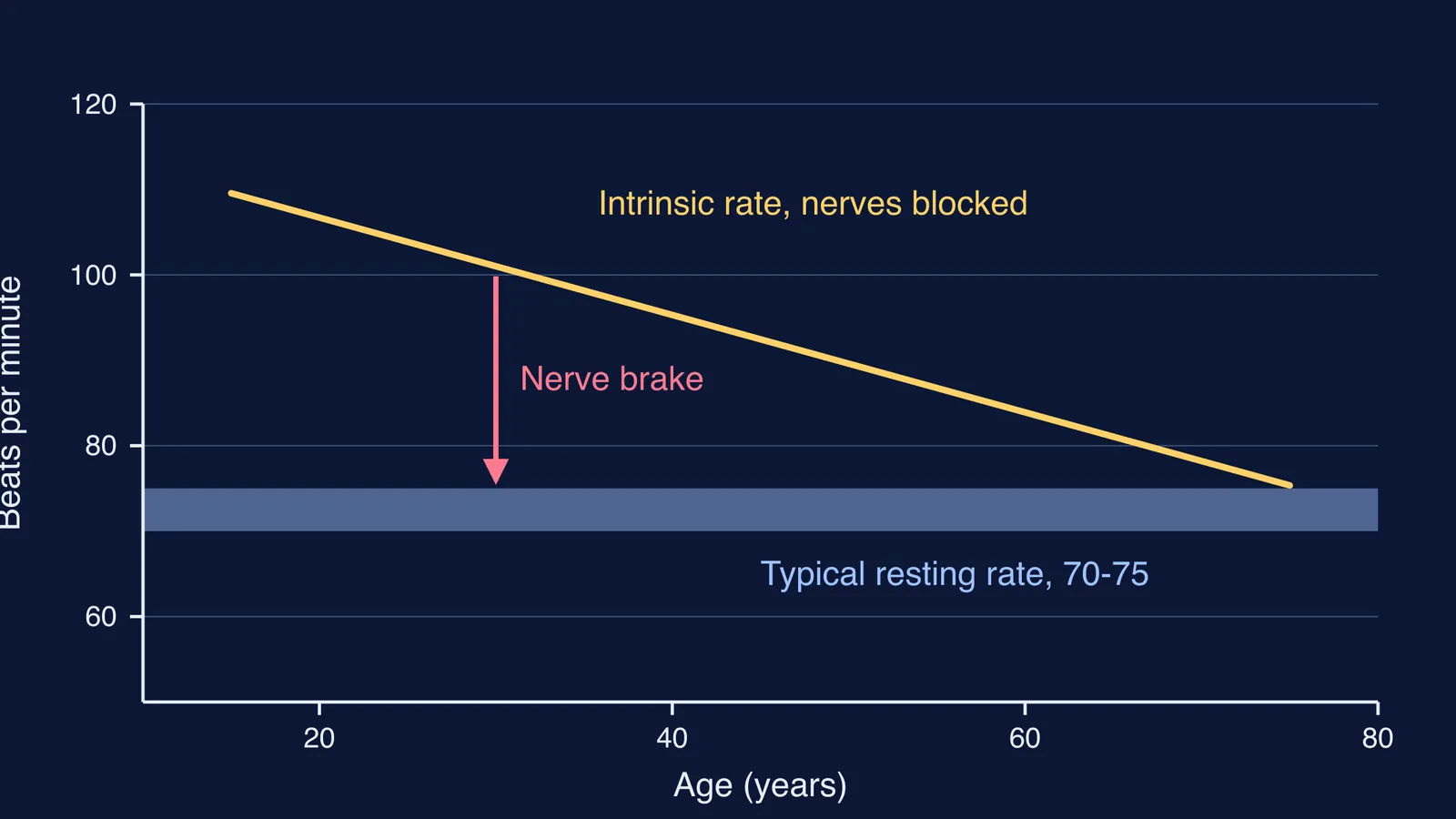
What changes is control. Without vagal and sympathetic input, the review says, the heart runs at its faster intrinsic rate. During exercise the heart has to rely on adrenaline-type hormones (catecholamines) carried in the blood, so the rate rises more slowly. Nerves grow back in some recipients, only partly and in patches: sympathetic fibres from at least 5 to 6 months, parasympathetic fibres after more than 1 to 3 years.
How do nerves change the heart rate?
Nerves act like an accelerator and a brake on a heart that already beats by itself. NCERT describes a neural centre in the medulla oblongata that works through the autonomic nervous system:
Sympathetic nerves increase the heart rate, the strength of ventricular contraction and the cardiac output.
Parasympathetic signals (the vagus nerve) decrease the heart rate, the speed of conduction of the action potential and the cardiac output.
Adrenal medullary hormones in the blood can also increase cardiac output. This is the route behind why your heart races when you're scared.
At rest, the brake is on. Researchers can measure the intrinsic heart rate by briefly blocking both nerve inputs with atropine and propranolol. A 2023 study in Scientific Reports by Weiser-Bitoun and colleagues cites Jose and Collison's 1970 equation: intrinsic heart rate = 118.1 - (0.57 x age).
Worked example. For a 16-year-old: 118.1 - (0.57 x 16) = 118.1 - 9.12 = about 109 beats per minute. NCERT gives an average resting rate of 72 beats per minute. So, on these rough averages, nerve input holds the resting heart something like 109 - 72 = 37 beats a minute below its own rate. Take the brake off, as transplant surgery does, and the rate climbs towards the intrinsic value.
These are textbook averages for learning, not a way to judge your own pulse. If your heart rate worries you, see a doctor.
How do you write this answer in an exam?
For a 2-3 mark "Why is the human heart called myogenic?" question, use this order:
Define it: the heartbeat starts in the heart muscle itself.
Name the tissue: specialised nodal tissue, chiefly the SA node in the right atrium.
Give the property: nodal tissue is autoexcitable and makes action potentials without outside stimuli.
Give the evidence: a transplanted heart, with its nerves cut, still beats.
Add the role of nerves: the medulla's sympathetic and parasympathetic signals only change the rate.
Common slips to avoid:
Writing that the brain "starts" the heartbeat. It only changes the rate.
Calling the SA node a nerve. It is specialised cardiac muscle.
If nodal tissue, the ECG and cardiac output still feel like separate facts, the Fermi Concept Library gives each biology concept its own lesson and shows its place in the map.
To see how the pacemaker was found, read how Keith and Flack discovered the heart's SA node.