On this page
A dog barks behind you, or the invigilator says "ten minutes left". Within moments your heart is thumping and you are breathing fast. Your body is getting ready to act, and a key messenger in that response is a hormone you meet in Class 10 science: adrenaline.
What happens in your body when you get scared?
The response starts in the brain, before you have even finished working out what you saw. Harvard Health Publishing describes the chain like this:
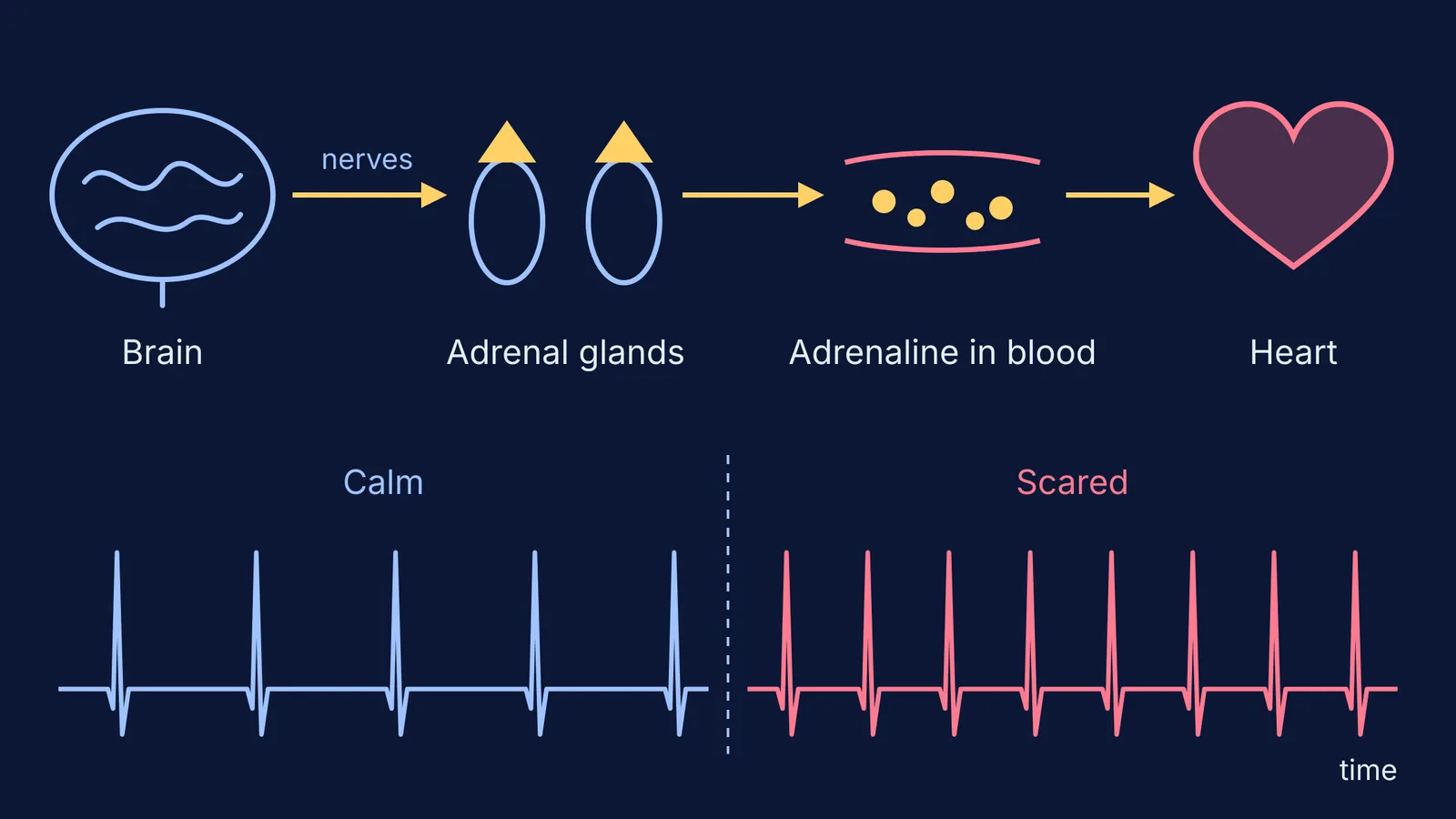
The amygdala, an area of the brain that contributes to emotional processing, sends a distress signal to the hypothalamus.
The hypothalamus works like a command centre and switches on the sympathetic nervous system, which Harvard compares to a "gas pedal".
Nerves carry the signal to the adrenal glands.
The adrenal glands pump adrenaline (also called epinephrine) into the bloodstream.
Harvard notes that this cascade starts even before the brain's visual centres have fully processed what is happening, which is why people can jump out of the path of an oncoming car before they think about what they are doing.
Why does adrenaline make your heart beat faster?
Adrenaline travels in the blood, so it reaches organs all over the body. NCERT's Class 10 science textbook lists its effects in Chapter 6, Control and Coordination:
Heart: it beats faster, supplying more oxygen to your muscles.
Blood flow: muscles around small arteries in the digestive system and skin contract, so blood is diverted to the skeletal muscles.
Breathing: the breathing rate rises because of contractions of the diaphragm and the rib muscles.
Harvard Health adds that small airways in the lungs open wide, stored glucose and fats are released for energy, and your senses sharpen.
The phrase "fight or flight" has a history of its own; read about Walter Cannon and the fight-or-flight response.
How does this link to hormones in Class 10?
Adrenaline sits in section 6.3, Hormones in Animals, and in Table 6.1, where you match it to the adrenal gland. The chapter's in-text questions include this one: "How does our body respond when adrenaline is secreted into the blood?" (NCERT). Here is a model answer you can adapt:
Adrenaline is secreted by the adrenal glands directly into the blood and carried to target organs, including the heart.
The heart beats faster, so more oxygen reaches the muscles. Blood flow to the digestive system and skin is reduced and diverted to the skeletal muscles.
The breathing rate increases because of contractions of the diaphragm and rib muscles. Together, these responses prepare the body to deal with the situation.
One mix-up to avoid is writing that the brain makes adrenaline. The brain starts the alarm through nerves; the adrenal glands release the hormone. Our explainer on nervous control vs hormonal control sets the two signals side by side, and the Fermi Concept Library gives each biology concept its own lesson.
How can you see it in your own pulse?
MedlinePlus, from the US National Library of Medicine, says to place your index and middle fingers on the underside of your wrist, below the base of the thumb, count the beats for 30 seconds, and multiply by 2. The same page gives a normal resting heart rate of 60 to 100 beats per minute for children aged 10 and over and for adults.
Try a three-reading log: once sitting calmly, once just before something that makes you nervous (a class presentation, a mock test), and once a few minutes later after slow breathing. If the middle number is the highest, you have probably seen the textbook paragraph happen. For ideas that are easier to see than to read, the Fermi Simulation Lab has interactive simulations.
What can you do when your heart races before an exam?
A racing heart before a paper is the same alarm, aimed at a threat you cannot fight or run from. Harvard Health describes the parasympathetic nervous system as acting like a "brake" that calms the body after danger has passed, and lists deep abdominal breathing among the ways to bring on the relaxation response.
A short script to say to yourself at the desk:
"My heart is fast because adrenaline is getting me ready. That is my body working."
"Breathe in slowly, let the belly rise, breathe out slowly."
"Read question one. Just question one."
Parents can help by naming the feeling calmly ("your body is gearing up") rather than adding urgency. For more, see exam stress in teenagers, and when to get help, and note the Health Ministry's free national helpline, Tele MANAS.
Next time your heart pounds, count it, name it, and remember the chain: brain, nerves, adrenal glands, adrenaline, heart.