On this page
The distance of a point from a plane is the length of the perpendicular from the point to the plane, the shortest segment you can draw to it. Below are both forms of the formula, a derivation you can reproduce in an exam, a worked example with checks, and the parallel-planes follow-up.
What is the formula for the distance of a point from a plane?
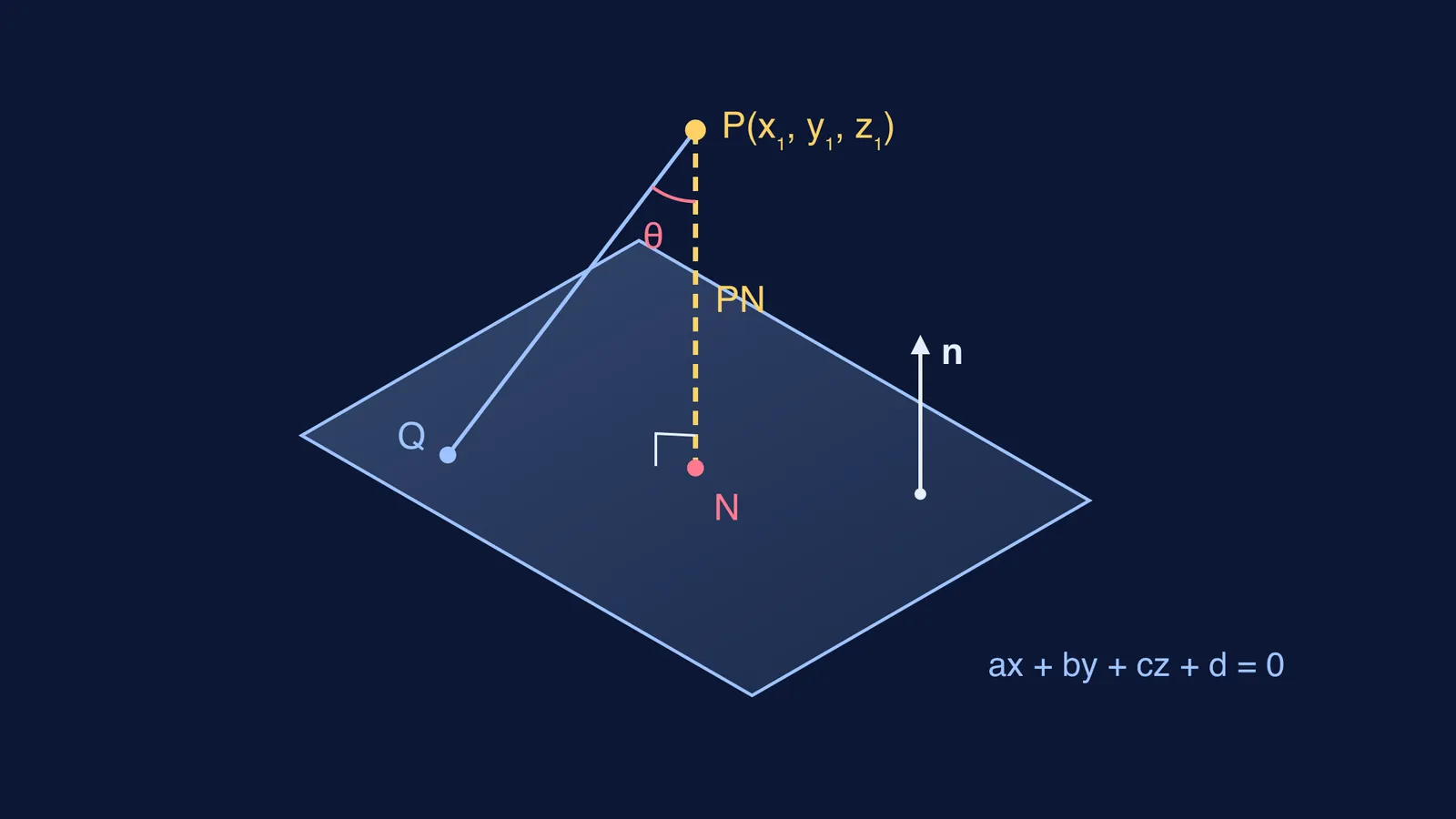
For the point P(x₁, y₁, z₁) and the plane ax + by + cz + d = 0, the distance is |ax₁ + by₁ + cz₁ + d| / √(a² + b² + c²), as stated in Wolfram MathWorld's entry on point-plane distance.
In vector form, if the plane is r·n = q and the point has position vector p, the distance is |p·n − q| / |n|. This is the same formula written differently: n = ai + bj + ck and q = −d.
Drop the absolute value and you get a signed distance: positive when the point is on the side the normal points to, negative on the other side (MathWorld).
A syllabus note: the end-of-chapter summary in the current NCERT Class 12 chapter on three dimensional geometry (reprint 2026-27) lists results for lines only (NCERT Chapter 11 PDF). Check your board and entrance-exam syllabus before deciding how much time to give planes.
Why does the formula work?
Take any point Q on the plane and draw the vector QP. Let N be the foot of the perpendicular from P. Triangle PNQ has a right angle at N, so PN = |QP| cos θ, where θ is the acute angle between QP and the normal. That is exactly the length of the projection of QP onto the normal n:
PN = |QP · n| / |n|
OpenStax Calculus Volume 3, Theorem 2.13 derives the distance the same way, as the projection of QP onto the normal.
Now switch to Cartesian form. Let Q = (x₀, y₀, z₀), so QP = (x₁ − x₀, y₁ − y₀, z₁ − z₀) and n = (a, b, c). Then QP · n = ax₁ + by₁ + cz₁ − (ax₀ + by₀ + cz₀).
Because Q lies on the plane, ax₀ + by₀ + cz₀ = −d. So QP · n = ax₁ + by₁ + cz₁ + d, and dividing by |n| = √(a² + b² + c²) gives the formula. Q has disappeared, which is why any point on the plane works.
Worked example: how far is (2, 3, −1) from 2x − y + 2z + 6 = 0?
Read off the normal: n = (2, −1, 2), so |n| = √(4 + 1 + 4) = 3.
Substitute the point: 2(2) − 3 + 2(−1) + 6 = 4 − 3 − 2 + 6 = 5.
Divide: distance = |5| / 3 = 5/3 units.
Now check it in vector form. The plane is r·(2i − j + 2k) = −6, and p = 2i + 3j − k gives p·n = 4 − 3 − 2 = −1. So |p·n − q| / |n| = |−1 + 6| / 3 = 5/3, as before.
Go one step further and find the foot of the perpendicular, N = P − t·n, where t = 5/9 (the value from step 2 divided by |n|² = 9). That gives N = (8/9, 32/9, −19/9). Substitute: 2(8/9) − 32/9 + 2(−19/9) + 6 = −54/9 + 6 = 0, so N really lies on the plane, and |PN| = (5/9) × 3 = 5/3. To go on and reflect P in the plane, see how to find the image of a point in a plane.
The sign in step 2 is useful too. The origin gives 0 + 0 + 0 + 6 = 6, which is also positive, so P and the origin lie on the same side of the plane.
How do you find the distance between two parallel planes?
OpenStax works the pair 2x + y − z = 2 and 2x + y − z = 8 by picking a point on one plane and measuring its distance from the other, and gets √6 units (OpenStax, Example 2.54).
Two planes are parallel when their normals are proportional. Take 2x − y + 2z + 6 = 0 and 4x − 2y + 4z − 3 = 0. First make the coefficients match: divide the second equation by 2 to get 2x − y + 2z − 3/2 = 0. Then distance = |d₁ − d₂| / √(a² + b² + c²) = |6 − (−3/2)| / 3 = 5/2 units.
Check with a point: (−3, 0, 0) lies on the first plane, and its distance from the second is |4(−3) − 3| / √(16 + 4 + 16) = 15/6 = 5/2. If you skip the scaling step, you get |6 + 3| / 3 = 3, a wrong answer that is likely to appear among the options. For more practice, read our post on the distance between two parallel planes.
Which mistakes cost marks, and how do you check?
Putting the constant on the wrong side. Write the plane as ax + by + cz + d = 0 before you substitute; 2x − y + 2z = −6 has d = +6, not −6.
Forgetting the absolute value and reporting a negative distance.
Dividing by a² + b² + c² instead of its square root.
Mixing up the d in the plane's equation with the distance. Call the distance PN to keep them apart.
The same projection idea gives the distance from a point to a line in 2D; compare it with the shortest distance from a point to a line. If you keep picking the wrong method, the Fermi Problem Library has a step-by-step solver that explains the reasoning, not just the answer. To revise normals, dot products and projections first, use the Fermi Concept Library.