

On this page
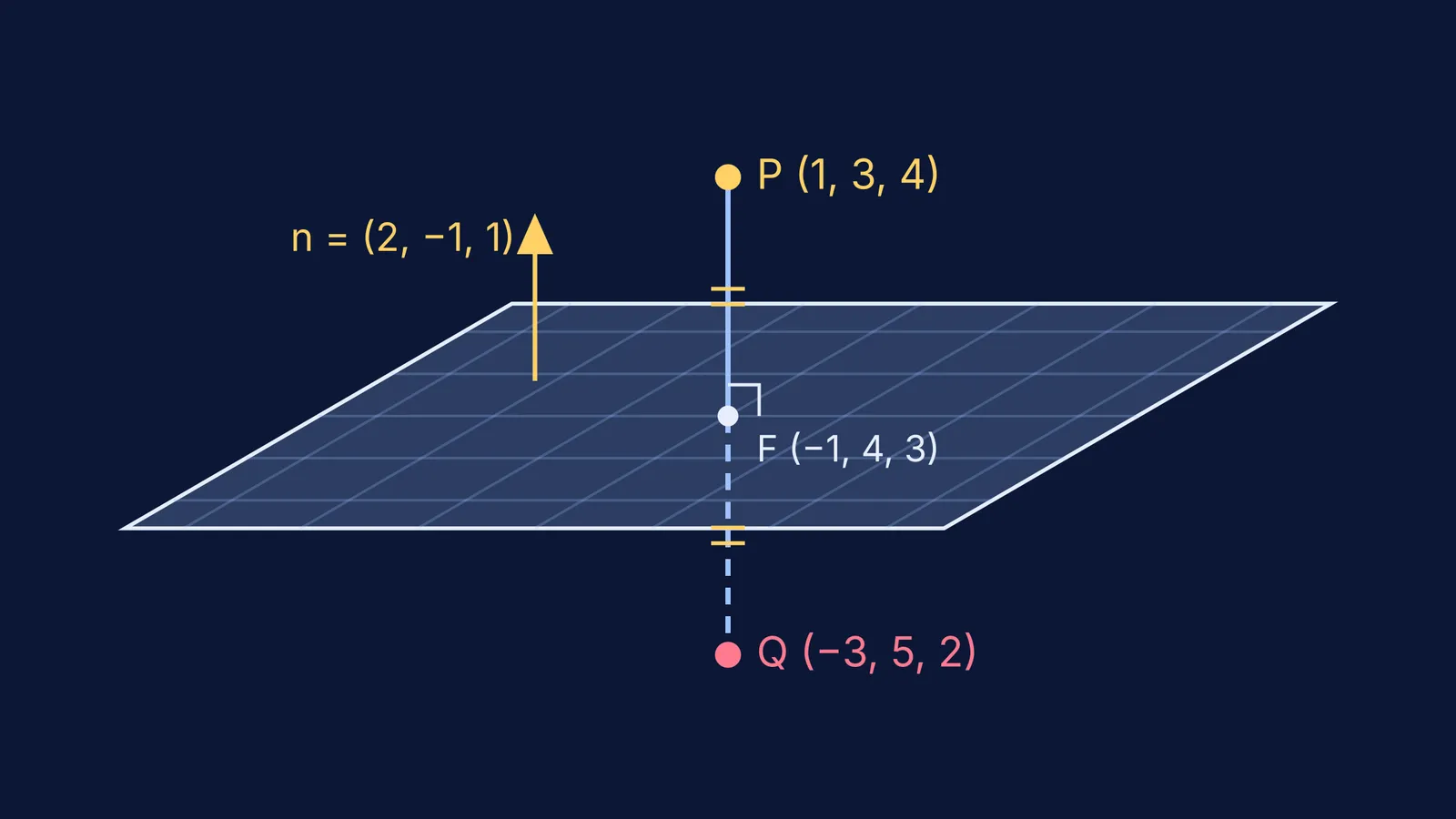
Think of the plane as a mirror: the image Q of a point P is where P would appear behind it. Two facts pin Q down. The segment PQ is perpendicular to the plane, and the plane cuts PQ exactly in half.
Why does the normal vector do all the work?
For a plane written as ax + by + cz + d = 0, the vector (a, b, c) is normal to the plane, as Wolfram MathWorld's point-plane distance page states. Because PQ must be perpendicular to the plane, PQ runs along this normal.
So every point on the line through P(x₀, y₀, z₀) along the normal can be written as one general point: (x₀ + at, y₀ + bt, z₀ + ct). If writing lines this way still feels shaky, our post on writing a 3D line in Cartesian and vector form covers it first.
One syllabus note: the current NCERT Class 12 chapter on three dimensional geometry (Reprint 2026-27) has sections on lines only, with no section on planes, so check your exam's current syllabus before deciding how much time to give this.
How do you find the foot of the perpendicular?
Read the normal (a, b, c) straight from the plane. Get the plane into the form ax + by + cz + d = 0 first.
Write the general point on the normal through P: (x₀ + at, y₀ + bt, z₀ + ct).
Substitute it into the plane equation and solve the linear equation for t.
Put that t back into the general point. That point is the foot F.
For the image, use 2t instead of t. Equivalently, Q = 2F − P, because F is the midpoint of PQ.
Worked example: what is the image of (1, 3, 4) in 2x − y + z + 3 = 0?
Normal: (2, −1, 1).
General point on the normal through P: (1 + 2t, 3 − t, 4 + t).
Substitute: 2(1 + 2t) − (3 − t) + (4 + t) + 3 = 0. Expand: 2 + 4t − 3 + t + 4 + t + 3 = 0, so 6 + 6t = 0 and t = −1.
Foot: F = (1 − 2, 3 + 1, 4 − 1) = (−1, 4, 3).
Image: double the step, t = −2, giving Q = (1 − 4, 3 + 2, 4 − 2) = (−3, 5, 2).
How do you check the answer quickly?
Each of these checks catches a different slip.
Midpoint check: the midpoint of P(1, 3, 4) and Q(−3, 5, 2) is (−1, 4, 3). It equals F, and it satisfies the plane: 2(−1) − 4 + 3 + 3 = 0.
Direction check: Q − P = (−4, 2, −2), which is −2 times the normal (2, −1, 1). So PQ really is perpendicular to the plane.
Distance check: MathWorld gives the distance from a point to the plane as |ax₀ + by₀ + cz₀ + d| / √(a² + b² + c²) (source). Here that is |2 − 3 + 4 + 3| / √6 = 6/√6 = √6. The length PF is |t| × √6 = √6, so the two agree.
What mistakes should you avoid when finding the image?
Moving the constant across. If the plane is given as 2x − y + z = −3, rewrite it as 2x − y + z + 3 = 0 before reading d.
Doubling the wrong thing. Use t for the foot and 2t for the image. Doubling F's coordinates is wrong; the image is 2F − P.
Vector form confusion. A plane given as r · n = p is the same as n · r − p = 0, so d = −p.
Skipping the sanity case. If P already lies on the plane, you will get t = 0, and P is its own image. That is correct, not an error.
The same general-point idea solves related questions, such as the angle between a line and a plane and finding a line perpendicular to two given lines in 3D.
When your answer fails the midpoint check and you can't see why, the Fermi Problem Library has worked problems with a step-by-step solver that explains the reasoning rather than printing an answer, so you can find the exact line where your working went off. If the idea of a normal vector itself is the gap, the Fermi Concept Library gives each mathematics concept its own lesson.
Solve one more by hand today, and do the midpoint check every time until it becomes a habit.


