

On this page
A line in space is fixed by one point and one direction. The Cartesian and vector equations write those same two facts, so converting is careful reading plus one repair step that is easy to miss. Everything below follows NCERT Class 12 Mathematics, Chapter 11: Three Dimensional Geometry.
What do the two forms of a line actually say?
In NCERT's notation, the vector equation of a line through the point with position vector a, parallel to the vector b, is r = a + λb, where λ is any real number (NCERT, section 11.3.1). Each λ gives one point.
If the point is (x1, y1, z1) and b = a i + b j + c k, then a, b, c are direction ratios of the line, and the Cartesian equation is (x − x1)/a = (y − y1)/b = (z − z1)/c (NCERT, equation 3 of section 11.3.1).
NCERT gets there through the parametric form x = x1 + λa, y = y1 + λb, z = z1 + λc, then eliminates λ. So the dictionary is short:
Numerators give the point, with the sign flipped: (x − 5) means x1 = 5, and (z + 4) means z1 = −4.
Denominators give the direction ratios, signs kept as they are.
The common value of the three fractions is λ.
How do you convert a line from Cartesian to vector form?
Make each numerator look exactly like (x − number), (y − number), (z − number), with coefficient 1 on x, y and z.
Read the point from the numerators, flipping each sign.
Read the direction ratios from the denominators.
Write r = (point) + λ(direction), using i, j, k.
NCERT's Example 6 runs the other way: the line through (5, 2, −4) parallel to 3i + 2j − 8k has vector form r = 5i + 2j − 4k + λ(3i + 2j − 8k) and Cartesian form (x − 5)/3 = (y − 2)/2 = (z + 4)/(−8) (NCERT, Example 6).
What if the coefficient of x, y or z is not 1?
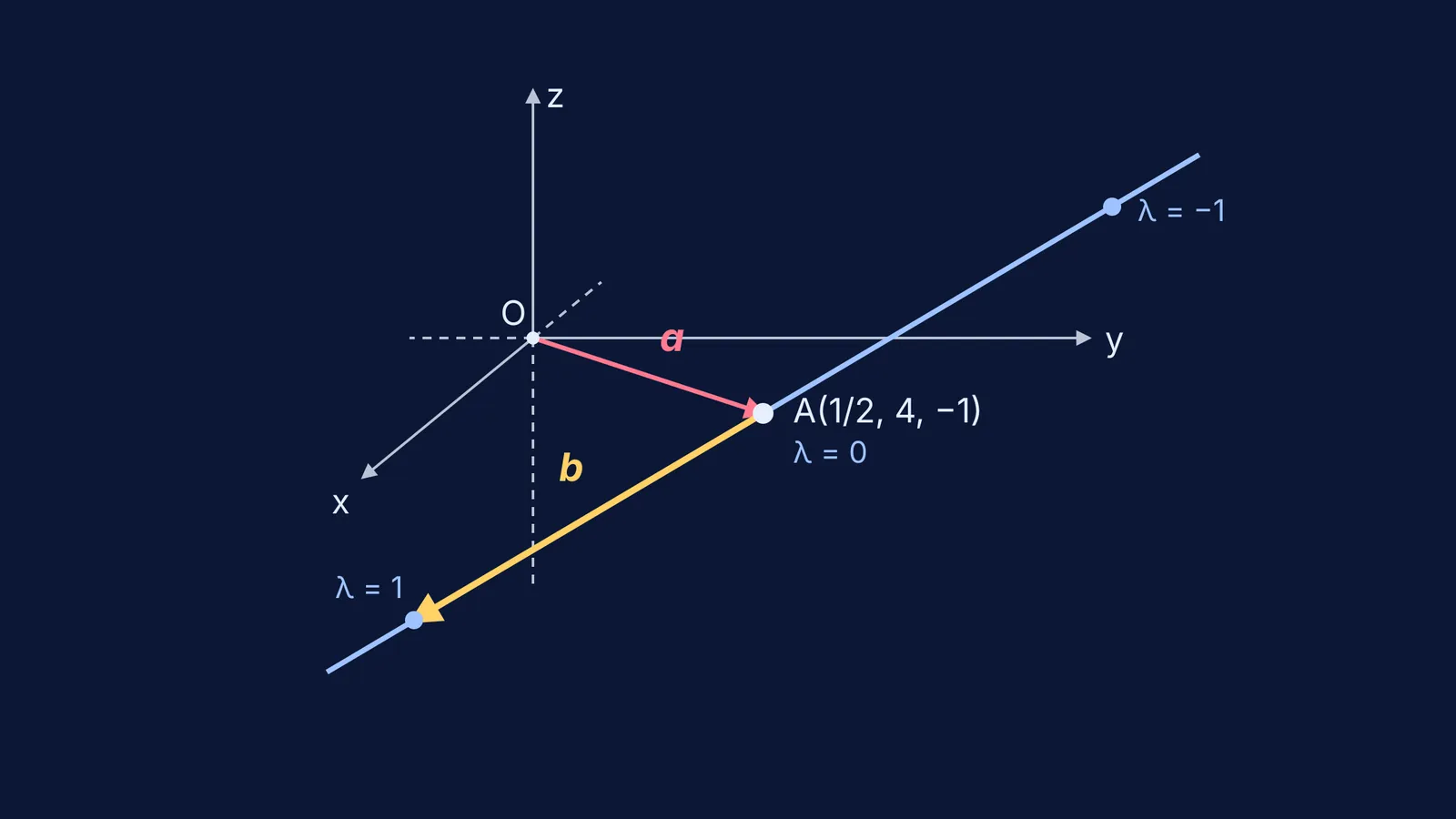
Slow down here. Take the line (2x − 1)/3 = (4 − y)/2 = (z + 1)/(−1). Step 1 fails twice: x has coefficient 2, and y has coefficient −1.
Fix x by factoring out the 2: 2x − 1 = 2(x − 1/2), so the first fraction becomes (x − 1/2)/(3/2). Divide the denominator by the coefficient you pulled out.
Fix y the same way: 4 − y = −(y − 4), so (4 − y)/2 becomes (y − 4)/(−2). The z term is already fine.
Now the standard form is (x − 1/2)/(3/2) = (y − 4)/(−2) = (z + 1)/(−1).
Point: (1/2, 4, −1).
Direction ratios: 3/2, −2, −1. Any non-zero multiple of direction ratios is also a set of direction ratios (NCERT, section 11.2), so multiply by 2 to clear the fraction: 3, −4, −2.
Vector form: r = (1/2 i + 4j − k) + λ(3i − 4j − 2k).
Check it: λ = 1 gives the point (7/2, 0, −3). In the original equation, (2 × 7/2 − 1)/3 = 2, (4 − 0)/2 = 2 and (−3 + 1)/(−1) = 2. All three agree, so the point is on the line. This quick check catches a wrong point or direction.
If you cannot see which step went wrong, the Fermi Problem Library has worked problems with a step-by-step solver that explains the reasoning rather than printing an answer.
When should you switch to direction cosines?
Only when a question asks for them. Direction cosines l, m, n satisfy l² + m² + n² = 1, and you get them by dividing direction ratios a, b, c by √(a² + b² + c²) (NCERT, section 11.2). For our line that is ±(3/√29, −4/√29, −2/√29). The vector form does not need them.
If direction ratios versus direction cosines still feels hazy, the Fermi Concept Library gives each mathematics concept its own lesson and its place in the map.
A two-minute practice plan
Convert these, then test each answer with λ = 1:
(x + 2)/4 = (y − 3)/(−1) = z/5.
(3x − 6)/2 = (1 − 2y)/4 = (z − 7)/3.
x/2 = (5 − y)/3, z = 4. A fixed z means the direction ratio for z is 0.
The skill carries into the next topics: finding the foot of the perpendicular and the image of a point in a line starts with r = a + λb, the section formula in 3D gives you points to build lines through, and the angle between lines uses the dot product from vector algebra for JEE maths.
Tonight, pick one line from your textbook, fix its coefficients, write it in vector form and check it with λ = 1.


