

On this page
In 3D geometry, you often need to find a straight line that is perpendicular to two other lines. This operation is central to calculating the shortest distance between skew lines and finding normal vectors, making it a high-yield concept for competitive exams. According to a Collegedunia analysis of the JEE Main mathematics syllabus, 3D Geometry and Vector Algebra combined account for about 11% of the Mathematics section's total weightage.
Because recent exam trends have removed planes from the syllabus, problems involving 3D lines have become more frequent and inventive. You are no longer just finding the intersection of a line and a plane; you must deeply understand how direction ratios and vectors interact in space.
How do you find the equation of a line perpendicular to two given lines?
Writing the equation of any straight line in 3D requires exactly two pieces of information: a specific point that the line passes through, and a vector that shows the line's direction. In these problems, the point is almost always given to you. Your only job is to calculate the correct direction vector.
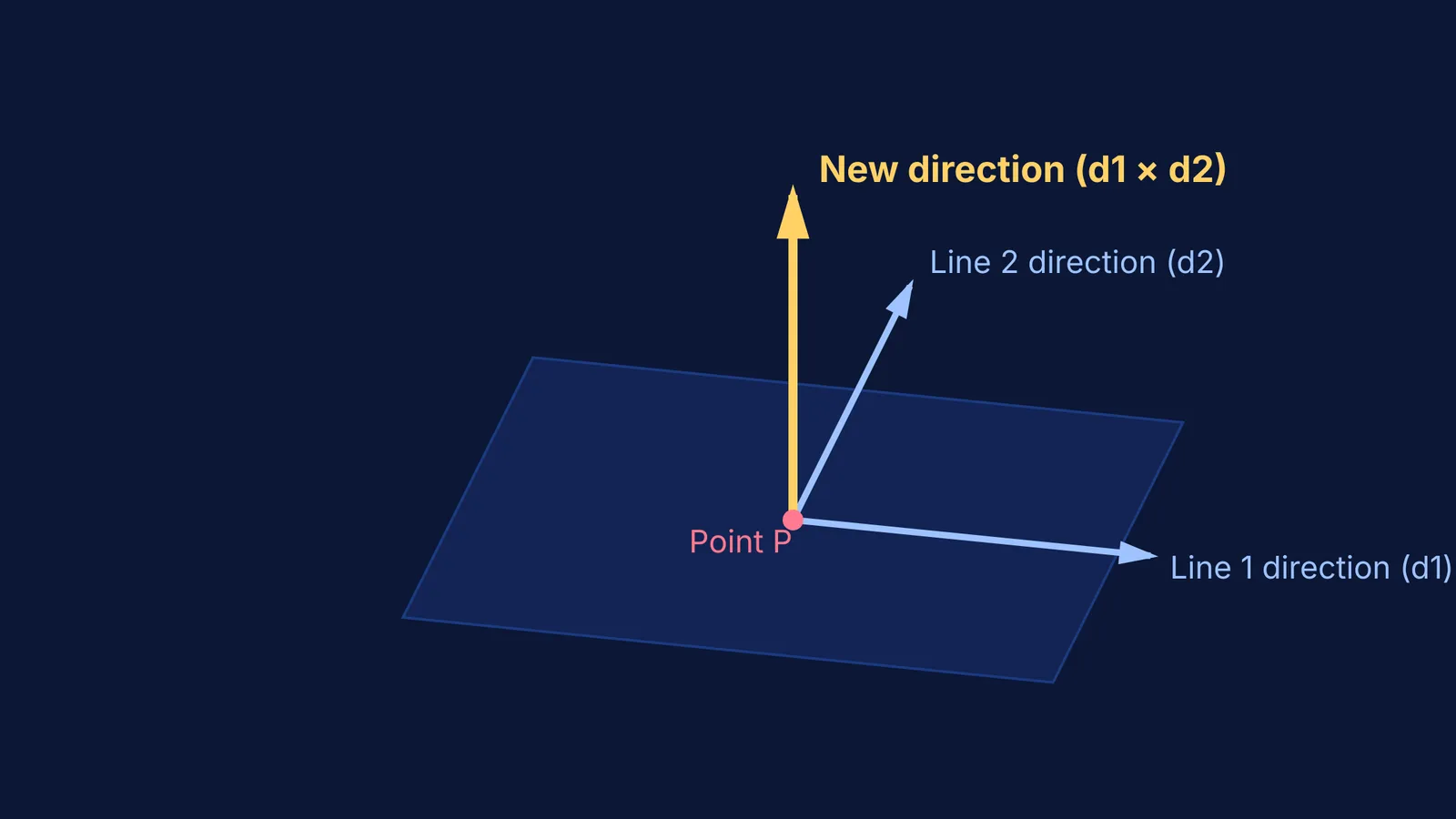
Since your new line must be perpendicular to both Line 1 and Line 2, its direction must be perpendicular to the direction vectors of both of those original lines.
This is where vector algebra comes in. The cross product of two vectors produces a third vector that is perpendicular to the plane containing the original two. If Line 1 has a direction vector d1 and Line 2 has a direction vector d2, the direction vector n of the new line is simply their cross product:
n = d1 × d2
You can then plug this new direction vector n, along with the given point, straight into the standard formula for a 3D line.
What is the step-by-step method?
Here is the foolproof procedure for setting up and solving these perpendicular line problems.
Extract the direction vectors from the given lines. Look at the equations of Line 1 and Line 2. Make sure they are written in the standard symmetric form: (x − x1)/a = (y − y1)/b = (z − z1)/c. The denominators a, b, and c are the components of the direction vector. If a term looks like (2x − 4)/6, you must divide the numerator and denominator by 2 to get (x − 2)/3 before extracting the direction ratio.
Compute the cross product. Set up a 3×3 determinant with unit vectors i, j, k in the top row, the direction ratios of Line 1 in the middle row, and the direction ratios of Line 2 in the bottom row. Expand this determinant to find your new direction vector.
Write the final equation. Take the coordinates of the given point (x0, y0, z0) and your newly calculated direction ratios (a', b', c'). The final equation in Cartesian form is (x − x0)/a' = (y − y0)/b' = (z − z0)/c'.
If you miscalculate a determinant or drop a minus sign, your final equation will be completely wrong. Fermi's AI tutor can spot these arithmetic slips immediately. Rather than just printing the final answer, it holds a line of reasoning across a whole session and helps you correct your own mistakes.
A worked example: putting it together
Let's find the equation of the line passing through the point (1, 2, 3) that is perpendicular to the following two lines:
Line 1: (x − 1)/2 = (y − 2)/3 = (z − 3)/4 Line 2: (x − 2)/3 = (y − 4)/4 = (z − 5)/5
Step 1: Extract the direction vectors Both equations are already in standard form (the coefficients of x, y, and z are exactly 1). The direction vector of Line 1 is d1 = 2i + 3j + 4k. The direction vector of Line 2 is d2 = 3i + 4j + 5k.
Step 2: Find the cross product We calculate the cross product d1 × d2 by expanding the determinant:
n = (3 × 5 − 4 × 4)i − (2 × 5 − 4 × 3)j + (2 × 4 − 3 × 3)k
n = (15 − 16)i − (10 − 12)j + (8 − 9)k
n = −i + 2j − k
The direction ratios of the required line are −1, 2, −1.
Step 3: Write the equation Using the given point (1, 2, 3), substitute the values into the standard Cartesian formula:
(x − 1)/−1 = (y − 2)/2 = (z − 3)/−1
Sometimes, multiple-choice questions will multiply the direction ratios by −1 to clear the leading negative sign. Equivalently, the answer could be written as:
(x − 1)/1 = (y − 2)/−2 = (z − 3)/1
Both forms represent the exact same line in 3D space.
For more step-by-step methods in coordinate geometry, check our complete guide to 3D geometry for JEE, or practice finding the foot of perpendicular and image of a point in a line in 3D. You can also review the vector operations that make this possible in the Fermi Concept Library.


