

On this page
The formula for a line meeting a plane looks familiar until a sine shows up where you expected a cosine. This post explains where the sine comes from, works one example from start to finish, and gives you the quick checks for parallel, perpendicular and lying in the plane. If your vector basics are rusty, start with our guide to dot, cross and triple products in vector algebra.
What is the angle between a line and a plane?
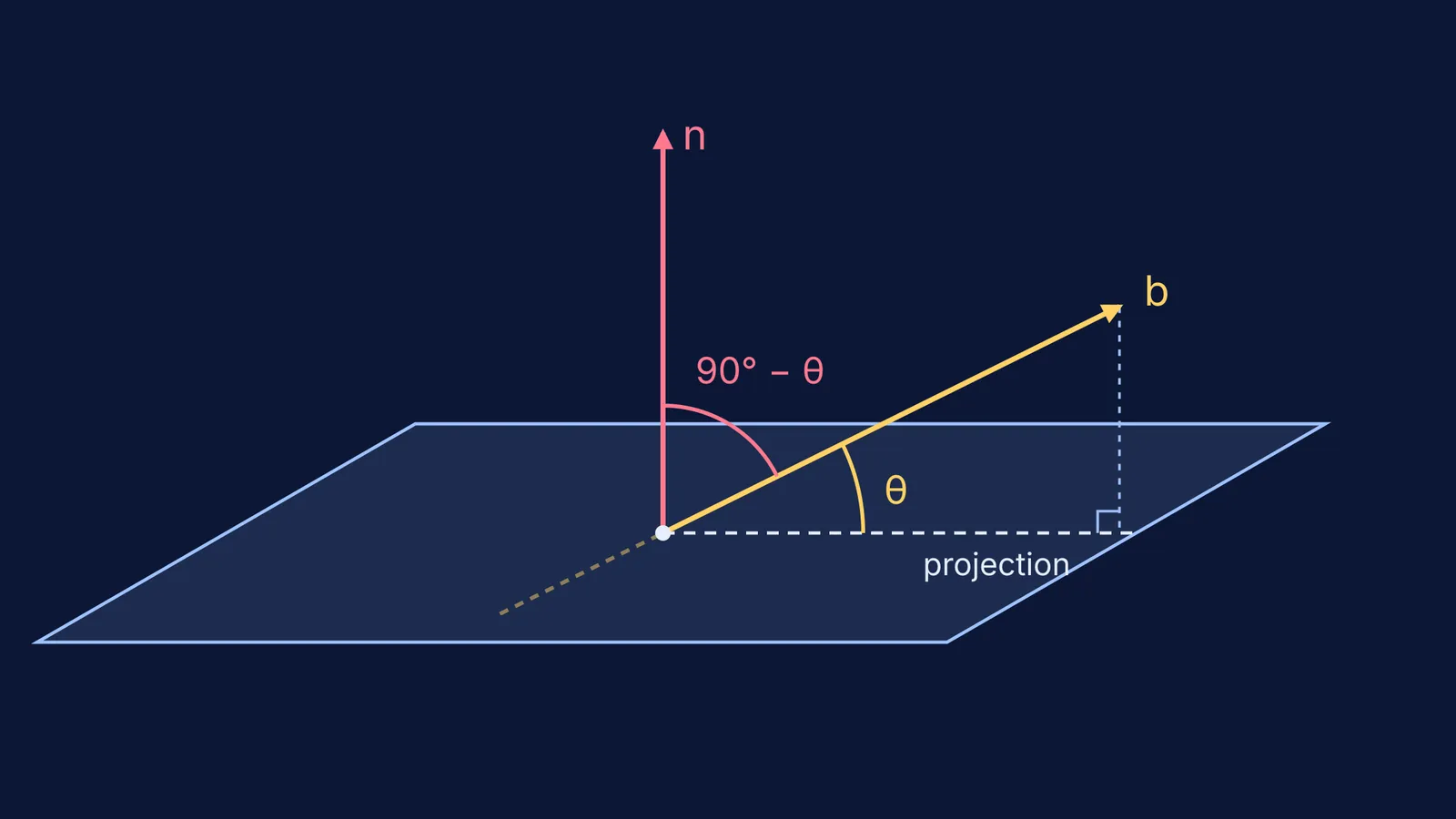
The angle between a line and a plane is the angle between the line and its projection onto that plane, as defined in OnlineMSchool's analytic geometry notes. It always lies between 0° and 90°.
A plane has no single direction you can dot a line with. What it does have is a normal vector n, the arrow that sticks straight out of it. In the equation ax + by + cz = d, the normal is n = (a, b, c), read straight off the coefficients.
Why does the formula use sin and not cos?
The dot product gives you the cosine of the angle between two vectors. If you dot the line's direction b with the normal n, you get the cosine of the angle between the line and the normal, not between the line and the plane.
The normal stands at 90° to the plane, so if the line makes an angle θ with the plane, it makes 90° − θ with the normal. Since cos(90° − θ) = sin θ, the formula becomes:
sin θ = |b · n| / (|b| |n|)
OnlineMSchool gives the same formula in Cartesian form. The absolute value keeps θ between 0° and 90°, because flipping the direction of a line does not change the line.
A worked example, start to finish
Find the angle between the line (x − 1)/2 = (y + 1)/1 = (z − 3)/2 and the plane 2x − 2y + z = 4.
Direction of the line: b = (2, 1, 2), from the denominators, so |b| = √(4 + 1 + 4) = 3.
Normal of the plane: n = (2, −2, 1), from the coefficients, so |n| = √(4 + 4 + 1) = 3.
Dot product: b · n = 4 − 2 + 2 = 4.
sin θ = 4 / (3 × 3) = 4/9, so θ = sin⁻¹(4/9), about 26.4°.
The usual slip is writing cos θ = 4/9, which gives about 63.6°. That is the angle with the normal, and 26.4° + 63.6° = 90° confirms it.
How do you find the angle between two planes?
Here cosine is correct. Two planes meet at the same angle as their normals, and OpenStax Calculus Volume 3 gives the angle between two intersecting planes as cos θ = |n₁ · n₂| / (|n₁| |n₂|). Both vectors are normals, so no complement is needed.
Example: take the plane 2x − 2y + z = 4 and the xy-plane z = 0, with normals (2, −2, 1) and (0, 0, 1). Then cos θ = 1 / (3 × 1) = 1/3, so θ is about 70.5°.
The quick rule: line with line, cos. Plane with plane, cos. Line with plane, sin.
How do you check if a line is parallel or perpendicular to a plane?
Each check is a special case of the sine formula. Using the same line, with b = (2, 1, 2) and the point (1, −1, 3):
Parallel: b · n = 0, so sin θ = 0. The plane x + 2y − 2z = 7 gives 2 + 2 − 4 = 0, so the line runs alongside it.
Lies in the plane: parallel, and a point of the line satisfies the plane's equation. The point (1, −1, 3) gives 1 − 2 − 6 = −7, not 7, so this line is parallel to the plane but sits off it.
Perpendicular: b is a multiple of n, so θ = 90°. The plane 4x + 2y + 4z = 1 qualifies, since (4, 2, 4) = 2 × (2, 1, 2).
For two planes, OpenStax states that parallel planes have parallel normal vectors, and planes are perpendicular when n₁ · n₂ = 0.
What should you check before writing the answer?
Name the pair: line and line, line and plane, or plane and plane.
Use sin only for a line and a plane; use cos for the other two.
If the dot product is zero, decide what that zero means for this pair.
For writing equations of lines and planes and finding distances, see our 3D geometry for JEE guide to lines, planes and distances, and for the next step, the walkthrough on the foot of the perpendicular and the image of a point in 3D.
When you get a question like this wrong and cannot see where, the Fermi Problem Library has worked problems with a step-by-step solver that explains the reasoning rather than printing an answer. If the normal vector itself still feels shaky, the Fermi Concept Library gives each mathematics concept its own lesson.
Run these three checks on your next line-and-plane question.


