On this page
You have a point and a straight line, and the question wants the distance between them. Here is why the perpendicular is the answer, where the formula comes from, and how to run it backwards when the point is unknown.
Why is the perpendicular the shortest distance?
The NCERT Class 11 Mathematics chapter on straight lines defines it directly in Section 9.4: "The distance of a point from a line is the length of the perpendicular drawn from the point to the line."
The reason is Pythagoras. Call the point P and the foot of the perpendicular M. Any other point R on the line gives a triangle PMR with the right angle at M, so PR is the hypotenuse and is longer than PM.
Where does |ax₁ + by₁ + c|/√(a² + b²) come from?
NCERT derives it using the area of a triangle formed by the point and the two points where the line meets the axes. A shorter route, given on Wolfram MathWorld's point-line distance page, projects onto a vector perpendicular to the line:
Pick any point Q(x₀, y₀) on the line, so ax₀ + by₀ + c = 0.
The vector n = (a, b) is perpendicular to the line. When a and b are non-zero, its slope b/a times the line's slope −a/b is −1, the test in our post on why perpendicular slopes multiply to −1.
The distance is the length of the projection of QP onto n: |a(x₁ − x₀) + b(y₁ − y₀)|/√(a² + b²).
Expand the top: ax₁ + by₁ − (ax₀ + by₀) = ax₁ + by₁ + c, because ax₀ + by₀ = −c.
So d = |ax₁ + by₁ + c|/√(a² + b²): substitute the point, take the absolute value, divide by the length of the normal.
A check from the same NCERT chapter (Example 9): the distance of (3, −5) from 3x − 4y − 26 = 0 is |9 + 20 − 26|/5 = 3/5.
How do you find points at a given distance from a line?
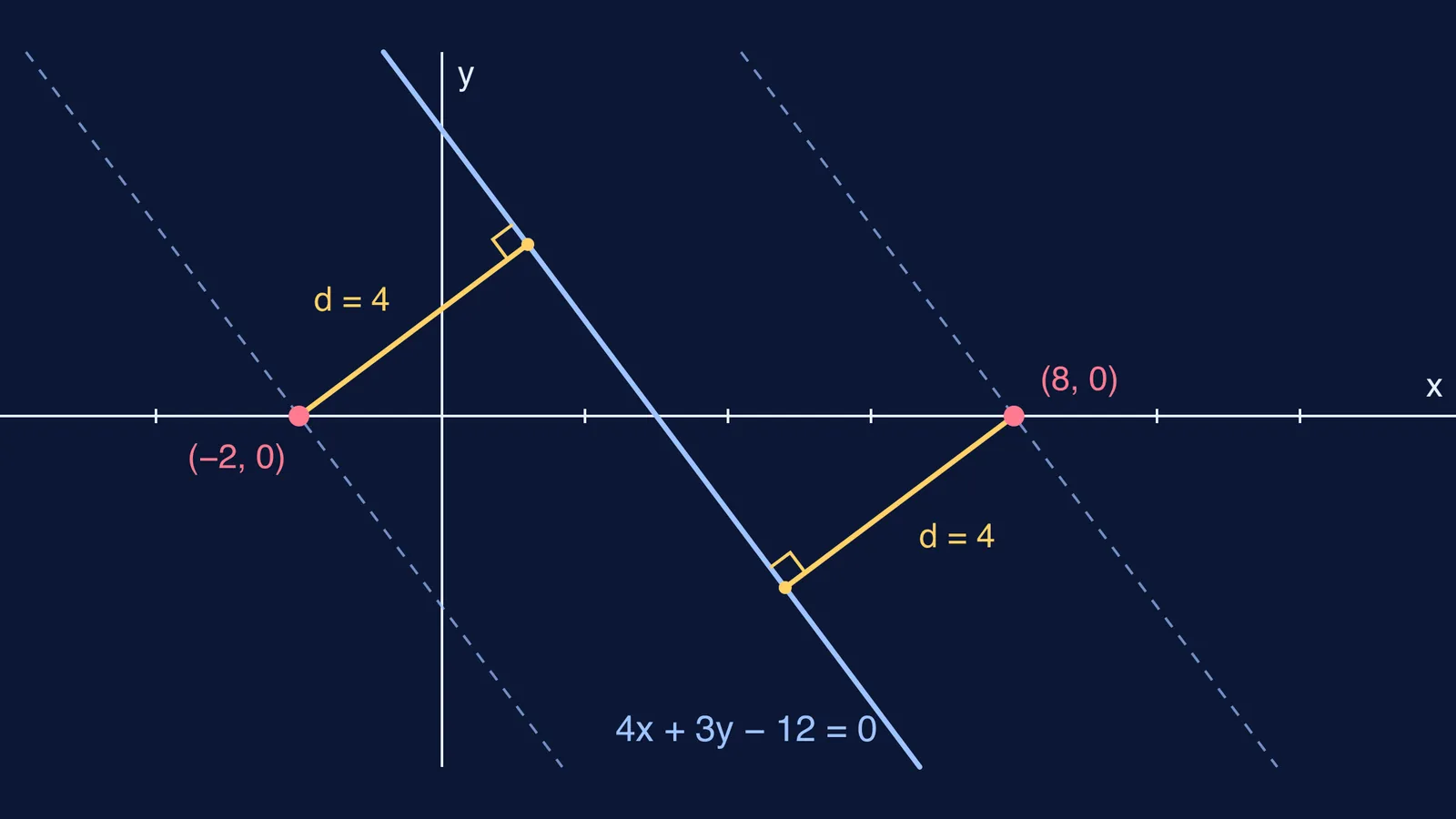
Take Exercise 9.3, Question 4 of the NCERT chapter: find the points on the x-axis whose distances from the line x/3 + y/4 = 1 are 4 units.
Rewrite the line in the form ax + by + c = 0. Multiply by 12: 4x + 3y − 12 = 0. So a = 4, b = 3, c = −12 and √(a² + b²) = 5.
Write the unknown point with one unknown. On the x-axis it is (h, 0).
Apply the formula: |4h − 12|/5 = 4, so |4h − 12| = 20.
Open the modulus both ways. 4h − 12 = 20 gives h = 8. 4h − 12 = −20 gives h = −2.
Check by substituting: |32 − 12|/5 = 4 and |−8 − 12|/5 = 4.
The answer is (8, 0) and (−2, 0), the two points in the diagram at the top. Geometrically, every point 4 units from the line lies on one of two parallel lines, 4x + 3y = 32 and 4x + 3y = −8, and the x-axis crosses each once. You can confirm the gap with the formula from our post on the distance between parallel lines.
The same recipe works for any unknown-point question:
Use the given condition to write the point with one unknown: (h, 0) on the x-axis, (0, k) on the y-axis, (t, t) on y = x.
Set |ax + by + c| equal to d√(a² + b²).
Solve the + and − cases separately.
Keep both answers unless the question adds a condition, such as "on the same side as the origin". Then use the sign test to drop one.
What mistakes cost marks on this formula?
Using the line as given. Rearrange it so one side is zero first.
Dropping the modulus, which loses one of the two answers.
Dividing by a² + b² instead of its square root.
Mixing up signs when moving terms across: in y = 2x + 5, the form is 2x − y + 5 = 0, so b = −1.
Skipping the check by substitution.
The formula also turns up inside other questions. A line touches a circle exactly when its distance from the centre equals the radius, which is the idea behind our post on the condition for a line to be tangent to a circle.
If you used the right formula and still got the wrong answer, the Fermi Problem Library has worked problems with a step-by-step solver that explains the reasoning rather than printing an answer, so you can see which step went wrong. If the idea of a normal vector is still hazy, the Fermi Concept Library gives each mathematics concept its own lesson and its place in the map.
Try it now: find the points on the y-axis that are 4 units from 4x + 3y − 12 = 0, then check them by substituting back.