

On this page
Because parallel lines never intersect, the shortest gap between them is constant everywhere. The distance between two parallel lines in the plane is the minimum distance between any two points on those lines. In coordinate geometry, finding this distance is a straightforward matter of reading the constants from their linear equations, provided you set them up correctly.
What is the formula for the distance between parallel lines?
When two lines are parallel, they share the exact same slope. In their general equations, this means their x and y coefficients are either identical or directly proportional.
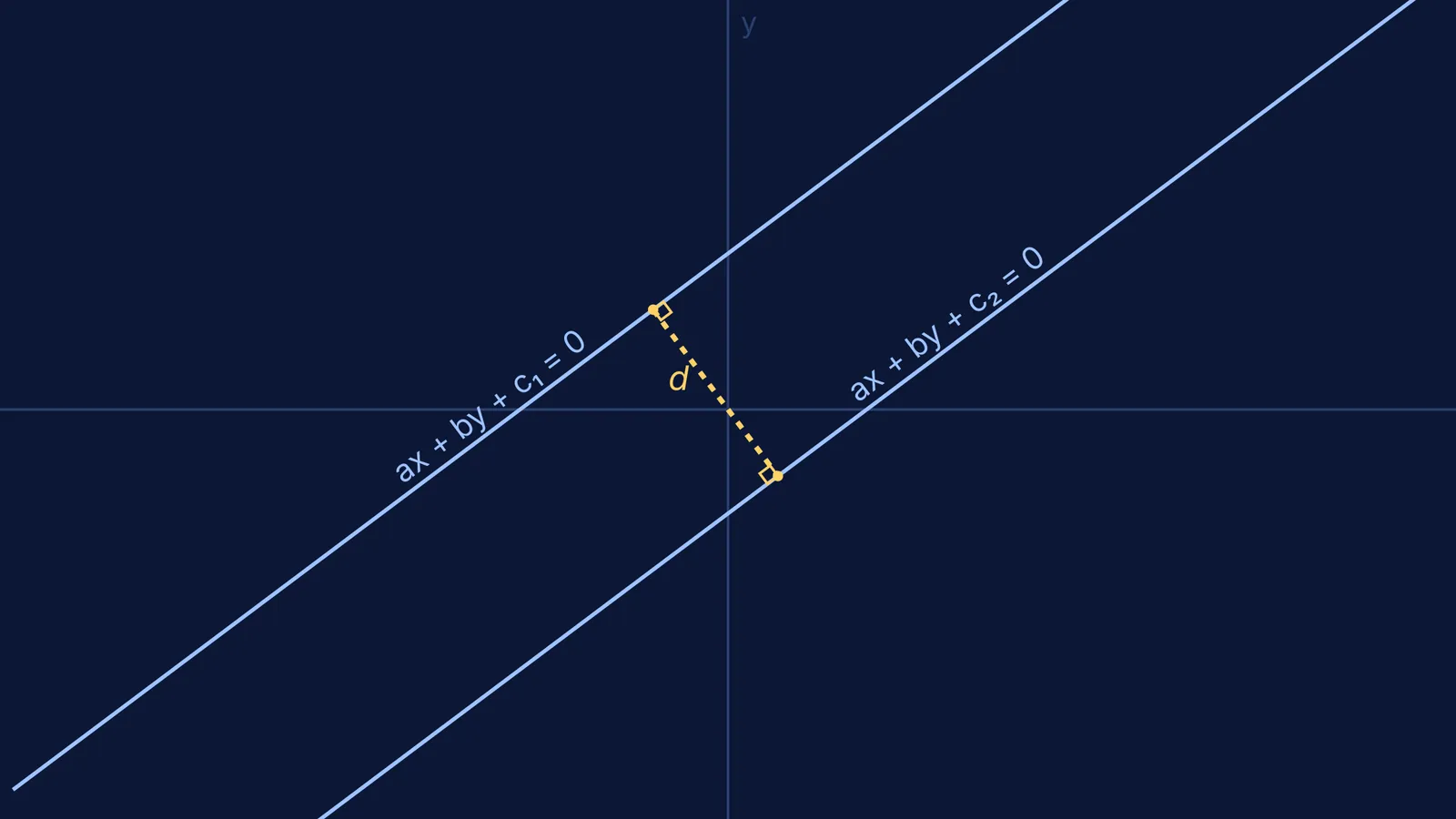
If you write the two lines in the exact same form, ensuring the coefficients perfectly align:
ax + by + c₁ = 0
ax + by + c₂ = 0
The perpendicular distance d between them is given by the difference in their constant terms divided by the length of their normal vector:
d = |c₁ - c₂| / √(a² + b²)
Because distance represents a physical, measurable length, the absolute value bars |c₁ - c₂| ensure the final result is always a positive number.
To visualize why this works, imagine drawing a straight line from the origin (0,0) that strikes both parallel lines at a 90-degree angle. The formula calculates how far each line is from the origin along that perpendicular path, and then subtracts those two distances to find the gap between the lines themselves.
For a broader overview of how this concept fits into your syllabus, see Straight lines in coordinate geometry: forms, distances and angles.
Why must you match the coefficients first?
The single most common mistake students make when using this formula is grabbing the constants before the x and y terms actually match.
If your lines are given to you as 2x + 3y - 5 = 0 and 4x + 6y + 7 = 0, you cannot simply subtract 7 from -5. The coefficients (a=2, b=3 versus a=4, b=6) are proportional, confirming the lines are indeed parallel, but the distance formula strictly requires them to be identical.
You have two choices to fix this before you do any calculating:
Divide the second equation by 2: This turns it into 2x + 3y + 3.5 = 0. Now your constants are c₁ = -5 and c₂ = 3.5.
Multiply the first equation by 2: This turns it into 4x + 6y - 10 = 0. Now your constants are c₁ = -10 and c₂ = 7.
Either choice will yield the exact same final distance. To review the foundational distance concepts that build up to this step, Coordinate geometry in Class 10: distance and section formulae is a highly recommended refresher.
How do you find the distance between parallel lines using an example?
Let's find the shortest distance between the parallel lines 3x - 4y + 12 = 0 and 3x - 4y - 8 = 0.
1. Check the coefficients Look at the front of both equations. They both start with 3x - 4y. This means a = 3 and b = -4. The coefficients already match perfectly, so we can proceed without any scaling.
2. Identify the constants The first line has a constant term of c₁ = 12. The second line has a constant term of c₂ = -8.
3. Apply the formula Substitute the identified values into the standard formula d = |c₁ - c₂| / √(a² + b²):
d = |12 - (-8)| / √(3² + (-4)²) d = |12 + 8| / √(9 + 16) d = 20 / √25 d = 20 / 5 = 4
The perpendicular distance between the two lines is exactly 4 units. If you find yourself stuck verifying these formulas or trying to remember which coefficients go where, the Fermi Concept Library maps out every concept in physics, chemistry, biology, mathematics and computing, each with its own lesson and its place in the map.
What happens with the slope-intercept form?
Sometimes, test questions present the lines in the slope-intercept form (y = mx + c). They might look like this:
Line 1: y = mx + c₁
Line 2: y = mx + c₂
You can easily rearrange these into the general form (mx - y + c₁ = 0), which effectively sets a = m and b = -1. Substituting these new a and b values into the main formula gives you a handy shortcut specifically for lines in slope-intercept form:
d = |c₁ - c₂| / √(1 + m²)
If you are just starting out with geometric angles and parallel transversals, reading Parallel lines and transversals in Class 7: finding every angle is a great place to build your intuition.


