

On this page
Your feet push the ground; a swimmer pushes the water. So it feels natural to think a rocket must push on the air, and would have nothing to push against in empty space. That idea is wrong, and once you see why, many Class 11 and JEE Main mechanics questions get easier.
Why doesn't a rocket need air to push against?
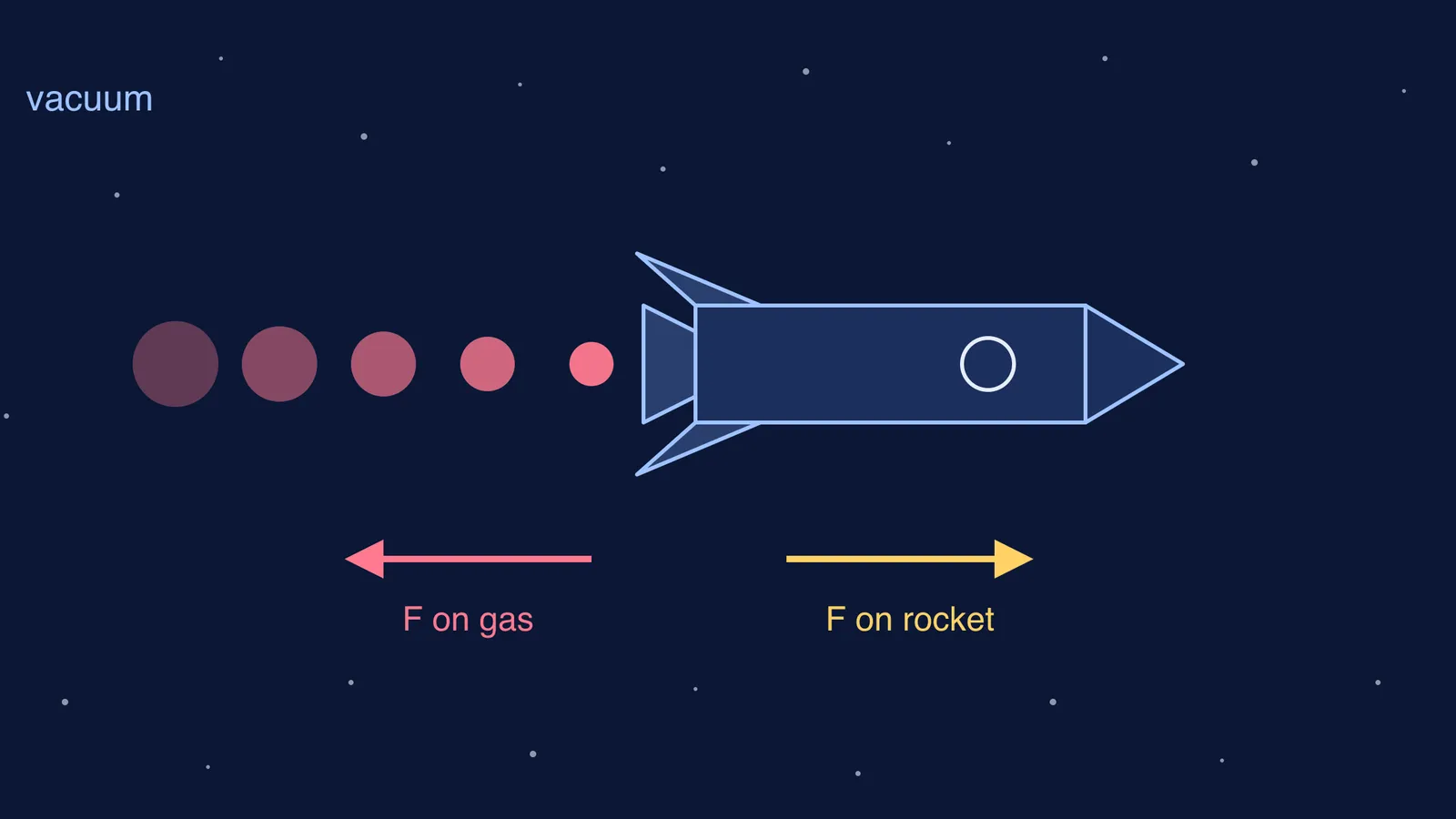
The rocket brings the thing it pushes on. Its engine burns propellant and throws the hot gas out of the nozzle at high speed. NASA Glenn Research Center's rocket principles guide puts it in one line: "The rocket pushes on the gas, and the gas in turn pushes on the rocket."
That is Newton's third law. The push on the gas (backward) and the push on the rocket (forward) are an action-reaction pair. The air outside plays no part in it.
The rocket does not need outside air for burning either. As NASA's Beginner's Guide to Aeronautics explains, no external air is brought on board, and because the oxidiser is carried on the rocket, it can produce thrust in a vacuum where there is no other source of oxygen.
Air actually gets in the way. The same NASA rocket principles guide says rockets work better in space than in air, because in air the exhaust must push the surrounding air away, which uses up some of the rocket's energy. You can see this in the thrust equation from NASA's guide, F = ṁVₑ + Aₑ(pₑ − p₀): the outside pressure p₀ is subtracted, so when p₀ is zero in a vacuum, the pressure term is as large as it can be.
Where did the "nothing to push against" idea come from?
Even newspapers once got this wrong. According to NASA's history office, an anonymous New York Times editorial on 13 January 1920 scoffed at the rocket pioneer Robert Goddard, claiming rockets could not work in the vacuum of space because they needed air to push against.
The same NASA page records that on 17 July 1969, the day after Apollo 11 lifted off, the paper printed "A Correction" saying it was now established that a rocket can function in a vacuum as well as in an atmosphere, and that "The Times regrets the error." If it once confused you, you are in good company.
How do you show it with momentum?
Momentum gives the same answer without talking about forces at all. Take a made-up probe in deep space, far from any planet, with illustrative round numbers.
Before firing, the probe and its fuel have a total mass of 1,000 kg and are at rest, so total momentum is zero.
The engine fires a short burst of 2 kg of gas backward at 3,000 m/s. The gas now carries 2 × 3,000 = 6,000 kg m/s of backward momentum.
With no outside force, total momentum must stay zero. So the remaining 998 kg probe must carry 6,000 kg m/s forward.
Its speed is 6,000 ÷ 998 ≈ 6.0 m/s forward.
No air appears anywhere in this calculation. If the engine instead threw out 2 kg of gas every second at 3,000 m/s, the first term of NASA's thrust equation, ṁVₑ, gives a steady force of 6,000 N. Our post on the rocket thrust formula u dm/dt takes this further, and our guide on how to identify action-reaction pairs shows how to pick out the right pair of forces. For a version you can build at home, see how a balloon rocket moves.
How should you write this in an exam answer?
A board or JEE short answer needs four moves. Say them in this order:
Name the system: the rocket and the exhaust gas it ejects.
State the pair: the rocket exerts a backward force on the gas, and by Newton's third law the gas exerts an equal forward force on the rocket.
Apply the second law: that forward force acts on the rocket, so the rocket accelerates. Outside air is not involved.
Optional momentum check: the total momentum of rocket plus gas stays constant, so the backward momentum of the gas equals the forward momentum gained by the rocket.
Then check your answer against these common mistakes:
Saying the exhaust pushes on the air or the launch pad.
Cancelling the action-reaction pair because the forces are equal and opposite.
Assuming the rocket needs oxygen from the air to burn its fuel.
Thinking the rocket stops when the engine stops. In empty space, with no friction, it keeps moving at the speed it has reached.
If you keep mixing up which force acts on which object, the Fermi Concept Library gives every concept in physics, including Newton's laws and momentum, its own lesson and its place in the map. To practise, the Fermi Problem Library has worked problems with a step-by-step solver that explains the reasoning rather than printing an answer.
Next time someone says a rocket has nothing to push against in space, you can tell them: it pushes against its own exhaust.


