

On this page
When you learn Newton's second law in school, it is almost always written as F = ma. This works perfectly for cars, blocks and planets because their mass does not change. But a rocket works by burning fuel and throwing it out of the back, meaning it becomes lighter every second.
To solve problems with rockets, we cannot use F = ma. Instead, we have to look at the rate at which momentum changes, which leads to the formula for thrust.
What is the thrust of rocket formula u dm by dt?
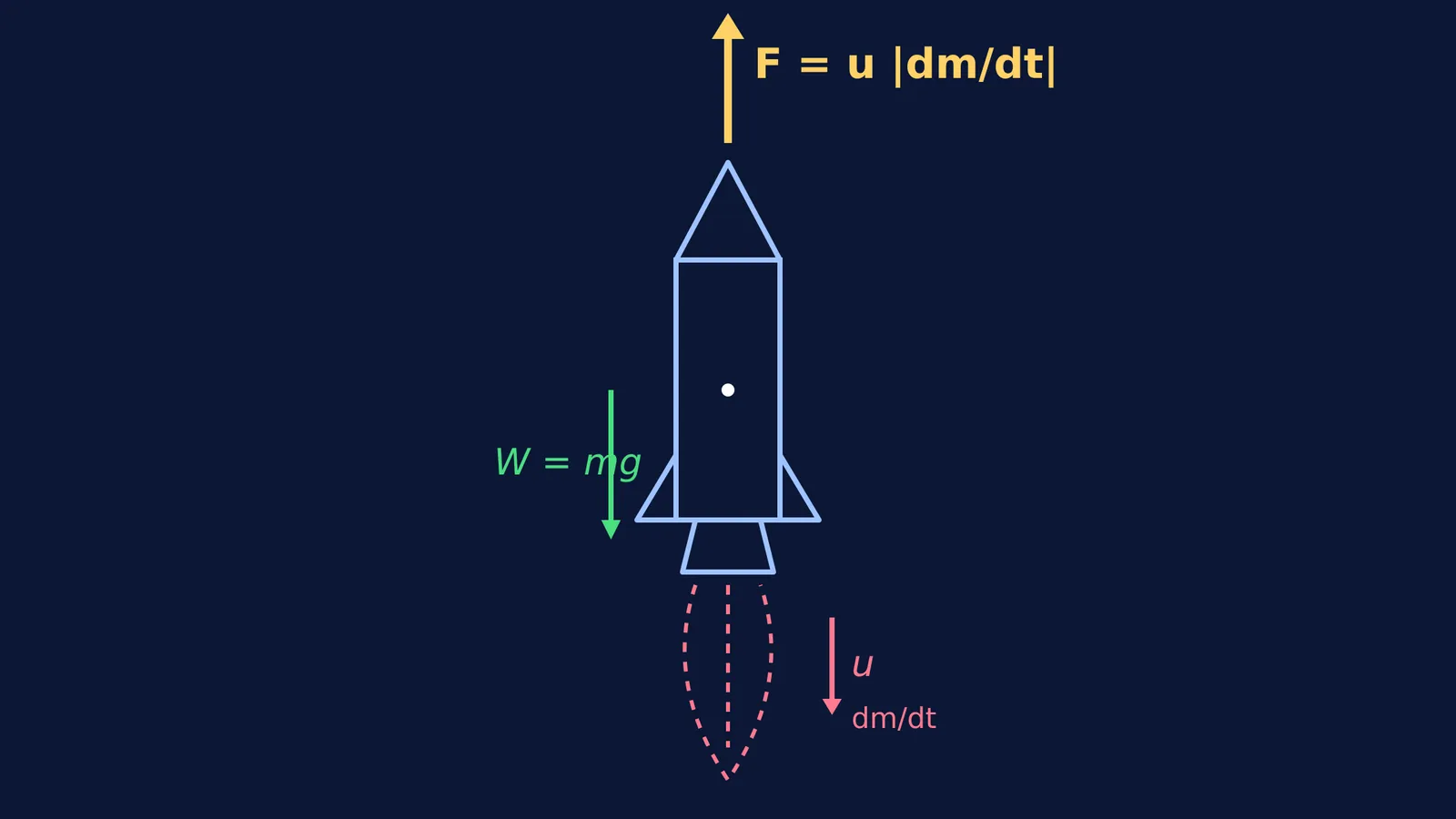
A rocket generates thrust by expelling mass (exhaust gases) at high speed. According to the OpenStax University Physics text, the thrust force is defined as:
F = u |dm/dt|
Here is what each term means:
Thrust (F): The upward force applied to the rocket by the ejected fuel, measured in Newtons.
Relative exhaust speed (u): The velocity of the exhaust gases *relative to the rocket*, measured in metres per second.
Mass flow rate (dm/dt): The rate at which the rocket burns and ejects fuel, measured in kilograms per second. Because the rocket is losing mass, the change in mass dm/dt is technically negative, so we use its absolute value to calculate the magnitude of the force.
This formula shows that to get more thrust, engineers can either throw the gas out faster (higher u) or burn more fuel per second (higher dm/dt). For example, the first stage of ISRO's PSLV burns an enormous 1,256 kilograms of solid propellant per second to generate its 4.8 million Newtons of lift-off thrust.
How is the rocket thrust formula derived?
We can understand where this formula comes from by looking at the conservation of momentum. Imagine a rocket is floating in deep space where there is no gravity or air resistance.
At a given time t, the rocket has a mass m and is moving forward with a velocity v. Its total momentum is m × v.
A moment later, at time t + dt, the rocket has pushed a small amount of gas out of the back. Let's call the mass of this gas dm_g. The rocket's mass is now slightly smaller (m − dm_g), and its forward velocity has increased to v + dv.
Because the exhaust gas is pushed backwards at a speed u relative to the rocket, its actual speed in space is (v − u).
Since no outside forces are pushing on the rocket in deep space, the total momentum of the system must stay the same. The momentum of the rocket moving slightly faster, plus the momentum of the exhaust gas moving backwards, must equal the original momentum of the rocket.
When physicists solve this momentum equation, the small changes cancel out to leave a very simple relationship: the mass times the acceleration (m × dv/dt) equals the relative exhaust speed times the mass flow rate (u × dm_g/dt). Since mass times acceleration is the force acting on the rocket, this gives us the thrust: F = u |dm/dt|.
What is the condition for a rocket to lift off?
When a rocket sits on the launch pad, gravity pulls it down. For the rocket to leave the pad, the engines must push up harder than gravity pulls down.
The downward force is the rocket's weight, W = mg, where m is the total initial mass (rocket structure plus all the fuel) and g is the acceleration due to gravity.
According to the OpenStax mechanics guide, the condition for lift-off is that the upward thrust must exceed the downward weight:
u |dm/dt| > mg
If the thrust exactly equals the weight (F = mg), the rocket will just hover without rising. If the thrust is less, the rocket stays on the pad.
Worked example: Calculating the minimum mass flow rate
Problem: A sounding rocket has a total initial mass of m = 2000 kg. Its engine ejects exhaust gas at a relative speed u = 500 m/s. What is the minimum mass flow rate required for the rocket to lift off from Earth (g = 9.8 m/s²)?
Step 1: Write down the lift-off condition. F > mg
Step 2: Substitute the thrust formula. u |dm/dt| > mg
Step 3: Put in the numbers. 500 × |dm/dt| > 2000 × 9.8
Step 4: Solve for the mass flow rate. 500 × |dm/dt| > 19600 |dm/dt| > 39.2 kg/s
The rocket must burn strictly more than 39.2 kilograms of fuel every second to leave the ground.
The rocket equation and final speed
The thrust formula tells us the instantaneous force acting on the rocket, but engineers also need to know the total change in speed (Δv) the rocket can achieve after burning all its fuel.
This is given by the Tsiolkovsky rocket equation, derived from the same momentum principles. By integrating the thrust formula over time, the final change in speed is found to be:
Δv = u ln(m_i / m_f)
Δv is the maximum change in velocity.
m_i is the initial mass (rocket fully loaded with fuel).
m_f is the final mass (the "dry mass" after the fuel is gone).
ln is the natural logarithm.
This equation shows why space travel is so difficult. Because the initial-to-final mass ratio sits inside a natural logarithm, you need an exponentially larger amount of fuel to double your final speed. This is why orbital rockets are mostly giant fuel tanks, with the actual payload making up only a tiny fraction of the starting mass.
Learning variable mass mechanics
Variable mass problems like this one often catch students out because they require you to step back from the familiar F = ma and think about momentum conservation instead.
If you are stuck on a tricky mechanics question — like when to treat connected blocks as one system or how to model a balloon rocket on a string — the Fermi Problem Library has worked problems with a step-by-step solver that explains the reasoning rather than printing an answer. And if you need to build your intuition for why momentum behaves this way, the Fermi Concept Library has every concept in physics, each with its own lesson and its place in the map.


