

On this page
Inflating a balloon, taping it to a plastic drinking straw on a taut string, and letting go creates physics education's most famous propulsion demonstration. The instant you release the neck, trapped air rushes backward, and the balloon streaks forward across the room.
While the apparatus looks like a simple craft, its flight is governed by the exact mechanical laws that propel space launch vehicles: Newton's laws of motion, momentum conservation, and variable-mass dynamics.
Why does a balloon rocket move forward along a string?
The motion of a balloon rocket is a direct demonstration of Newton's third law of motion: to every action, there is an equal and opposite reaction. As explained in NASA's overview of Newton's laws of motion, forces never exist in isolation; they always occur in matched interaction pairs.
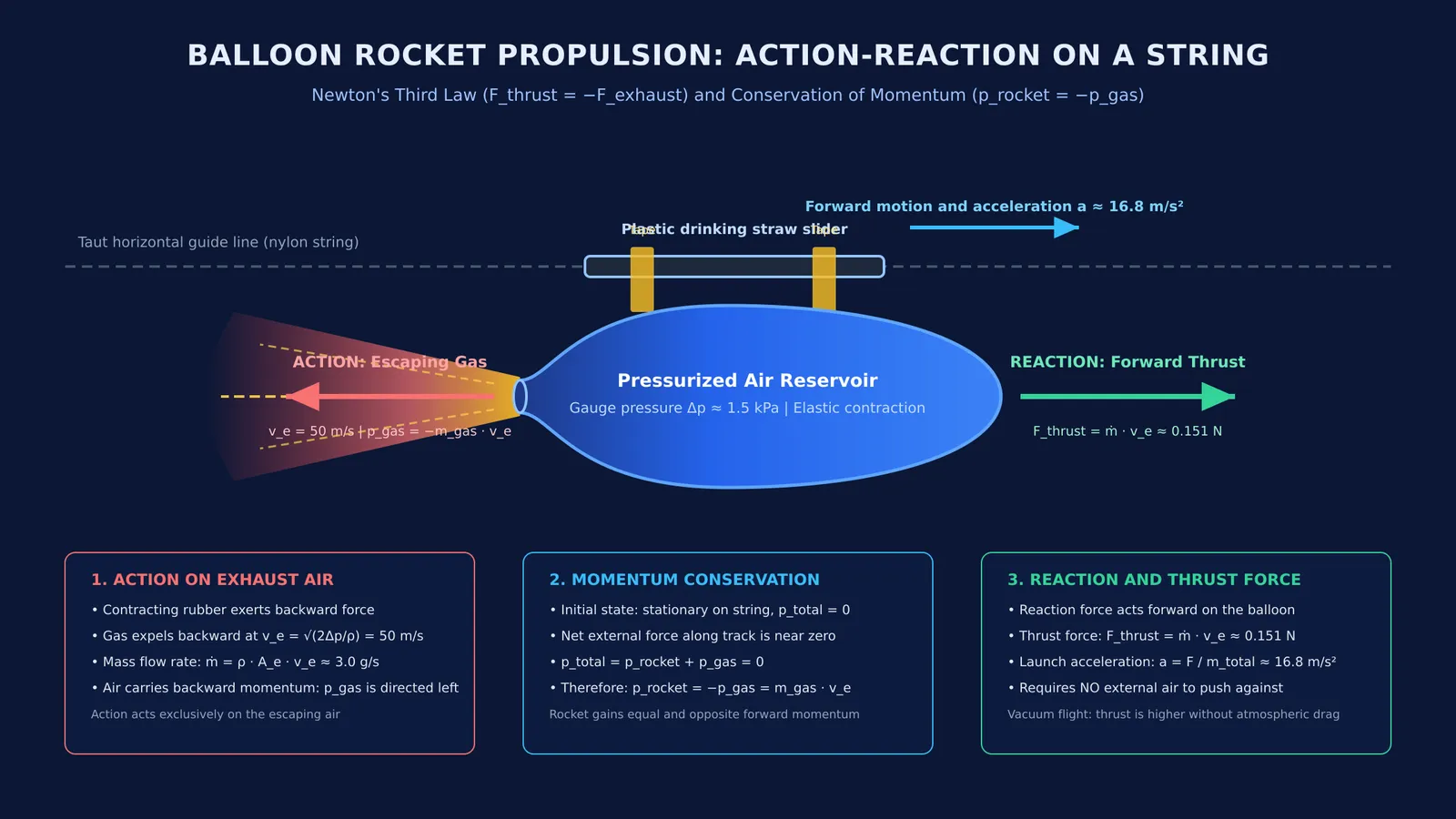
Inflating the balloon stretches its rubber walls, compressing the air molecules inside. When you release the nozzle, the elastic walls snap inward, exerting a backward force on the air and driving it out of the opening. That expulsion is the action.
Simultaneously, the exiting air exerts an equal and opposite forward reaction force—known as thrust—directly on the balloon membrane. In India, this activity is a core practical demonstration in the Class 9 laws of motion: friction, F = ma and action-reaction syllabus (NCERT Science). Because the action acts on the air and the reaction acts on the balloon, the two forces never cancel each other out.
How does momentum conservation explain rocket thrust?
You can also analyze the balloon rocket by treating the balloon, straw, and enclosed air as one combined system.
Before release, the assembly rests motionless on the string. Its initial velocity is zero, so system momentum is strictly zero: p_total = 0. Under the law of conservation of momentum, without an external horizontal force, this total cannot change.
When the nozzle opens, air escapes backward at exhaust velocity v_e, carrying negative momentum: p_gas = m_gas × (-v_e). To conserve total momentum, the remaining structure must gain equal positive momentum forward: p_rocket = m_rocket × v_rocket = - p_gas. This principle connects Newton's three laws of motion directly to propulsion.
According to the rocket thrust equation established by the NASA Glenn Research Center, total thrust equals:
F = m_dot × v_e + (p_e - p_0) × A_e
Here, m_dot is the exhaust mass flow rate, v_e is exhaust velocity, p_e is nozzle exit pressure, p_0 is ambient air pressure, and A_e is nozzle exit area. Because exit pressure rapidly matches room pressure, momentum thrust dominates: F ≈ m_dot × v_e.
Why doesn't the balloon rocket need outside air to push against?
A common classroom misconception is that rockets move by "pushing off" the surrounding air. Students often assume that without outside air to push against, a rocket cannot accelerate.
The balloon rocket disproves this intuition. Propulsion comes from expelling internal mass, not pushing against the environment. Outside air actually impedes flight through aerodynamic drag. In a vacuum, where ambient pressure p_0 drops to zero and drag vanishes, a balloon rocket would accelerate faster and glide farther. Real rockets use this exact mechanism to navigate outer space.
The balloon's elasticity adds another dynamic detail. In the *American Journal of Physics*, researchers D. R. Merritt and F. Weinhaus (American Journal of Physics, 1978) showed that balloon gauge pressure does not rise steadily with volume. Instead, it reaches a peak when the radius stretches to roughly 1.4 times its uninflated size, before dropping across moderate expansions. When you open the nozzle, the wide initial aperture and pressure difference produce a swift burst of exhaust.
When students struggle to visualize how internal pressure differentials generate net thrust without external resistance, interactive models help. The Fermi Simulation Lab provides interactive simulations for the ideas that are easier to see than to read, allowing learners to adjust nozzle diameters, track gas particle vectors, and observe thrust curves in real time.
How do you calculate the thrust and acceleration of a balloon rocket?
To connect theoretical equations to physical numbers, consider a standard classroom balloon rocket:
Mass: A latex balloon, straw, and tape have an empty dry mass of m_dry = 4.0 g (0.0040 kg). Inflated to a diameter of 20 cm (radius 0.10 m), the volume is V = (4/3) × π × (0.10)³ ≈ 0.00419 m³ (4.2 liters). At air density of 1.2 kg/m³ (NASA Glenn Research Center), the air mass is m_air = 0.0050 kg (5.0 g), giving a total launch mass of m_total = 0.0090 kg (9.0 g).
Exhaust velocity: At an internal gauge pressure of 1.5 kPa, or 1500 Pa (American Journal of Physics, 1978), Bernoulli's relation gives v_e = √(2 × Δp / ρ) = √(2 × 1500 / 1.2) = 50 m/s.
Mass flow rate and thrust: With an 8 mm nozzle diameter (area A_e ≈ 5.03 × 10⁻⁵ m²), the mass flow rate is m_dot = ρ × A_e × v_e ≈ 0.00302 kg/s (3.0 g/s). Propellant expels in Δt = m_air / m_dot ≈ 1.65 seconds, producing momentum thrust F_thrust = m_dot × v_e ≈ 0.151 N.
Applying Newton's second law, the initial forward acceleration is:
a = F_thrust / m_total = 0.151 N / 0.0090 kg ≈ 16.8 m/s²
This initial acceleration is nearly 1.7 times the acceleration due to gravity (g = 9.8 m/s²). Because mass drops by over 50% as air leaves, full trajectory analysis requires the calculus of variable mass systems and rocket thrust.
If you are working through mechanics problems where mass varies with time, the Fermi Problem Library offers worked problems with a step-by-step solver that explains the reasoning rather than printing an answer.
How can students test balloon rocket variables systematically?
To turn this demonstration into a quantitative experiment, students can isolate variables using classroom materials (NCERT Science):
Guide line friction: Compare rough cotton string against smooth monofilament nylon fishing line. Monofilament reduces kinetic friction between straw and track, extending flight distance significantly.
Nozzle diameter: Insert small straw segments of different diameters into the neck. A wide nozzle expels air quickly for high initial thrust, while a narrow nozzle throttles mass flow rate m_dot for a longer, steady glide.
Aerodynamic drag: Compare spherical party balloons against elongated airship balloons. Elongated shapes decrease frontal cross-sectional area, reducing air resistance drag (F_D = 0.5 × C_D × ρ × A × v²).
Payload mass: Tape 1-gram paper clips to the straw to observe how added inertia reduces acceleration, testing Newton's second law (a = F_net / m).
Recording distance and flight time across these variations gives you a complete empirical view of momentum conservation in action.


