

On this page
If you have three blocks and two strings, standard textbook methods tell you to draw three free-body diagrams, write three Newton's second law equations, and solve a mess of simultaneous algebra. It is easy to make a sign error and lose the entire problem.
But if the blocks move together, there is a much faster way. Taking the whole set of blocks as one body gives the acceleration fast; then isolating one block gives the tension or contact force. Mastering this switch is one of the most reliable ways to save time on physics exams.
Why do simultaneous equations slow you down?
When students first learn Newton's laws, they are taught to isolate every object. If a 5.0 kg block pulls a 3.0 kg block along a frictionless table, the standard method requires you to write `F - T = 5a` for the first block and `T = 3a` for the second. You then substitute the tension `T` from the second equation into the first to solve for the acceleration `a`.
This works perfectly well for two blocks. However, when an exam question introduces three blocks, pulleys, and friction, the algebraic substitution becomes overwhelming. Every new block adds another variable and another equation. The likelihood of a mathematical error grows with every step, and the actual physics gets lost in the algebra.
How does the system approach work?
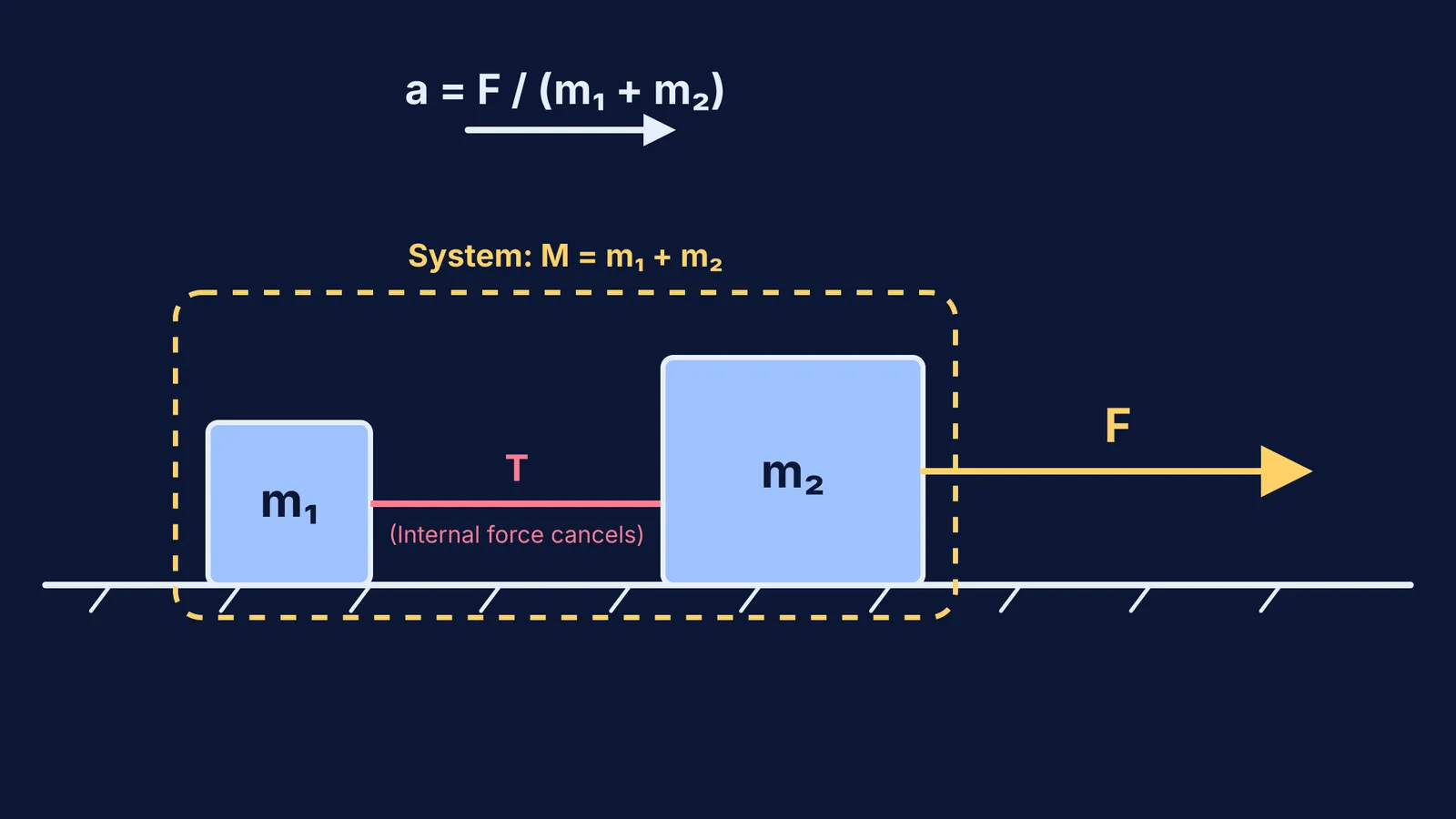
When blocks are connected by taut strings or rest flush against each other, they share the same magnitude of acceleration. Because they move as a single unit, you can mentally draw a dashed boundary around the whole group and treat it as one giant mass.
According to OpenStax University Physics Volume 1, the key is that internal forces—like the tension in the string connecting the blocks, or the normal force between touching boxes—cancel out when looking at the system as a whole. This is a direct consequence of Newton's third law: the string pulls block A forward just as hard as it pulls block B backward. Inside our dashed boundary, those two forces add to zero. Only external forces, such as gravity or an applied pull, matter.
To find the shared acceleration, you simply divide the net external force by the total mass of all the blocks. For example, in a classic Atwood machine with a 4.00 kg and a 2.00 kg mass hanging over a pulley, the net unbalanced force is the difference in their weights. The heavier mass pulls down with a force of 4.00 kg × 9.80 m/s², and the lighter mass resists with 2.00 kg × 9.80 m/s². The difference is an unbalanced force of 19.6 N.
Because both masses must accelerate together, the total mass being moved is 6.00 kg. Dividing the net force by the total mass (19.6 N / 6.00 kg) gives an acceleration of 3.27 m/s² in a single, direct calculation.
When do you need to isolate a block?
The system approach gives you the acceleration instantly, but it hides the internal forces. If an exam question specifically asks for the tension in the middle string or the contact force between two specific blocks, you cannot find it while treating everything as one body.
Once you have the system's acceleration, you must break the system apart and isolate a single block. You draw a new free-body diagram just for that piece. Since you already know its acceleration and its mass, you can plug those into Newton's second law (F = ma) to find the missing tension.
This is exactly the same logic used when you isolate the bob to find the simple pendulum string tension or isolate a body to find the tension of a monkey climbing a rope: you focus only on the object of interest and tally the forces directly acting on it.
What is the best plan for connected blocks?
Follow this checklist the next time you face a train of blocks or a complex pulley on a test:
Check the acceleration. Do the blocks share the same acceleration? If they are connected by a taut string or push directly against each other, they do.
Use the system approach. Treat them as one system to find acceleration: a = F_net / M_total. Ignore all the tensions and contact forces between them.
Read the question carefully. Decide if you actually need to find a tension or contact force. If the question only asks for acceleration, you are already finished.
Pick the easiest block. If you do need the tension, isolate the block at the very end of the train. The last block usually has the fewest forces acting on it, making the math much simpler.
Apply Newton's second law. Write F = ma for that single block to find the unknown force.
Mastering the switch between the system view and the isolated view will build your physics intuition and save you crucial minutes on test day. If you keep getting tangled in tension equations, the Fermi Problem Library has worked problems with a step-by-step solver that explains the reasoning rather than printing an answer.


