

On this page
Newton's third law is easy to recite and easy to misuse. The hard part is picking out which two forces actually belong together.
What makes two forces an action-reaction pair?
NCERT's Class 11 Physics textbook states the law plainly: "Force on a body A by B is equal and opposite to the force on the body B by A" (NCERT Class 11 Physics, Laws of Motion). The chapter adds that the two forces act at the same instant, that neither causes the other, and that they act on different bodies. That is why the forces of a pair never cancel each other (OpenStax University Physics, Newton's third law).
From those points, a true pair passes four checks:
Different bodies. One force acts on A, the other on B.
Same interaction. Both gravitational, both contact, both tension, and so on.
Equal at every instant. If you can picture a case where the two become unequal, they are not a pair.
Vanish together. Take one body away and both forces disappear at once.
Why are weight and normal force not a third-law pair?
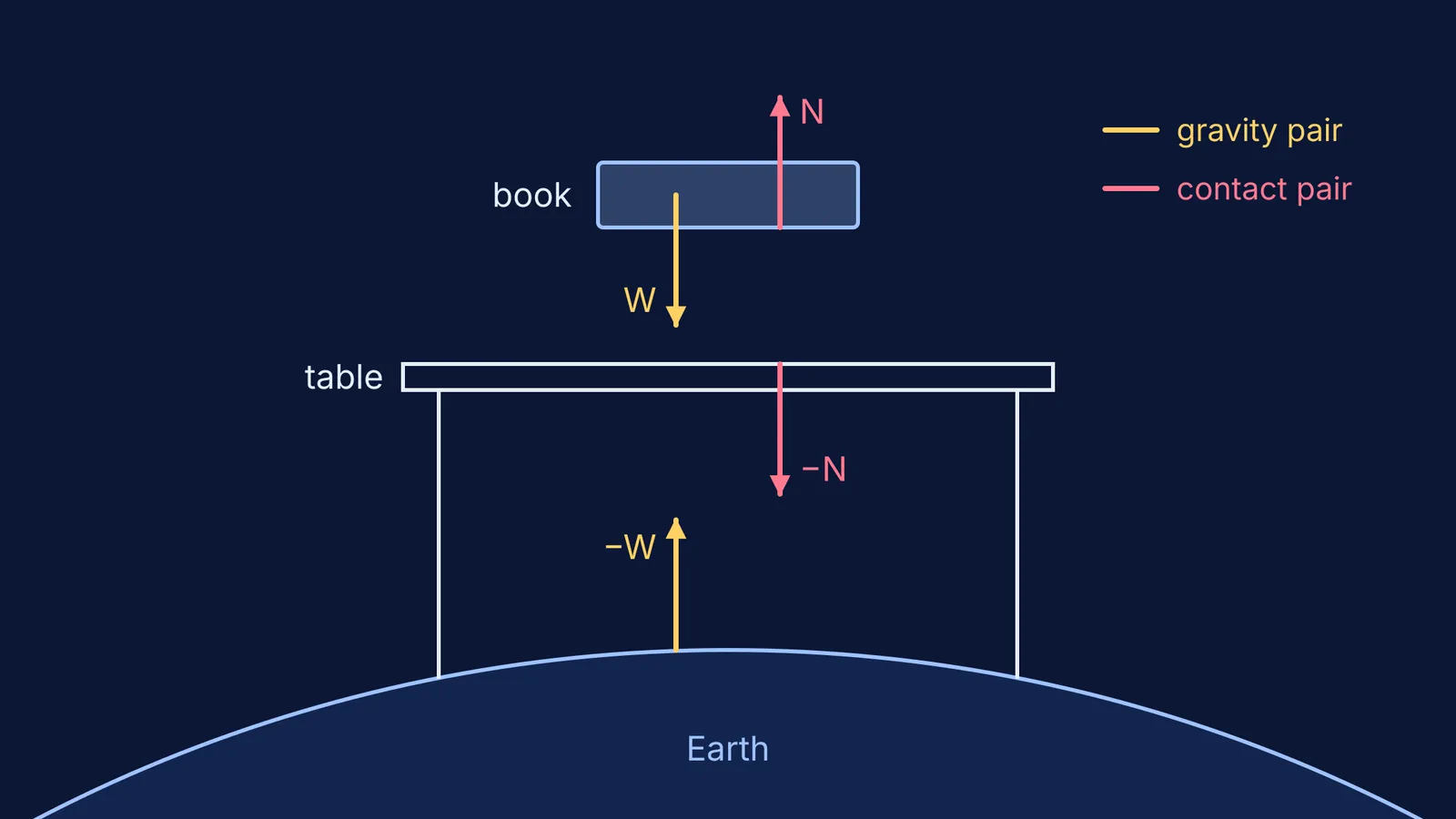
A book rests on a table. Two forces act on it: its weight W (on the book by Earth) and the normal force N (on the book by the table). They are equal and opposite, so many students call them a pair. Run the checks:
Both act on the book. Fails check 1.
One is gravity, the other is contact. Fails check 2.
Put the table in a lift that is accelerating upward: N grows, W does not. Fails check 3.
Slide the table away: N is gone, W stays. Fails check 4.
NCERT is explicit: two equal and opposite forces on the same body "can never constitute an action-reaction pair", and mg = R for a body on a table holds only in equilibrium and "has no connection with the third law" (NCERT, Laws of Motion). The partner of W is the book pulling Earth upward. The partner of N is the book pressing down on the table.
For the cases where N and mg part company, see when the normal reaction is not equal to mg. If contact forces themselves feel shaky, the Fermi Concept Library gives every physics concept its own lesson and its place in the map.
How does a horse pull a cart if the forces are equal?
The horse pulls the cart forward with a force T; the cart pulls the horse back with an equal T. So how does anything move? NCERT's exercise 4.23 asks a close cousin: explain why a horse cannot pull a cart and run in empty space (NCERT, Laws of Motion).
Check 1 answers it. The two T forces act on different bodies, so they never sit in the same equation. Try our own round numbers: a 400 kg horse, a 200 kg cart, 300 N of road resistance on the cart, both speeding up at 0.5 m/s².
Cart alone: T − 300 = 200 × 0.5, so T = 400 N.
Horse alone: the ground pushes its hooves forward with F, so F − 400 = 400 × 0.5, giving F = 600 N.
Whole system: 600 − 300 = 600 × 0.5. Both sides are 300 N, and T has dropped out because it is internal.
The horse speeds up because the ground pushes it forward harder than the cart pulls it back. That ground force is half of another pair: the hooves push the ground backward. In empty space there is nothing to push against. The same idea explains why friction on a car's driving wheels points forward.
Why do so many students get third-law pairs wrong?
Physicist David Hestenes reported that in a typical university physics course, nearly 80% of students could state Newton's third law at the start, yet Force Concept Inventory data showed fewer than 15% fully understood it at the end (Hestenes, American Journal of Physics, 1998). The inventory, a test of force concepts by Hestenes, Malcolm Wells and Gregg Swackhamer (The Physics Teacher, 1992), was written to avoid technical language. Hestenes argued that on exams students often respond to the form of the technical language rather than its meaning.
A five-step routine before any mechanics problem
Pick one body and circle it.
List every force on it as "on [body] by [agent]".
Write each partner by swapping the names.
Cross out every partner: each lands on a different body, so none belongs in this body's equation.
Only now write F = ma for the circled body.
To test your diagram, see how to check an AI-drawn free-body diagram. For practice, the Fermi Problem Library has worked problems with a step-by-step solver that explains the reasoning rather than printing an answer.
Tonight, run one problem you have already solved through these five steps. If a crossed-out force crept into your equation, you have found the mistake.


