

On this page
Many students memorise the formula N = mg when they first learn about forces. However, this is a special case, not a universal rule. The normal reaction is simply the force that stops an object from falling through a surface.
According to *University Physics Volume 1*, the normal force is defined as the component of the contact force perpendicular to the surface. It adjusts its magnitude to exactly balance whatever is pushing the object into the surface, up to the point where the surface breaks or yields.
Here are five common cases in JEE and NEET physics where the normal reaction is not equal to mg.
1. When is normal reaction not equal to mg on an incline?
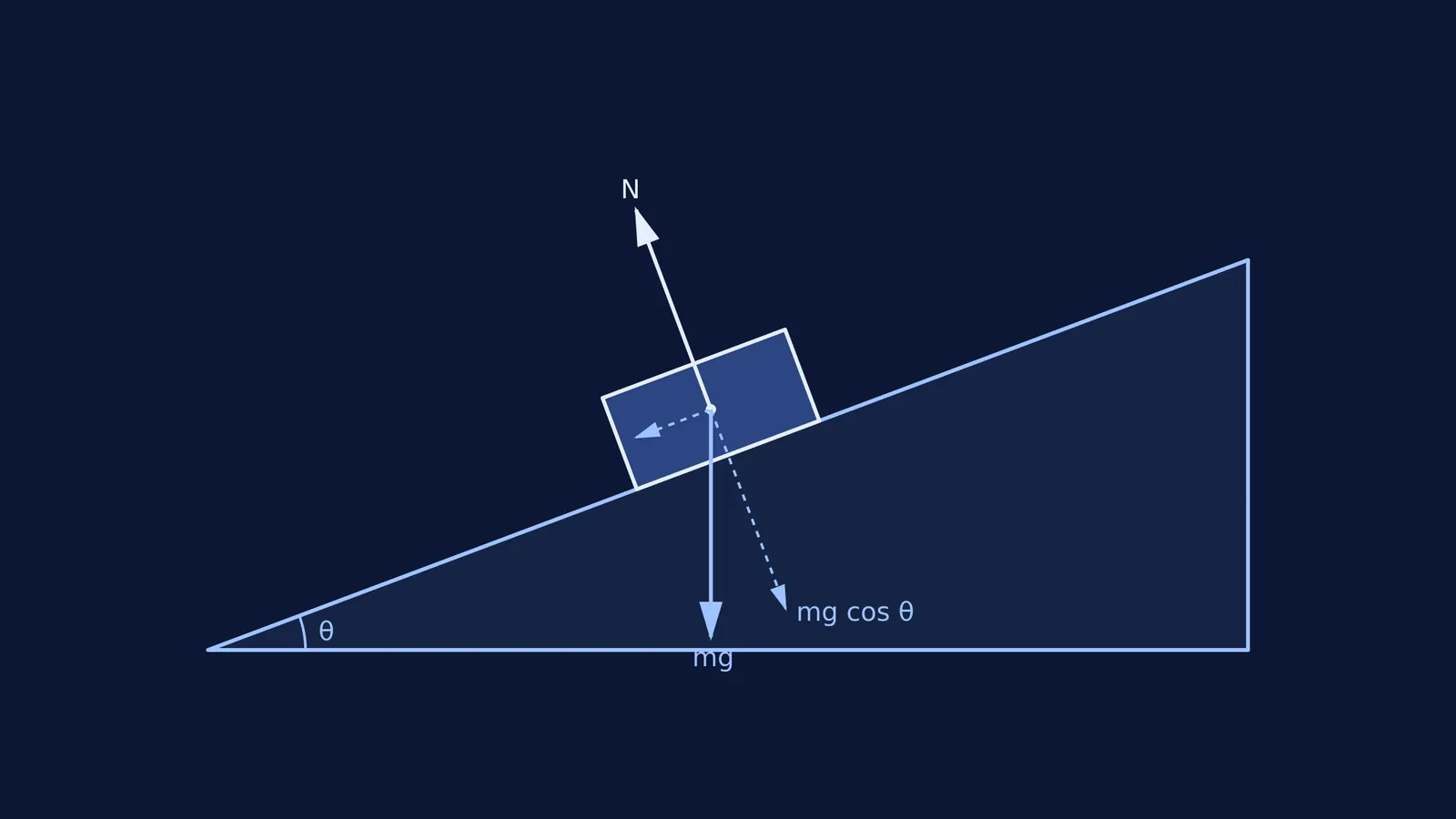
When an object rests on an inclined plane at an angle θ, gravity pulls it straight down, but the surface is tilted. The normal force only needs to balance the component of gravity that pushes into the surface.
By resolving the weight (mg) into components parallel and perpendicular to the incline, the perpendicular component is mg cos θ. Because there is no acceleration perpendicular to the incline, the normal force must exactly balance this component: N = mg cos θ
Since cos θ is less than 1 for any tilt, the normal reaction on an incline is always less than the object's weight. You can see how this affects sliding in our guide to the time for a block to slide down a rough incline.
2. How does an angled pull or push affect normal force?
If you pull a block across a flat floor with a string angled upwards, you are lifting some of its weight off the floor. If the tension is T at an upward angle θ, it has a vertical component T sin θ.
Balancing the vertical forces: N + T sin θ = mg N = mg - T sin θ
The normal reaction decreases. This is why it is easier to pull a lawnmower than to push it. If you push downward at an angle θ, your push adds to the vertical load, making N = mg + F sin θ, which increases the normal force (and thus friction).
3. How does acceleration in a lift change normal reaction?
When you stand in a lift, the floor pushes up on you. This upward push is the normal reaction, and it is what a weighing scale actually measures (your apparent weight).
If the lift accelerates upwards with acceleration a, the net force must be upwards. N - mg = ma N = m(g + a) The normal reaction is greater than mg, so you feel heavier.
If the lift accelerates downwards: mg - N = ma N = m(g - a) The normal reaction is less than mg. If the lift is in free fall (a = g), then N = 0, leading to weightlessness.
4. What is the normal force during circular motion?
When an object travels over a curved surface, it is accelerating towards the centre of the curve. This centripetal acceleration changes the required normal force.
Consider a car driving over a convex hump (like a speed bump) of radius r at speed v. At the top of the hump, gravity pulls down and the normal force pushes up. The net force must provide the centripetal acceleration v²/r downwards: mg - N = mv²/r N = mg - mv²/r
The normal force is less than mg. If the car goes too fast, N drops to zero and the car loses contact with the road. We explain this further in our post on a car over a hump.
5. Is there a normal force on a vertical wall?
Sometimes gravity plays no role in the normal reaction at all. If you press a book against a vertical wall with a horizontal force F, gravity pulls the book down (resisted by friction), while your push is horizontal.
The normal force from the wall acts horizontally to balance your push: N = F
Here, N depends entirely on how hard you push, not on the book's mass. This is also true for the contact force between blocks pushed together on a smooth floor.
How do you find the correct normal reaction?
Whenever you face a mechanics problem, follow these steps to find N:
Draw a free-body diagram showing all forces on the object.
Choose a coordinate system where one axis is perpendicular to the surface.
Resolve all forces into components along these axes.
Apply Newton's second law perpendicular to the surface. If the object isn't sinking into or flying off the surface, the net force in this direction is zero (or mv²/r if the surface is curved).
If you are stuck on setting up these force equations, the Fermi Problem Library has worked problems with a step-by-step solver that explains the reasoning rather than printing an answer. You can also use the Fermi Concept Library to find every concept in physics, chemistry, biology, mathematics and computing, each with its own lesson and its place in the map.


