

On this page
This is one of the first Laws of Motion problems where the answer depends on how you move, not just how heavy you are. Hanging still, a rope only has to hold your weight. Speed up as you climb, and it has to do more.
Why does the rope pull harder when you accelerate upward?
Only two forces act on the climber: the rope pulls up with tension T, and gravity pulls down with weight mg. Newton's second law says the net force equals mass times acceleration.
For an object accelerating upward, the net force is the supporting force minus the weight, so the support must equal ma + mg (OpenStax University Physics, section 6.1). Taking up as positive:
T − mg = ma
so T = m(g + a)
The same OpenStax section notes that at constant velocity, a = 0, the support simply equals the weight. That is why, in this simple model, climbing at a steady speed is no harder on the rope than hanging still.
You pull down on the rope with your hands, and by Newton's third law the rope pulls up on you with the same force. If you are unsure which forces pair up, our guide to identifying action-reaction pairs walks through the checks.
What is the maximum acceleration before the rope breaks?
A rope fails when the tension it must supply passes its breaking strength, T_max. Set m(g + a) ≤ T_max and solve for a:
a_max = T_max/m − g
It also gives you a sanity check: if T_max is less than mg, a_max comes out negative, and the rope cannot even hold you still.
Worked example: the 40 kg monkey and the 600 N rope
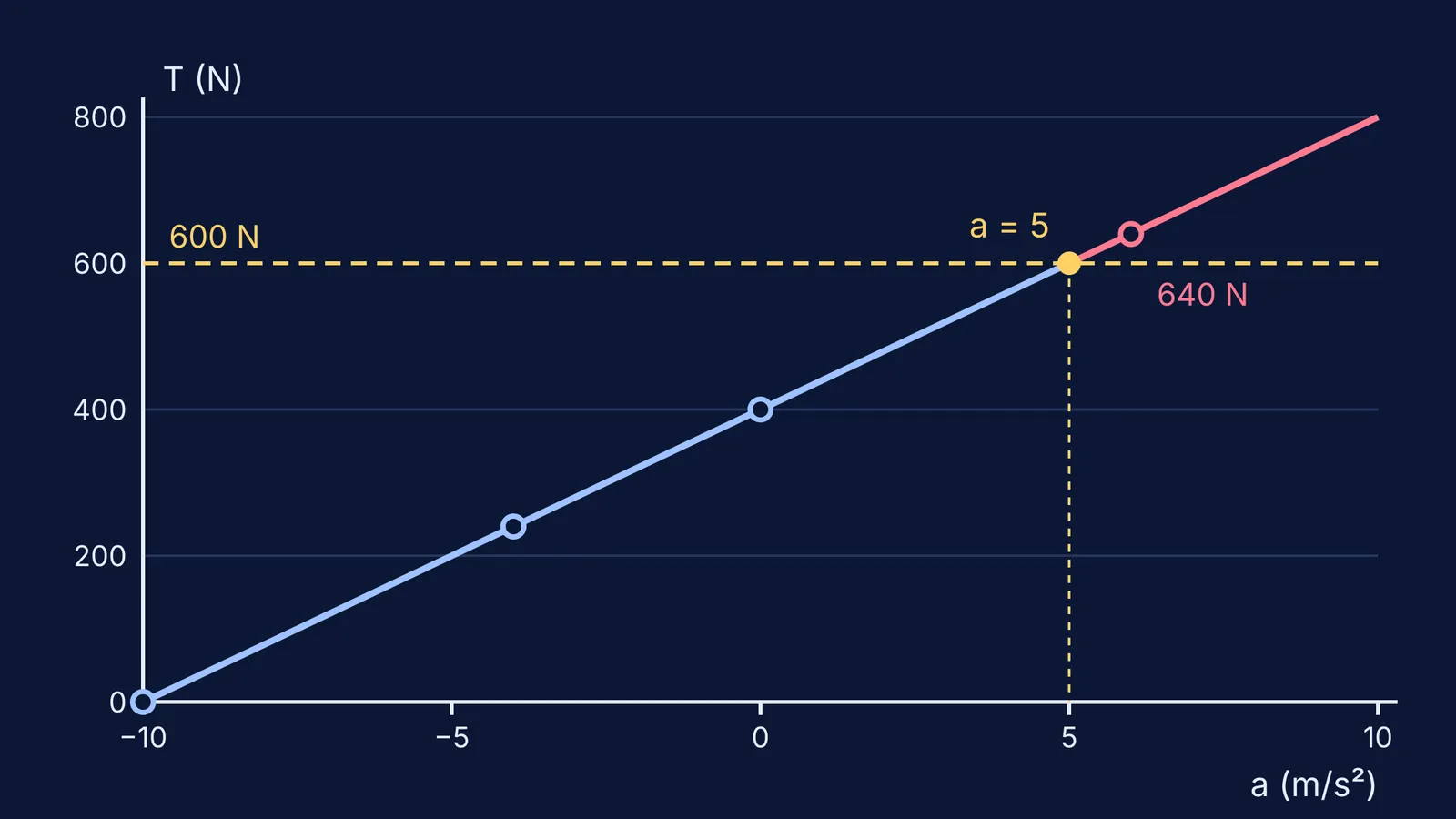
A long-running NCERT exercise asks about a monkey of mass 40 kg on a rope that can stand a maximum tension of 600 N, in four cases: climbing up at 6 m/s², climbing down at 4 m/s², climbing up at a uniform 5 m/s, and falling nearly freely (question and answer, Careers360). Take g = 10 m/s², as the NCERT Class 11 Laws of Motion chapter asks you to for its exercises.
Climbing up at 6 m/s²: T = 40 × (10 + 6) = 640 N. That is more than 600 N, so the rope breaks.
Climbing down at 4 m/s²: T = 40 × (10 − 4) = 240 N. Safe.
Climbing up at a steady 5 m/s: a = 0, so T = 40 × 10 = 400 N. Safe. The 5 is a speed, not an acceleration; this is the trap.
Falling nearly freely: a = g downward, so T = 40 × (10 − 10) = 0 N. Safe, though not for the monkey.
The question the textbook does not ask: how fast can the monkey speed up? a_max = 600/40 − 10 = 15 − 10 = 5 m/s². Anything above 5 m/s² upward snaps this rope, which is why 6 m/s² fails.
The monkey question is not in the current reprint of that NCERT chapter, but two exercises there use the same tools: 4.13, a 70 kg man on a weighing scale in a lift, and 4.21, a stone whirled on a string that can withstand a maximum tension of 200 N (NCERT keph104). In the lift, the scale reading plays the part of rope tension. Our post on a coin dropped in an accelerating lift uses the same "effective g" idea from another angle.
Where do students lose marks on rope-climbing questions?
Mixing speed and acceleration. A uniform speed means a = 0, whatever the number.
Flipping the sign. Accelerating upward adds to g; accelerating downward subtracts. Slowing down while going up counts as downward acceleration.
Forgetting the rope's own mass. If the rope is heavy and hangs from the ceiling, the top must also hold the rope below it, so tension is largest there. Our explainer on when tension changes along a string shows how.
Skipping the diagram. OpenStax says a free-body diagram is essential to solving problems like this, and it is where most sign errors get caught (OpenStax).
How can you practise this until it is automatic?
Try three variations on your own: a 50 kg climber on an 800 N rope (answer: 6 m/s²), the same climber slowing down while climbing up, and a 60 kg climber on a 500 N rope (no safe way to hang still). If you get stuck on a step, the Fermi Problem Library has worked problems with a step-by-step solver that explains the reasoning rather than printing an answer. If the gap is the idea itself, the Fermi Concept Library covers every concept in physics, each with its own lesson and its place in the map.


