

On this page
When a JEE question says "light string" and "smooth pulley", those words let you write one T for the whole string. Remove either and you may need two tensions, or one that changes from point to point.
Why is tension the same throughout an ideal string?
Tension is "a pulling force that acts along a stretched flexible connector, such as a rope or cable", in the words of OpenStax University Physics. Imagine cutting the string at any point: the two pieces pull on each other with equal and opposite forces, and that pair is the tension at that point.
Now take any short piece of the string. The net force on it, tension difference plus weight, must equal mass times acceleration. With zero mass, weight and mass times acceleration both vanish, so the two tensions are equal even while the string accelerates. OpenStax applies it to the Atwood machine: "Since the string and the pulley have negligible mass, and since there is no friction in the pulley, the tension is the same throughout the string."
When is tension different in the same string?
Three things break the rule.
The string has mass. A heavy piece of rope that accelerates, or holds up rope below it, needs a tension difference across it. In MIT OpenCourseWare's 8.01 notes (Example 8.4), a uniform rope of mass M and length L hanging from a ceiling has tension T(y) = Mg(1 − y/L) at a distance y below the ceiling: Mg at the top, zero at the free end.
The pulley has mass. A heavy pulley needs a net torque to change its spin; with a smooth axle and no slipping, only the two tensions supply it, so T₁ and T₂ must differ. American Journal of Physics papers by de Oliveira and Lemos (2018) and Durian, Kroll and Mele (2021) analyse where the string touches a heavy pulley; the first shows the pulley behaves as if the end tensions act on it, the model used below.
The string rubs on a surface. For a rope wrapped round a fixed drum and about to slip, the same MIT notes (Example 8.11, the capstan) derive T_B = T_A e^(−μθ), where μ is the coefficient of static friction and θ the angle of wrap in radians.
How does a heavy pulley change the tension?
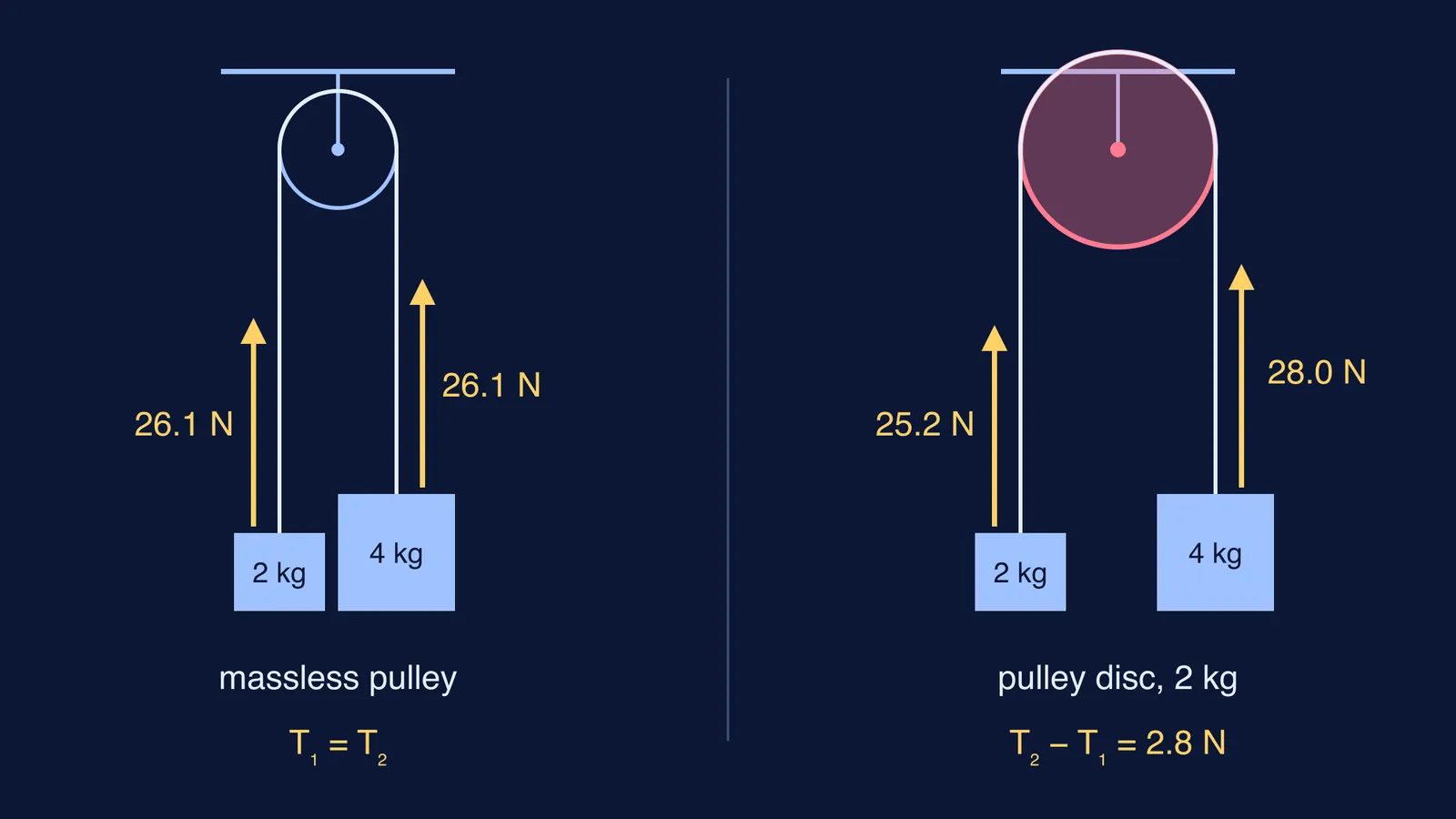
Start with the OpenStax Atwood machine: blocks of 2.00 kg and 4.00 kg over a massless, frictionless pulley give a = 3.27 m/s² and T = 26.1 N on both sides (OpenStax).
Now make the pulley a uniform disc of mass M = 2 kg (moment of inertia ½MR²), with the string not slipping and g = 9.8 m/s².
Lighter block, rising: T₁ − 2g = 2a.
Heavier block, falling: 4g − T₂ = 4a.
Pulley: (T₂ − T₁)R = ½MR² × (a/R), so T₂ − T₁ = (M/2)a = 1 × a.
Add all three: 2g = (2 + 4 + 1)a, so a = 19.6/7 = 2.8 m/s².
Then T₁ = 2(9.8 + 2.8) = 25.2 N and T₂ = 4(9.8 − 2.8) = 28.0 N.
Same string, two tensions, and the gap spins the pulley. Set M = 0 and both return to 26.1 N. For more set-ups, see Atwood machine problems and three common variations.
What about a heavy rope or a rough rod?
Heavy rope: a 2 kg block hangs from a 1 kg uniform rope fixed to the ceiling. Each point holds up the block plus the rope below (the MIT notes method), so tension is 29.4 N at the top and 19.6 N at the block. This varying tension is why a wave pulse speeds up as it climbs; see how long a pulse takes to climb a hanging rope.
Friction: a rope makes a half turn (θ = π) over a fixed rough rod with μ = 0.3. Using the capstan result from the MIT notes, e^(0.3π) ≈ 2.57, so 10 N on one side can hold about 25.7 N on the other before slipping.
How do you know which case a question is?
Read the wording first:
Light string, smooth pulley, no pulley mass given: one T for that string.
Pulley mass or moment of inertia given: T₁ ≠ T₂; add a torque equation.
Rope mass given: tension varies with position; cut the rope and draw a free-body diagram for one piece.
Rope over a rough peg or post: use T_B = T_A e^(−μθ) at slipping.
A block tied partway along: two strings, two tensions, as in which string is tightest when three blocks are pulled in a row.
If you keep writing one T where a question needs two, the Fermi Problem Library has worked problems with a step-by-step solver that explains the reasoning rather than printing an answer. If moment of inertia feels shaky, the Fermi Concept Library gives each concept its own lesson.
Read "light string, smooth pulley" as a promise of one tension; anything heavier or rougher, and the string can disagree with itself.


