

On this page
When three connected blocks sit in a row on a smooth horizontal surface and a force pulls them forward, which string is under the most tension? Students in Class 11 physics and JEE preparation often guess that tension is equal across all strings, or that the string between the two heaviest blocks experiences the greatest pull. Neither intuition is correct.
Which string carries the most tension when pulled?
Consider three blocks of masses m₁, m₂, and m₃ connected by two light, inextensible strings on a frictionless horizontal plane. A horizontal force F pulls block m₃ forward, dragging block m₂ and block m₁ along behind it.
Because the strings do not stretch, all three blocks share the same common acceleration. According to OpenStax University Physics, applying Newton's second law to the entire system yields:
a = F / (m₁ + m₂ + m₃)
To find the tension in each string, isolate each block using a free-body diagram:
Trailing block (m₁): Only String 1 pulls it forward, giving T₁ = m₁ × a.
Middle block (m₂): String 2 pulls forward while String 1 pulls back, giving T₂ − T₁ = m₂ × a, so T₂ = (m₁ + m₂) × a.
Leading block (m₃): The external force pulls forward while String 2 pulls back, giving F − T₂ = m₃ × a.
Each string's tension equals the total mass trailing behind it multiplied by the common acceleration. String 1 accelerates only block m₁, whereas String 2 must accelerate both m₁ and m₂. Because masses are positive, String 2 is always tighter than String 1.
How does changing the block order alter string tension?
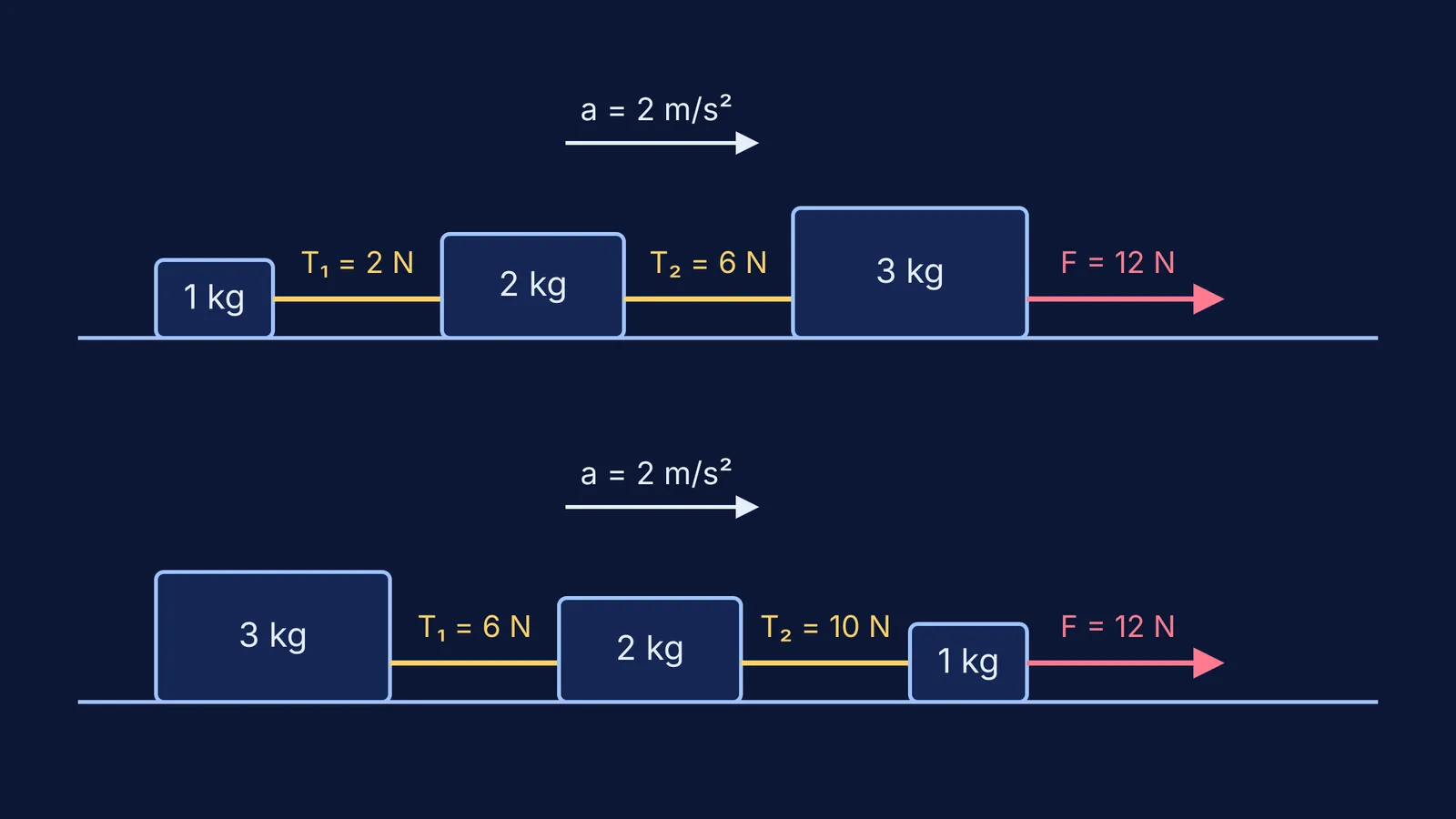
What happens if you keep the same three masses but rearrange their sequence? Suppose the blocks have masses of 1 kg, 2 kg, and 3 kg, pulled by a horizontal force of F = 12 N across a frictionless surface. The total mass is 6 kg, producing an acceleration of a = 12 N / 6 kg = 2 m/s² (OpenStax).
Comparing two arrangements shows a dramatic difference in internal forces:
Lightest block trailing (1 kg, 2 kg, 3 kg): String 1 hauls only the 1 kg mass, giving T₁ = 1 kg × 2 m/s² = 2 N. String 2 hauls 3 kg (1 kg + 2 kg), giving T₂ = 3 kg × 2 m/s² = 6 N, or exactly 50% of the 12 N pulling force (OpenStax).
Heaviest block trailing (3 kg, 2 kg, 1 kg): String 1 now hauls 3 kg, giving T₁ = 3 kg × 2 m/s² = 6 N. String 2 hauls 5 kg (3 kg + 2 kg), giving T₂ = 5 kg × 2 m/s² = 10 N, carrying over 83% of the 12 N pulling force (OpenStax).
The acceleration remains 2 m/s² in both arrangements because the total mass and pull are unchanged (OpenStax). However, placing heavier masses at the rear forces the connecting strings to transmit far more tension to keep the entire line accelerating together.
Why does passive observation fail to teach connected forces?
Physics education researchers have studied why connected-body dynamics mislead students. A study by McDermott, Shaffer, and Somers (1994) in the *American Journal of Physics* found that introductory students frequently confuse internal and external forces, treating tension as an independent property transmitted intact rather than an internal reaction force. Research by Flores-García et al. (2010) in the same journal confirmed that students often rely on proximity heuristics instead of free-body diagrams.
Passive viewing rarely fixes these errors. In an active-learning study in the *American Journal of Physics*, Crouch, Fagen, Callan, and Mazur (2004) showed that students who passively observed demonstrations explained underlying concepts correctly only 24% of the time—scarcely distinguishable from the 22% rate among students who saw no demonstration at all. However, when students committed to a prediction beforehand, correct physical outcome recognition rose to 77% (and 82% with peer discussion, up from 70% for passive observers), while fully correct conceptual explanations reached 30% (and 32% with peer discussion) (Crouch et al., 2004). For more on visual representations, explore our review of simulations compared to static diagrams.
How does testing in a simulation build intuition?
Predicting tension values before running an experiment turns equations into physical insight. In the Fermi Simulation Lab, you can configure three connected blocks on a digital track, adjust their masses, and apply different pulling forces.
As the blocks accelerate, real-time vector arrows and numerical tension displays confirm how each string responds. Dragging heavier masses to the rear visibly increases the tension gauges. For structured practice with free-body diagrams, the Fermi Problem Library offers worked problems with a step-by-step solver that explains the reasoning rather than printing an answer.
A 4-step framework for solving connected block problems
When solving train-of-blocks problems on physics exams, use this four-step checklist:
Find common acceleration first: Sum the masses to find M = m₁ + m₂ + m₃, then compute a = F / M.
Cut at the string of interest: Imagine cutting the string you need to find and isolate the trailing section.
Sum the trailing mass: Multiply that trailing mass by the acceleration: T = m_trailing × a.
Check the tension gradient: Verify that tension increases as you move from the rear block toward the pulling force.


