

On this page
Flick the bottom of a rope hanging from a hook and a small kink runs upward. It starts slowly and gets faster as it climbs, because the rope is pulled tighter higher up. That idea turns a familiar formula into a short calculus problem, and it has appeared in JEE Main more than once.
Below: the derivation, a shortcut that skips the integral, and the block-at-the-bottom version with real exam numbers.
Why does the pulse speed up as it climbs?
The speed of a transverse wave on a string is v = √(T/μ), where T is the tension and μ is the mass per unit length, as derived in OpenStax University Physics, section 16.3. On a hanging rope, T is not the same everywhere.
Take a point at height y above the free end. The rope below that point has mass μy, and the rope above has to hold it up, so the tension there is T = μgy. Put that into the wave-speed formula and μ cancels:
v = √(μgy / μ) = √(gy)
So the speed is zero at the free end and √(gL) at the top. For a refresher on why tension and density set the speed, see our post on wave speed in a wire from stress and density.
How do you get t = 2√(L/g)?
You cannot divide length by one speed, so cut the rope into small pieces:
In a short length dy, the pulse takes dt = dy / v = dy / √(gy).
Add up all the pieces from y = 0 to y = L: t = (1/√g) × ∫ y^(-1/2) dy.
The integral of y^(-1/2) is 2√y, so t = (1/√g) × 2√L.
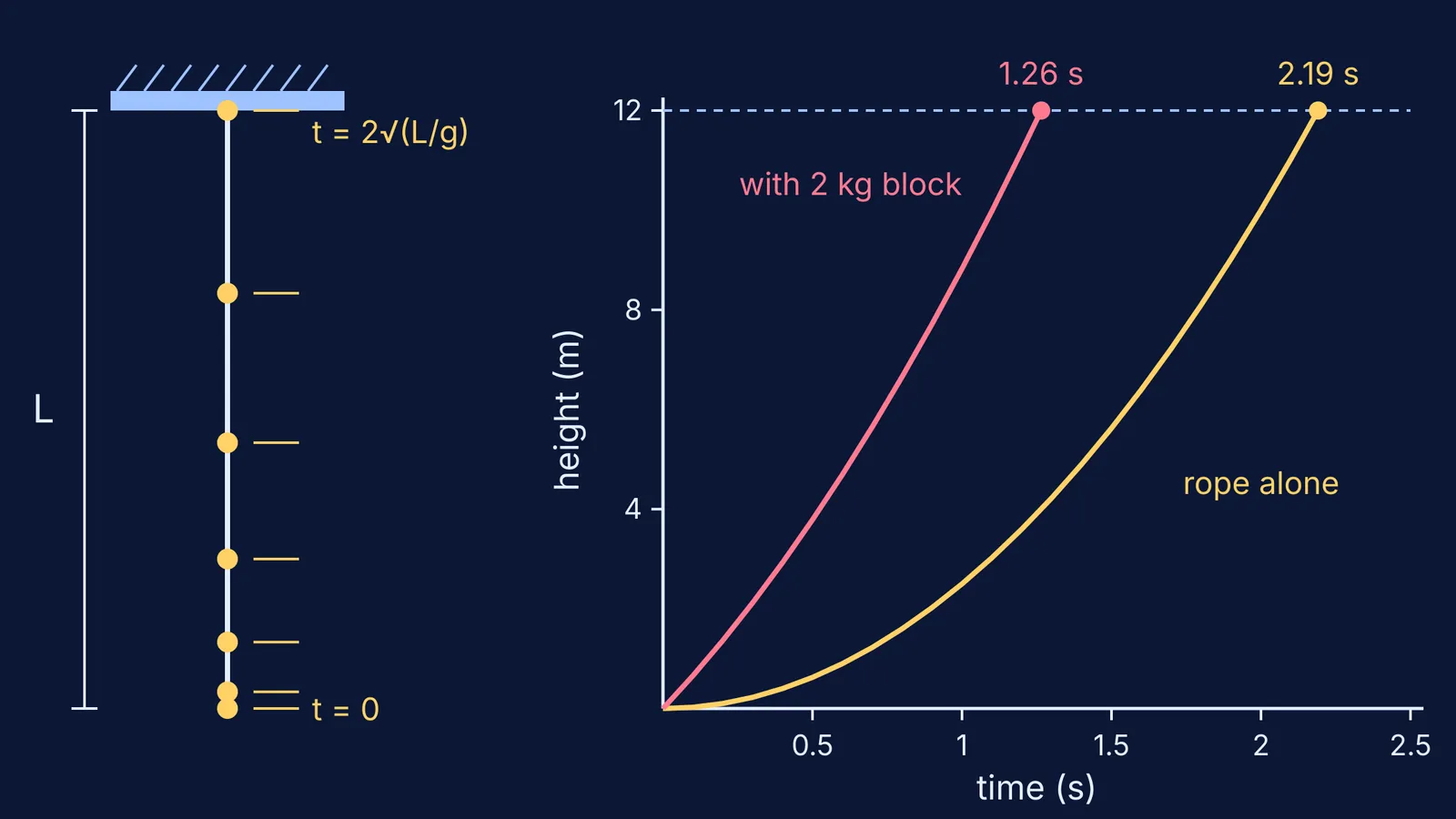
So t = 2√(L/g).
There is a second way to see it with no integral. Compare v² = gy with the kinematics equation v² = 2as. They match if a = g/2. So the pulse climbs exactly like a ball starting from rest with a constant acceleration of g/2. Then L = ½(g/2)t², which gives t = 2√(L/g) again.
This exact question was set in JEE Main 2016 (offline paper, 3 April): a 20 m string, a pulse started at the lowest end, g = 10 m/s². The formula gives t = 2√(20/10) = 2√2 s, about 2.83 s.
What changes if a block hangs at the bottom?
Now hang a block of mass M from the free end of a rope of mass m and length L. Every point now carries the block as well as the rope below it, so at height y the tension is T = (M + my/L)g, with μ = m/L. The speed becomes:
v = √(g(ML/m + y))
The pulse now starts with a real speed, √(MgL/m), instead of zero. Doing the same integral from y = 0 to y = L gives:
t = 2√(L/(mg)) × (√(M + m) − √M)
Check it: M = 0 gives back 2√(L/g). The g/2 shortcut still works, because v² still grows by g times the height climbed. The pulse always accelerates at g/2, so t = 2(v at top − v at bottom)/g.
JEE Main on 3 September 2020 (Shift 1) used a 12 m rope of mass 6 kg with a 2 kg block at its free end. Take g = 10 m/s² and work it through:
Mass per metre: μ = 6/12 = 0.5 kg/m.
Bottom: T = 2 × 10 = 20 N, so v = √(20/0.5) = √40 ≈ 6.32 m/s.
Top: T = (2 + 6) × 10 = 80 N, so v = √(80/0.5) = √160 ≈ 12.65 m/s.
Shortcut: t = 2(12.65 − 6.32)/10 ≈ 1.26 s.
Full formula: t = 2√(12/60) × (√8 − √2) = 2√0.4 ≈ 1.26 s. Both agree.
Without the block, the same rope gives 2√(12/10) ≈ 2.19 s. The block speeds the whole journey up.
That 2020 question asked about wavelength. The frequency is fixed at the source, so as the speed doubles, the wavelength doubles: a 6 cm wave train arrives at the top as 12 cm. It helps to keep wave speed and particle speed apart; see particle velocity vs wave speed.
Which mistakes cost marks on this problem?
Using one speed for the whole rope, worked out from the tension at the top or the bottom.
Adding the block's weight only at the bottom. It adds Mg to the tension at every height.
Expecting a heavier rope to be slower. With no block, μ cancels completely.
To test your feel for tension and speed, try our quick test on wave speed and string tension. For more practice, the Fermi Problem Library has worked problems with a step-by-step solver that explains the reasoning rather than printing an answer. If v = √(T/μ) itself feels shaky, the Fermi Concept Library gives each physics concept its own lesson.


