

On this page
When you pluck a guitar string or stretch a wire between two clamps, the speed of the transverse wave travelling along it depends on how tight and how heavy the wire is. The standard formula involves tension and linear density, but exam questions frequently frame this in terms of the material's stress and volume density instead.
Let us break down how you get from the standard formula to the stress-based one, and why it means that a thick wire and a thin wire can sometimes carry waves at the exact same speed.
What is the formula for the speed of a transverse wave in a wire?
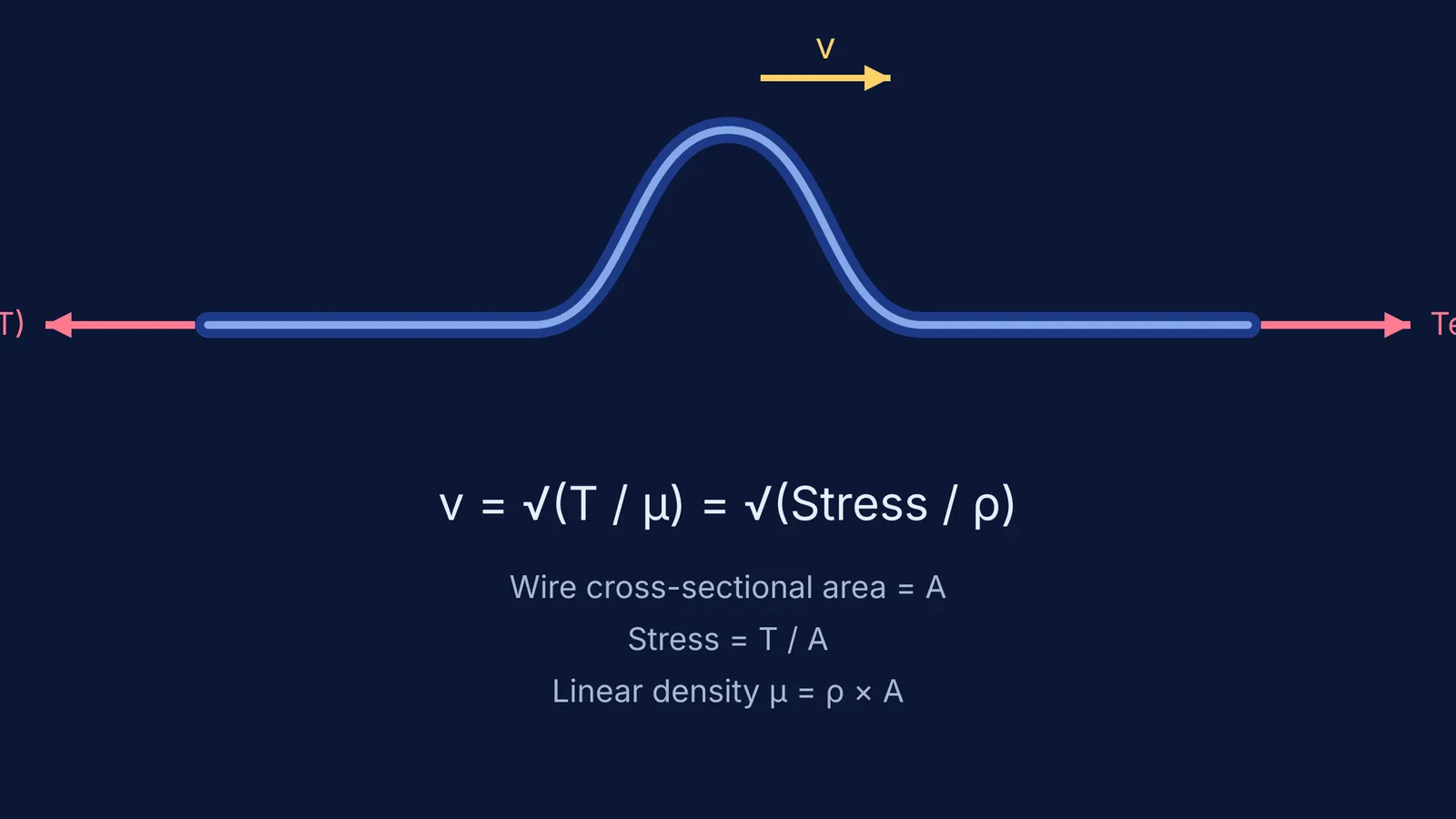
According to University Physics, the speed of a mechanical wave through a medium depends on the square root of an elastic property divided by an inertial property. For a stretched string or wire, this gives us the standard wave speed formula:
v = √(T / μ)
Here, T is the tension applied to the wire, and μ is the linear mass density (the mass of the wire per unit of length).
If you are studying for exams like JEE or NEET, remembering the physical meaning of these variables is critical. Tension provides the restoring force that pulls displaced particles back to the centre, while the linear mass density provides the inertia that resists that change in motion.
How do you rewrite the wave speed using stress and density?
Often, you will be given the properties of the material itself rather than the tension and the mass per unit length. We can rewrite the wave speed formula by substituting the definitions of tensile stress and volume density.
First, consider the tensile stress on the wire. Stress is defined as the deforming force per unit area. Since the force pulling the wire is the tension (T), we can write:
Stress = T / A
Rearranging this gives us the tension in terms of stress and the cross-sectional area (A):
T = Stress × A
Second, consider the mass of the wire. The average density (ρ) of a substance is defined as its mass (m) per unit volume (V). For a wire of length L and constant cross-sectional area A, the volume is V = A × L.
The linear mass density (μ) is m / L. We can rewrite the mass as m = ρ × A × L. Therefore:
μ = (ρ × A × L) / L = ρ × A
Now, substitute both T and μ back into our original wave speed equation:
v = √((Stress × A) / (ρ × A))
The cross-sectional area (A) cancels out perfectly, leaving:
v = √(Stress / ρ)
If you find these algebraic substitutions tricky to follow, the Fermi Concept Library contains every concept in physics, chemistry, biology, mathematics and computing, each with its own lesson and its place in the map.
Why do wires of the same material under the same stress carry waves at the same speed?
The formula v = √(Stress / ρ) reveals a surprising physical truth: the wave speed does not depend on the cross-sectional area of the wire.
If you take two steel wires — one very thin and one very thick — they both share the same density (ρ). If you stretch both wires so that they experience the exact same tensile stress, the value of Stress / ρ is identical for both. Therefore, a transverse wave will travel at the exact same speed in both wires.
The thick wire requires a much larger tension (T) to reach that same stress, but its larger mass exactly balances out the extra tension, keeping the wave speed constant.
Practice problem: finding the transverse wave speed from stress
Let us put this formula into practice with a textbook-style problem: An iron wire has a density of 7860 kg/m³. It is subjected to a tensile stress of 3.144 × 10⁸ N/m². What is the speed of a transverse wave in the wire?
Check the units: Density is in standard SI units (kg/m³), and stress is in Pa or N/m². No conversions are needed.
Apply the formula: v = √(Stress / ρ)
Substitute the values: v = √(3.144 × 10⁸ / 7860)
Simplify the fraction: v = √(40000)
Calculate the square root: v = 200 m/s.
The wave travels at 200 m/s.
If you get stuck on questions that mix properties of solids with wave mechanics, the Fermi Problem Library has worked problems with a step-by-step solver that explains the reasoning rather than printing an answer.


