

On this page
A wave on a string carries a shape from one end to the other, but no piece of string travels with it. Each bit only moves up and down. Class 11, JEE Main and JEE Advanced waves questions ask for both speeds, and mixing them up costs marks. Here is how to get one from the other, plus a sign rule and a worked example.
What is the difference between particle velocity and wave velocity?
OpenStax University Physics, section 16.2 states it plainly: the wave speed is the speed of the wave as it moves through the medium, not the speed of the particles that make up the medium.
Wave velocity (v) is how fast the shape moves along x. For y = A sin(kx − ωt) it is v = ω/k, and it stays the same everywhere along the string.
Particle velocity (v_y) is how fast one point of the medium moves about its rest position. It is the time derivative ∂y/∂t = −Aω cos(kx − ωt), so it changes from point to point and moment to moment.
The largest particle speed is Aω, according to the same OpenStax section.
For a transverse wave the two are at right angles. If y = A sin(kx − ωt) feels unfamiliar, start with our guide to reading the travelling wave equation step by step.
How do you get particle velocity from the wave equation?
Any wave moving in the +x direction at speed v can be written as y = f(x − vt), whatever its shape. Take two partial derivatives using the chain rule:
∂y/∂t = −v f′(x − vt)
∂y/∂x = f′(x − vt)
The f′ is the same in both, so:
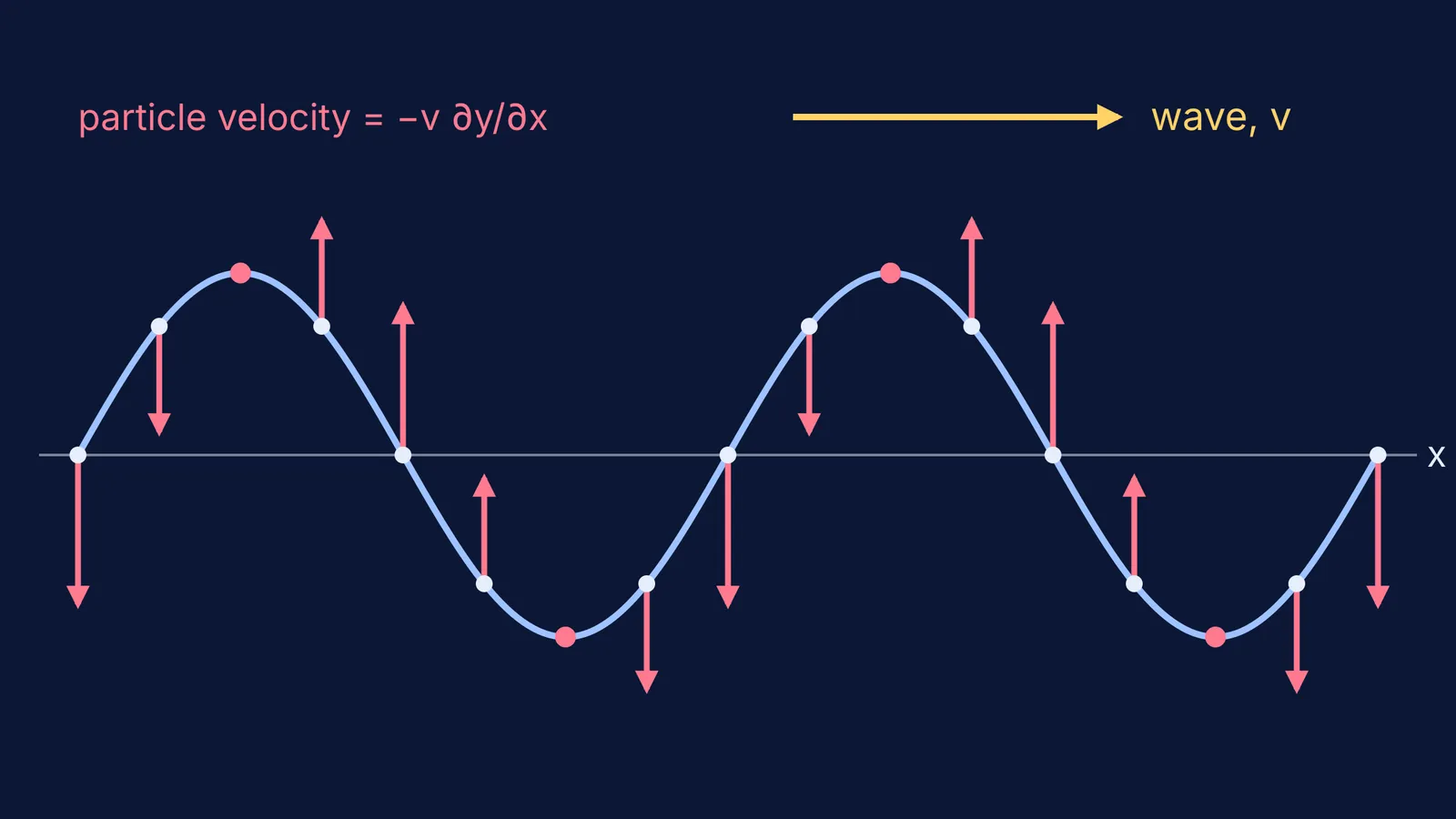
Particle velocity = −v × ∂y/∂x
For a wave moving towards −x, y = f(x + vt) and the sign flips. Check on the sine wave: slope Ak cos(kx − ωt) times −ω/k gives −Aω cos(kx − ωt), the same answer as differentiating with respect to time.
Which way do particles move on a wave snapshot?
A snapshot is a y–x graph at one instant. For a wave moving to the right:
Find the slope at the point: uphill to the right is positive, downhill negative.
Apply −v × slope. Uphill points move down; downhill points move up.
Crests and troughs have zero slope, so they are momentarily at rest.
Neighbour test: each point is about to take the height of its neighbour on the side the wave comes from.
In the diagram above, arrows are longest where the string crosses the axis and vanish at crests and troughs. The same slope reasoning helps when a pulse flips on reflection; see reflection of waves at fixed and free ends.
If this is easier to see than to read, the Fermi Simulation Lab has interactive simulations for ideas like this.
Worked example: how fast is each point moving?
OpenStax's Example 16.3 uses the wave y = 0.2 sin(6.28x − 1.57t), with x and y in metres and t in seconds, and finds A = 0.2 m, a wavelength of 1.0 m, a period of 4 s and a wave speed of 0.25 m/s (OpenStax 16.2). Take the snapshot at t = 0, so y = 0.2 sin(6.28x) and the slope is 0.2 × 6.28 × cos(6.28x) = 1.256 cos(6.28x).
At x = 0: slope = 1.256, so particle velocity = −0.25 × 1.256 = −0.314 m/s (moving down).
At x = 0.125 m: slope = 1.256 × cos 45° ≈ 0.888, so particle velocity ≈ −0.222 m/s.
At x = 0.25 m, a crest: slope = 0, so the particle is at rest.
At x = 0.5 m: slope = −1.256, so particle velocity = +0.314 m/s (moving up).
Check: OpenStax gives the maximum as Aω = 0.2 × 1.57 = 0.314 m/s, matching the result at x = 0. Notice that 0.314 m/s is larger than the wave speed of 0.25 m/s. Because the peak particle speed Aω equals v × Ak, particles move faster than the wave whenever the steepest slope, Ak, is greater than 1.
What mistakes do students make with particle velocity?
Writing v = ω/k when the question asks for the speed of a point on the string.
Forgetting to flip the sign when the wave moves towards −x.
Using −v × slope on a y–t graph instead of a y–x snapshot.
Assuming the crest moves fastest. It is the point at the axis that moves fastest.
Treating longitudinal waves as different: same algebra, but the particle velocity is along x. Our post on displacement and pressure waves in sound applies the same slope reasoning to air.
Then try the sign rule on mixed questions in the Fermi Problem Library, where the step-by-step solver explains the reasoning rather than printing an answer, so you can see where a sign went wrong.


