

On this page
The Atwood machine is two masses on one string over a pulley. It was invented in 1784 by the English mathematician George Atwood as a laboratory experiment to verify the laws of motion with constant acceleration. Exams change one detail, but the method stays the same. Here is the basic result, then three variations with numbers you can check.
What are the tension and acceleration in a basic Atwood machine?
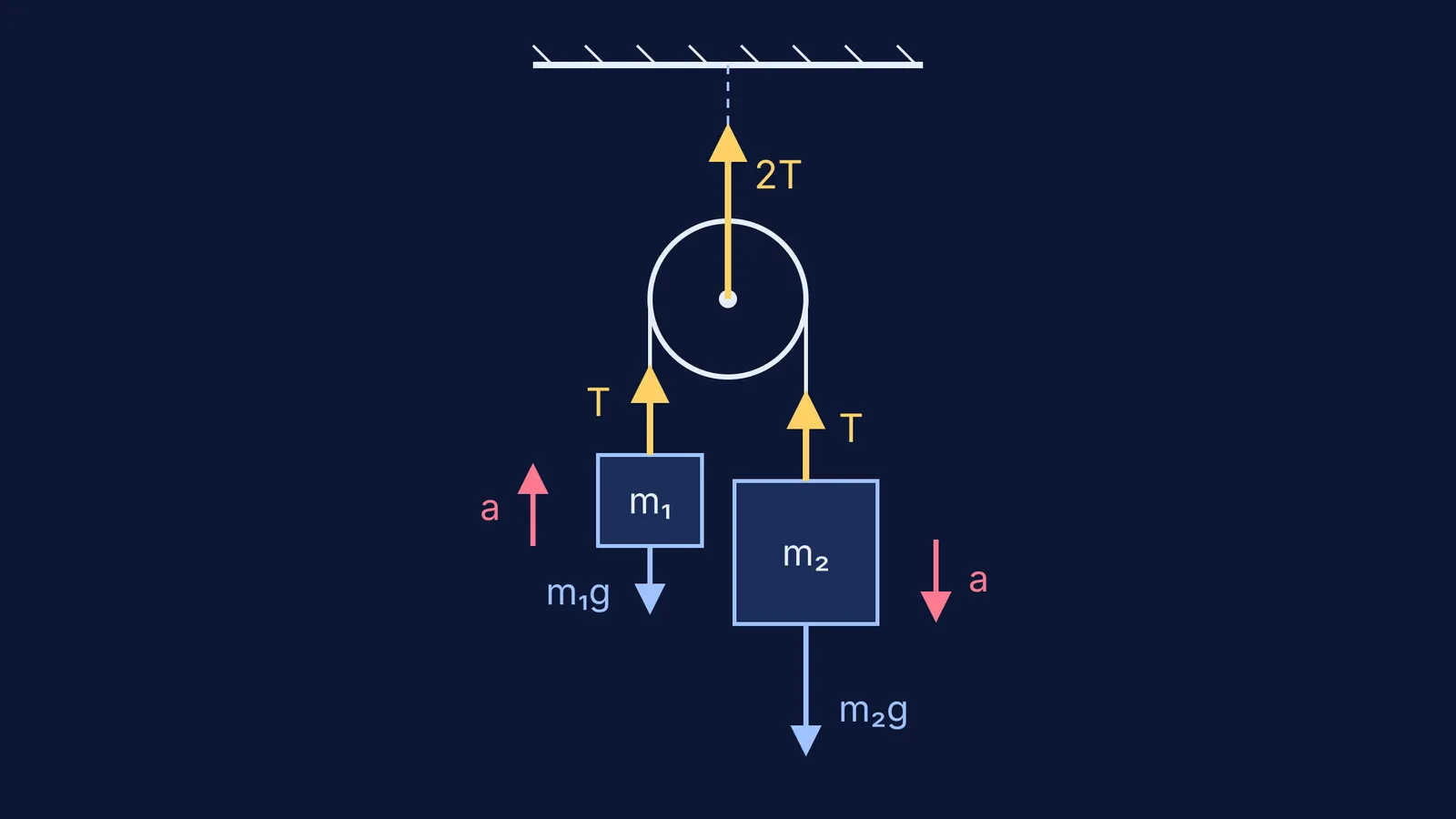
Assume a light, inextensible string and a massless, frictionless pulley. The heavier m₂ goes down, m₁ goes up, both with acceleration a, and the string has one tension T.
Apply Newton's second law along each block's motion:
For m₁ (moving up): T − m₁g = m₁a
For m₂ (moving down): m₂g − T = m₂a
Add them and T cancels: a = (m₂ − m₁)g/(m₁ + m₂)
Put a back into the first equation: T = 2m₁m₂g/(m₁ + m₂)
The MIT RELATE wiki's Atwood's machine problem gives the same tension formula under the same assumptions. In OpenStax University Physics Example 6.5, m₁ = 2.00 kg and m₂ = 4.00 kg give a = 3.27 m/s² and T = 26.1 N. We use those masses below.
How does an Atwood machine behave in an accelerating lift?
An upward-accelerating lift makes everything feel heavier. In OpenStax Example 6.3, a scale under a 75.0 kg person reads 825 N when the lift accelerates upward at 1.20 m/s², against 735 N at constant velocity.
In the lift's frame, add a pseudo force m·a₀ downward on each block. That is the same as replacing g with g + a₀ (or g − a₀ if the lift accelerates downward). The method is explained in our post on solving problems with pseudo forces in an accelerating frame.
Worked example: the same 2 kg and 4 kg blocks, with the lift accelerating upward at a₀ = 2.2 m/s², so g + a₀ = 12.0 m/s².
Acceleration relative to the lift: (4 − 2)(12.0)/6 = 4.0 m/s²
Tension: 2(2)(4)(12.0)/6 = 32.0 N
Acceleration of m₁ seen from the ground: 4.0 + 2.2 = 6.2 m/s² upward
Acceleration of m₂ seen from the ground: 4.0 − 2.2 = 1.8 m/s² downward
Most errors happen in the last two lines: the formula gives acceleration relative to the lift, so for the ground frame add the lift's acceleration back as a vector.
What changes when one mass sits on a table?
Now m₁ slides on a smooth horizontal table and m₂ hangs over a pulley at the edge. Gravity on m₁ is balanced by the normal force, so only m₂g drives the system. OpenStax Example 6.4 gives a = m₂g/(m₁ + m₂) and T = m₁m₂g/(m₁ + m₂).
With m₁ = 2 kg on the table and m₂ = 4 kg hanging: a = 4(9.8)/6 = 6.53 m/s² and T = 8(9.8)/6 = 13.1 N. That is half the hanging version's tension, because the table holds up m₁'s weight. With kinetic friction coefficient μ, the driving force becomes m₂g − μm₁g. If m₂g does not exceed the maximum static friction on m₁, nothing moves.
For strings that run over more than one pulley, use constraint relations for pulley accelerations before you write any force equations.
What force does the pulley support feel?
The clamp holding a massless pulley must balance both string segments pulling on it. In the basic machine both point straight down, so the MIT RELATE solution gives the axle force as 2T.
For our blocks that is 2 × 26.1 = 52.3 N, less than their 58.8 N total weight. The 6.5 N difference is the net force that accelerates the centre of mass downward; with equal masses, the support carries the full weight.
In the table version, the two segments are at 90°, one horizontal and one vertical. The support force is then T√2 = 13.1 × 1.414 ≈ 18.5 N, pointing 45° below the horizontal, towards the table. In the lift, it is 2 × 32.0 = 64.0 N. A pulley with mass adds its own weight, and the two tensions stop being equal, as our post on pulleys with mass and rotational dynamics explains.
A five-line check before you solve any Atwood problem
Are the pulley and string massless and the pulley frictionless? If yes, the tension is the same on both sides.
Which frame are you in? In a lift, use g + a₀ or g − a₀ and report ground accelerations separately.
What drives the motion? Count only the weight components along the string.
Do the limits work? Equal hanging masses should give a = 0, and a very light m₁ should give a close to g.
What does the support feel? Add the string tensions as vectors, then add the pulley's own weight if it has mass.
If your answer keeps disagreeing with the key, the Fermi Problem Library has worked problems with a step-by-step solver that explains the reasoning rather than printing an answer. To see the motion first, the Fermi Simulation Lab has interactive simulations for ideas that are easier to see than to read.


