

On this page
You let go of a coin in a moving lift, and the exam asks how long it takes to reach the floor. The trap is that the coin and the floor are both moving. Pick one frame of reference, stick to it, and let the relative acceleration do the work.
Why does the coin fall faster in a lift accelerating upwards?
The moment you let go, nothing pushes the coin up any more, so its acceleration relative to the ground is just g downwards. The floor, meanwhile, keeps accelerating upwards at a to meet it. Relative to the lift, the coin closes the gap at g + a.
This comes straight from the rule for adding accelerations between frames: the acceleration of a particle in frame S equals its acceleration in frame S′ plus the acceleration of S′ relative to S, as set out in OpenStax University Physics, section 4.5. Put the lift as S′ and the ground as S, take down as positive, and the coin's acceleration relative to the lift is g − (−a), which is g + a pointing down.
If the lift accelerates downwards at a, the floor runs away from the coin and the relative acceleration drops to g − a:
Lift accelerating up at a: use g + a.
Lift accelerating down at a: use g − a.
Lift at rest or moving at constant speed: use g.
Lift in free fall (a = g downwards): the coin floats beside your hand and never reaches the floor.
The same g + a explains why a scale reads more in a lift accelerating up: in OpenStax's elevator example, a 75 kg person reads about 825 N at 1.20 m/s² upwards, against 735 N at constant speed. More in our post on how a weighing scale reading changes in an accelerating lift.
What is the formula for the time to reach the floor?
In the lift's frame the coin starts at rest, at height h above the floor, with a constant acceleration g_eff. From h = ½ g_eff t²:
t = √(2h / g_eff), with g_eff = g + a (lift accelerating up) or g − a (lift accelerating down).
Equivalently, inside the lift you can add a fictitious force ma on the coin, opposite to the lift's acceleration; added to mg it gives the same g + a. OpenStax describes inertial forces as fictitious forces that seem to arise only because the observer's frame is accelerating or rotating.
Worked example: three lifts, one coin
Take g = 9.8 m/s² (the internationally agreed standard value is 9.806 65 m/s², per NIST), a drop height of h = 1.6 m and a lift acceleration of a = 2.0 m/s².
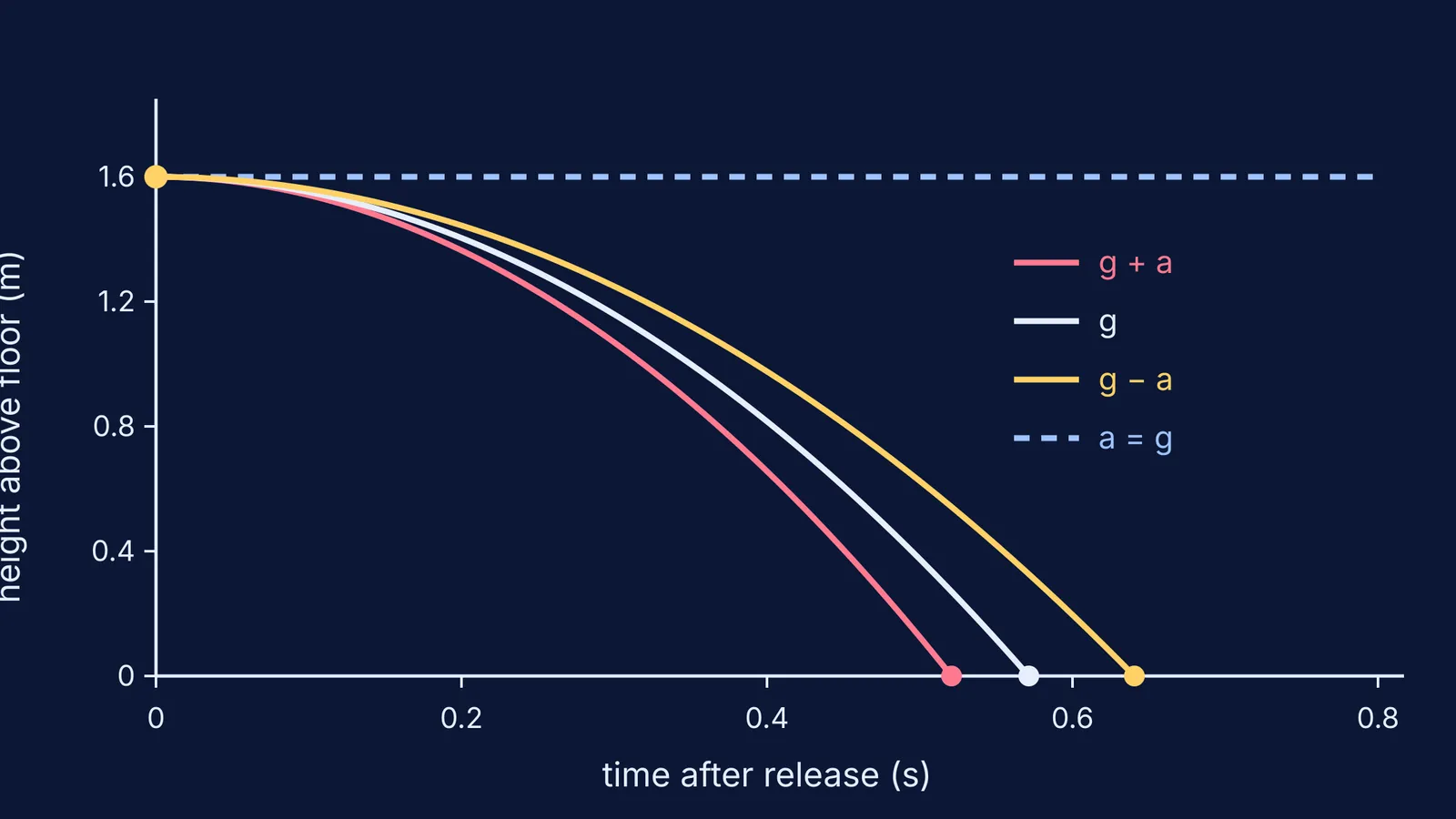
Lift accelerating up: g_eff = 11.8 m/s², so t = √(3.2 / 11.8) ≈ 0.52 s.
Lift at rest or at constant speed: g_eff = 9.8 m/s², so t = √(3.2 / 9.8) ≈ 0.57 s.
Lift accelerating down: g_eff = 7.8 m/s², so t = √(3.2 / 7.8) ≈ 0.64 s.
How does it look from the ground?
Check the up case from the ground, with the lift also moving up at 3.0 m/s at release. The coin leaves your hand at 3.0 m/s upwards, then accelerates at g downwards; the floor keeps accelerating up at 2.0 m/s².
Coin's rise after 0.52 s: 3.0 × 0.52 − ½ × 9.8 × 0.52² ≈ 0.23 m upwards.
Floor's rise after 0.52 s: 3.0 × 0.52 + ½ × 2.0 × 0.52² ≈ 1.83 m upwards.
Gap closed: 1.83 − 0.23 = 1.6 m, which is h.
The 3.0 m/s terms cancel when you subtract, which is why the speed drops out. Seen from the ground, the coin lands 0.23 m above its release point, already falling, because the floor comes up to meet it. If the signs in that check feel shaky, our explainer on whether g should be positive or negative in equations of motion sets out one convention to keep.
A 30-second checklist for lift problems
Note the direction of the lift's acceleration, not its velocity.
Work in the lift frame; use the ground frame as a check.
Write g_eff as g + a or g − a, and confirm it is positive.
Use h = ½ g_eff t² for a coin released from rest relative to you.
Sanity-check: up is quicker than at rest, down slower.
The same reasoning sets how hard a cable has to pull, which we cover in maximum acceleration of a lift and cable tension. For more practice, the Fermi Problem Library has worked problems with a step-by-step solver that explains the reasoning rather than printing an answer. If relative motion still feels loose, the Fermi Concept Library gives each physics concept its own lesson.


