

On this page
Few topics in introductory physics cause as many lost marks on exam day as the sign of acceleration due to gravity. The confusion stems from a basic distinction in mechanics: g is a scalar magnitude, whereas the acceleration a in your equations is a signed vector component. As explained in OpenStax University Physics Volume 1, free-fall acceleration near Earth's surface has a constant magnitude of approximately 9.80 m/s² directed vertically downward. Because g represents the magnitude of this vector, g itself is always a positive number.
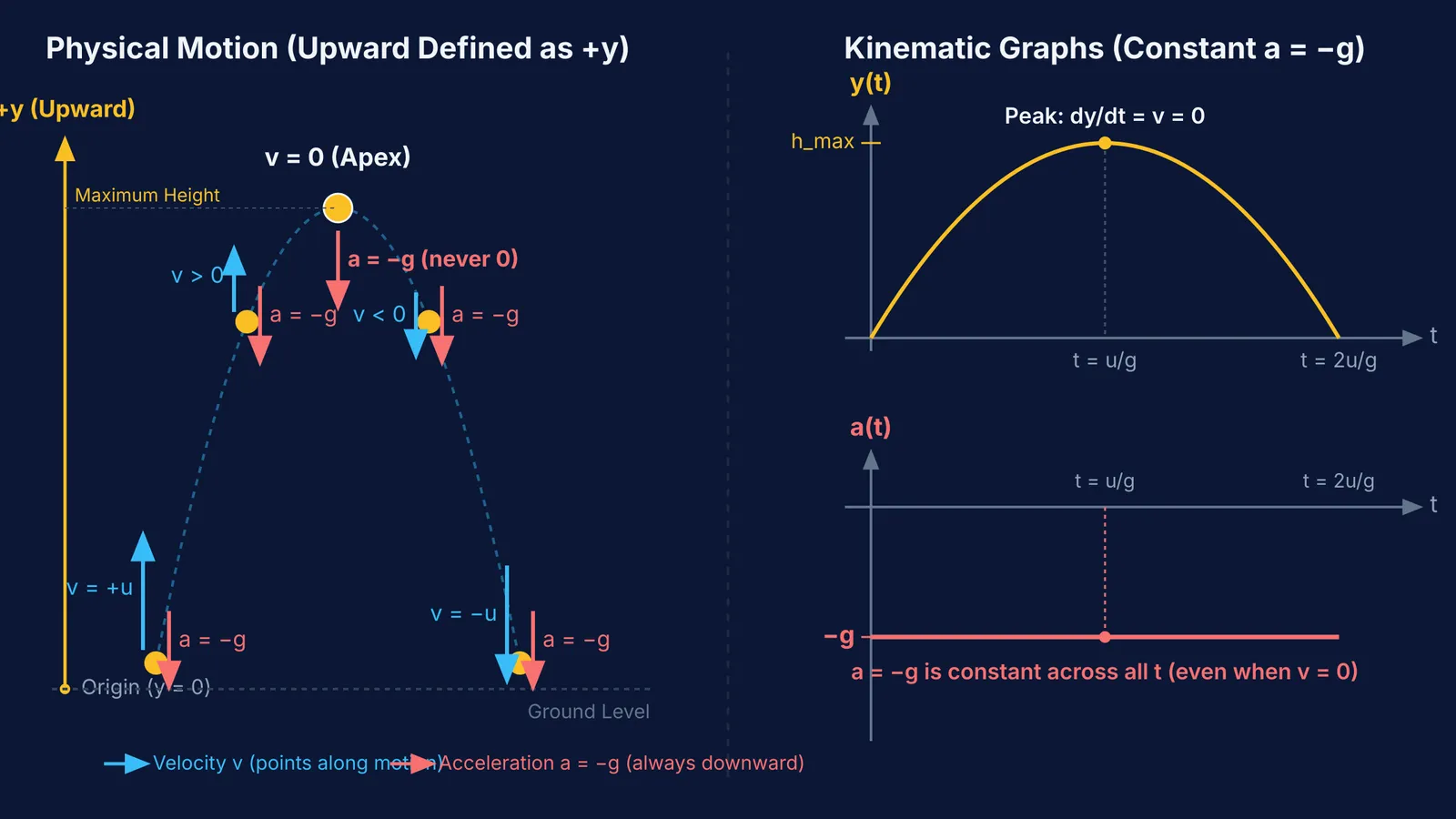
Whether you substitute +g or −g into equations of motion depends on the coordinate axis you choose. If you define vertically upward as positive (+y), any downward vector points in the negative direction. Because gravity pulls downward toward Earth's centre, the acceleration along the vertical axis is negative: a = −g = −9.80 m/s². Physics education researchers Kate Hayes and Michael C. Wittmann (2010) documented that students often struggle when converting vector relationships into scalar equations, frequently conflating direction of motion with acceleration. Negative acceleration does not simply mean slowing down; it means the acceleration vector points along the negative axis.
Should you change the sign of g at the top of the trajectory?
A widespread mistake in Class 11 physics and JEE Main, JEE Advanced or NEET-UG preparation is treating acceleration as negative on the way up, zero at the peak, and positive on the way down. This breaks the equations of motion—v = u + at, s = ut + ½at², and v² = u² + 2as—which are derived on the condition that acceleration a remains constant over the entire time interval.
In an investigation published in the *American Journal of Physics*, David E. Trowbridge and Lillian C. McDermott (1981) conducted 200 individual demonstration interviews with introductory physics students and found that learners commonly assume zero velocity implies zero acceleration. But gravity never turns off. Earth exerts a constant downward force, F = mg, throughout the flight. If acceleration were zero at the apex, Newton's second law dictates the net force would vanish, leaving the ball suspended in mid-air. Even when instantaneous velocity is zero (v = 0), acceleration remains −9.80 m/s².
How do you solve free-fall problems with upward taken as positive?
In standard mechanics curricula such as OpenStax University Physics Volume 1, solving vertical motion begins with setting an explicit origin and positive direction. Consider a ball thrown vertically upward from a 25 m tall building with an initial velocity of 20 m/s. We choose upward as positive (+y), set the launch point as origin (y = 0), and take g = 10 m/s² for clean numbers:
Initial velocity: u = +20 m/s.
Acceleration: a = −g = −10 m/s² throughout the flight.
Ground displacement: s = −25 m (since the ground is 25 m below the origin).
Using v² = u² + 2as with v = 0 at the peak gives 0² = (20)² + 2(−10)h, so h = +20 m above the roof (45 m above ground). The time to reach the top is t_up = u/g = 20/10 = 2 s from v = u + at.
To find the total time until the ball strikes the ground, apply the displacement equation across the full trajectory: s = ut + ½at² −25 = 20t − 5t² t² − 4t − 5 = (t − 5)(t + 1) = 0
Discarding the negative root leaves t = 5 s. The impact velocity is v = u + at = 20 + (−10)(5) = −30 m/s, where the minus sign confirms downward motion. A single equation solved the entire flight without splitting the motion into pieces. For multi-body problems, see our guide on vertical motion under gravity. The Fermi Problem Library has worked problems with a step-by-step solver that explains the reasoning rather than printing an answer.
What happens if you choose downward as the positive direction?
Coordinate orientation is an arbitrary mathematical convention. As outlined in OpenStax University Physics Volume 1, defining downward as positive (+y downward) leaves physical outcomes unchanged while inverting algebraic signs consistently:
Acceleration: a = +g = +10 m/s² (gravity acts downward).
Initial velocity: u = −20 m/s (thrown upward, opposing positive axis).
Ground displacement: s = +25 m (ground lies below the launch point).
The displacement equation becomes +25 = −20t + 5t², simplifying to t² − 4t − 5 = 0, which yields the exact same flight time: t = 5 s. Impact velocity is v = −20 + (10)(5) = +30 m/s, meaning 30 m/s downward. Taking downward as positive is particularly helpful when dropping objects from rest, as shown in horizontal projectile from a cliff, because every quantity remains positive.
How can you avoid sign errors in kinematics numericals?
To eliminate sign mistakes in physics problems, follow four practical steps:
Draw the axis first: Sketch an arrow for +y and mark your origin (y = 0) before writing formulas.
List signed values: Write u, a, and s with explicit + or − signs before calculating.
Keep standard formulas untouched: Write v = u + at and s = ut + ½at², substituting a = −g directly, rather than memorizing separate formulas with built-in minuses that cause double negatives.
Interpret signs physically: Negative displacement means the position is below the origin; negative velocity means downward motion.
To learn which formula fits each problem, read our guide on equations of motion. You can explore how coordinate conventions apply across mechanics on the Fermi Concept Library, which covers every concept in physics, chemistry, biology, mathematics and computing, each with its own lesson and its place in the map. When you hit a roadblock on sign conventions, Fermi's AI tutor notices where a student is stuck, draws the figure, and checks understanding as it goes.


