

On this page
How does cable breaking tension limit upward acceleration?
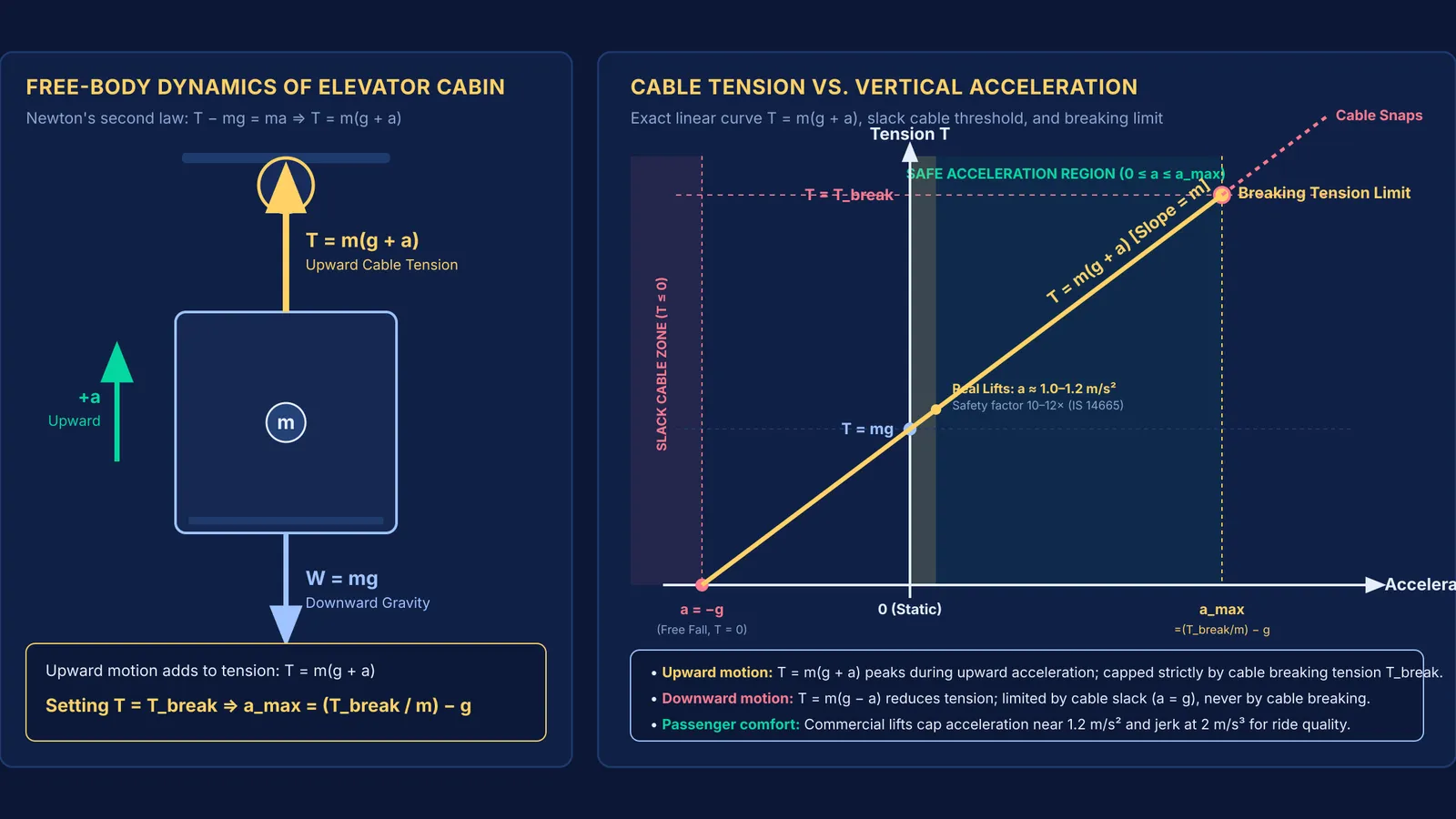
When an elevator cabin of mass m accelerates vertically, the cable must support both the gravitational pull and the inertial resistance to changes in velocity. By Newton's second law, net vertical force equals mass times acceleration. Taking upward as positive, cable tension T pulls upward while gravity mg acts downward, giving T − mg = m a, or T = m(g + a).
Because upward acceleration adds directly to gravity g, the cable experiences its greatest load whenever the lift speeds up while ascending or slows down while descending. Setting tension to the breaking limit T_break determines the maximum upward acceleration:
a_max = (T_break / m) − g
In OpenStax University Physics Volume 1, standard elevator problems show that an upward acceleration of just 1.20 m/s² increases the required support force by over 12% above static weight. In real engineering, elevators never operate near T_break. Under the Bureau of Indian Standards specification IS 14665 for electric traction lifts, suspension ropes must maintain a minimum factor of safety between 10 and 12 depending on rated operating speed, ensuring cables carry only a fraction of their breaking capacity.
Why is downward acceleration limited differently?
When a lift accelerates downward, acceleration reverses. Newton's second law yields mg − T = m a_down, giving T = m(g − a_down). Downward acceleration reduces cable tension, so breaking strength does not restrict downward motion.
Instead, downward motion faces three physical constraints:
The slack-cable boundary: If downward acceleration reaches a_down = g, the cabin enters free fall and tension drops to zero (T = 0). If forced downward faster than g, the cable would need to push downward. Because steel wire ropes cannot support compression, the cable immediately goes slack, risking derailment from traction sheaves.
Floor contact and passenger safety: Supporting normal force on a passenger of mass m_p is N = m_p(g − a_down). When a_down reaches g, passengers become weightless. If a_down exceeds g, normal force vanishes and passengers collide with the ceiling.
The downward braking penalty: A descending elevator must eventually decelerate to a stop. Decelerating during downward motion requires an upward acceleration, causing tension to surge back to T = m(g + a_brake). Excessive downward speed requires aggressive upward braking, which can exceed T_break at the bottom of the shaft.
Worked example: calculating maximum acceleration from cable limits
Consider an elevator with total loaded mass m = 1,200 kg supported by a cable with maximum allowable tension T_allow = 18,000 N. Using g = 9.8 m/s²:
Static weight: W = mg = 1,200 kg × 9.8 m/s² = 11,760 N.
Net upward force available: F_net = T_allow − mg = 18,000 N − 11,760 N = 6,240 N.
Maximum upward acceleration: a_max = F_net / m = 6,240 N / 1,200 kg = 5.2 m/s².
If the elevator accelerates downward at 5.2 m/s², cable tension drops to T = 1,200 × (9.8 − 5.2) = 5,520 N—less than half its static weight. The cable is far from breaking. However, downward acceleration cannot exceed 9.8 m/s² without making the cable slack. Understanding how force varies with motion connects directly to other mechanics scenarios, including weighing machine readings in a lift, effective gravity for a pendulum in an accelerating lift, and tension variations when observing a monkey climbing a rope tension.
What limits elevator acceleration in real buildings?
While mechanics permits an upward acceleration of 5.2 m/s² in our example, passenger elevators operate far below these limits. The practical ceiling is human physiology and passenger comfort. In vertical transportation engineering, international standards like ISO 8100-34 define measurement procedures for ride quality, restricting both vertical acceleration and jerk—the rate of change of acceleration.
According to engineering criteria summarized on Wikipedia's guide to jerk in physics), vertical jerk of 2 m/s³ is generally rated acceptable for standing passengers, while hospital elevators target 0.7 m/s³ to protect fragile patients, and jerk reaching 6 m/s³ is considered intolerable. In addition, OpenStax University Physics Volume 1 shows that a modest acceleration of 1.20 m/s² changes apparent weight by over 12%. Skyscraper elevators achieve high speeds not through aggressive acceleration, but by sustaining gentle accelerations of roughly 1.0 to 1.2 m/s² over longer distances.
Mastering vertical dynamics requires moving beyond memorized formulas to analyzing free-body diagrams across every phase of motion. The Fermi Problem Library provides worked problems with a step-by-step solver that explains the reasoning rather than printing an answer, helping students practice constraint relations and sign conventions. To explore how Newton's laws connect across mechanics, the Fermi Concept Library maps every concept in physics with its own lesson and its place in the curriculum.


