

On this page
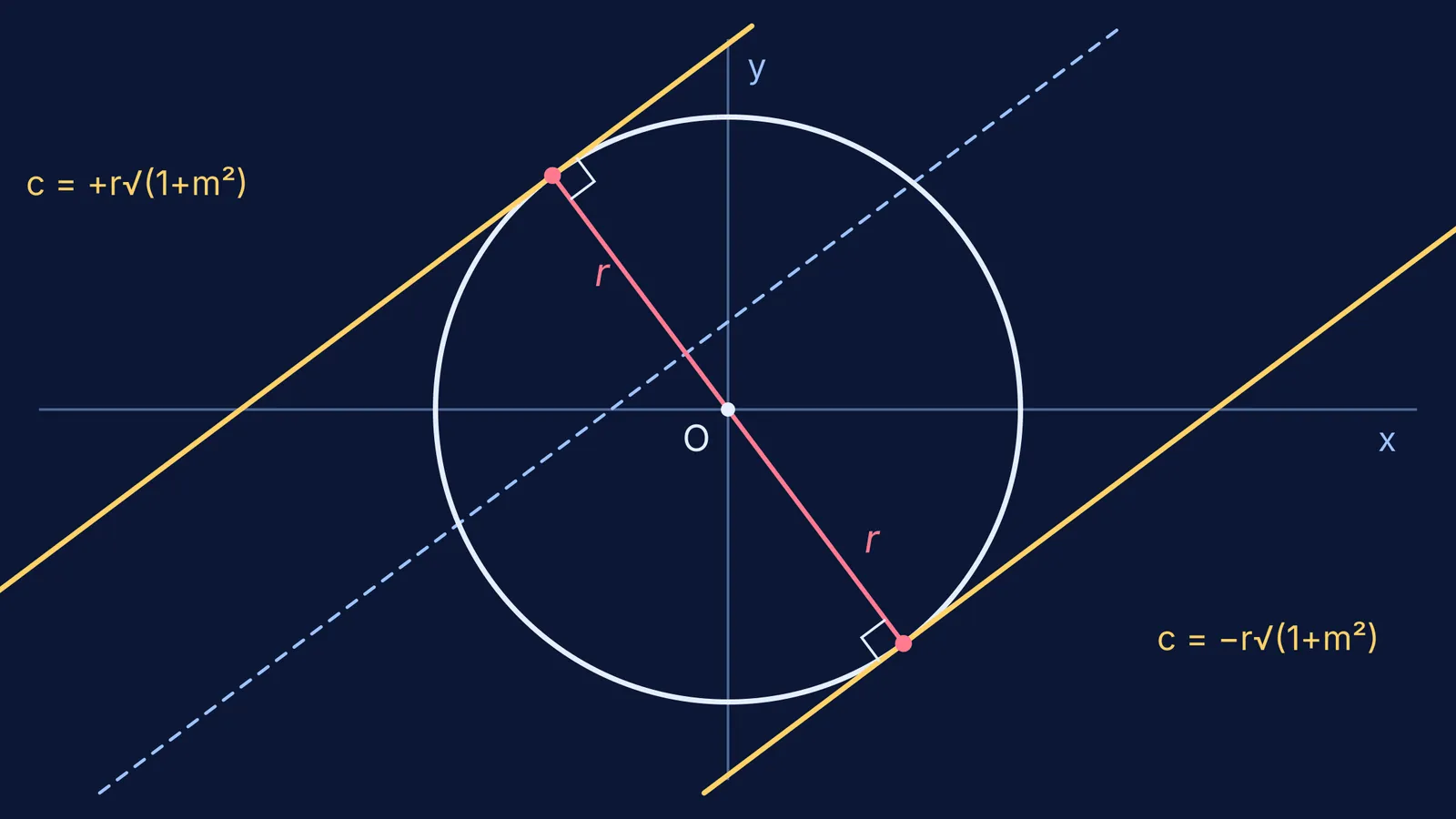
Many tangent questions in school coordinate geometry and JEE Main come down to one test. Measure how far the line is from the centre of the circle. If that distance equals the radius, the line is a tangent. Everything else, including the formula c² = r²(1 + m²), comes from this one idea.
What is the condition for a line to be tangent to a circle?
A tangent line touches a circle at exactly one point and never enters the circle's interior, as the Wikipedia article on tangent lines to circles defines it. The same article states that every tangent is perpendicular to the radius at the point of tangency.
So the radius to the point of contact is the perpendicular from the centre to the line, and its length is the distance we need.
The distance from a point (x₀, y₀) to the line Ax + By + C = 0 is |Ax₀ + By₀ + C| / √(A² + B²), the standard point-to-line distance formula.
So for a circle with centre (h, k) and radius r, the line Ax + By + C = 0 is a tangent exactly when |Ah + Bk + C| / √(A² + B²) = r. If the distance is less than r, the line cuts the circle twice; if it is more, the line misses.
Why is c² = r²(1 + m²) for y = mx + c?
Take the circle x² + y² = r², centred at the origin. Rewrite y = mx + c as mx − y + c = 0. Its distance from (0, 0) is |c| / √(m² + 1). Set this equal to r and square both sides: c² = r²(1 + m²).
The Tamil Nadu State Board Class 12 mathematics text states the same condition for x² + y² = a², and gives the point of contact as (−a²m/c, a²/c), as reproduced on BrainKart's page on the tangent condition.
As a check, substituting y = mx + c into x² + y² = r² gives (1 + m²)x² + 2mcx + (c² − r²) = 0. A tangent meets the circle once, so the discriminant must be zero, and expanding it leaves the same c² = r²(1 + m²). The distance route is shorter and works for any centre.
How do you find the tangents with a given slope?
Example 1: circle at the origin. Find the tangents to x² + y² = 25 with slope 3/4.
Read off r = 5 and m = 3/4.
Apply the condition: c² = 25(1 + 9/16) = 625/16, so c = ±25/4.
Write the tangents: 3x − 4y + 25 = 0 and 3x − 4y − 25 = 0.
Check: the distance from (0, 0) is 25/√(9 + 16) = 5, the radius.
The point of contact (−a²m/c, a²/c) with c = 25/4 is (−3, 4). The other tangent touches at (3, −4).
The diagram at the top shows this case; its dashed line has the same slope but cuts the circle twice.
Example 2: circle not at the origin. Find the tangents to x² + y² − 4x − 6y − 12 = 0 parallel to 4x + 3y + 5 = 0.
Complete the squares: centre (2, 3), radius √(4 + 9 + 12) = 5.
Any parallel line has the form 4x + 3y + k = 0.
Set the distance from the centre equal to the radius: |8 + 9 + k| / 5 = 5, so |17 + k| = 25.
Solve: k = 8 or k = −42, giving 4x + 3y + 8 = 0 and 4x + 3y − 42 = 0.
Check: (−2, 0) lies on the circle and the first line; (6, 6) on the circle and the second.
Here c² = r²(1 + m²) would fail: it assumes the centre is the origin.
Which mistakes cost marks on tangent questions?
Dropping the minus sign in c = ±r√(1 + m²).
Using the origin formula on a shifted circle.
Forgetting to divide by √(A² + B²).
Missing a vertical tangent, which has no slope m.
If your answers keep differing from the key, the Fermi Problem Library has worked problems with a step-by-step solver that explains the reasoning rather than printing an answer. If the gap is the idea itself, the Fermi Concept Library gives each concept its own lesson and shows its place in the map.
Next, read the tangent condition for an ellipse or hyperbola, finding a circle's radius from a tangent line, and why the chord of contact equation T = 0 matches the tangent.
Try it now: find the tangents to x² + y² = 9 with slope 1, then check your answers with the distance formula.


