

On this page
The equation of a circle is completely defined by its centre and its radius. When a coordinate geometry problem gives you the centre but only a line that the circle touches (a tangent), you have to calculate the radius yourself.
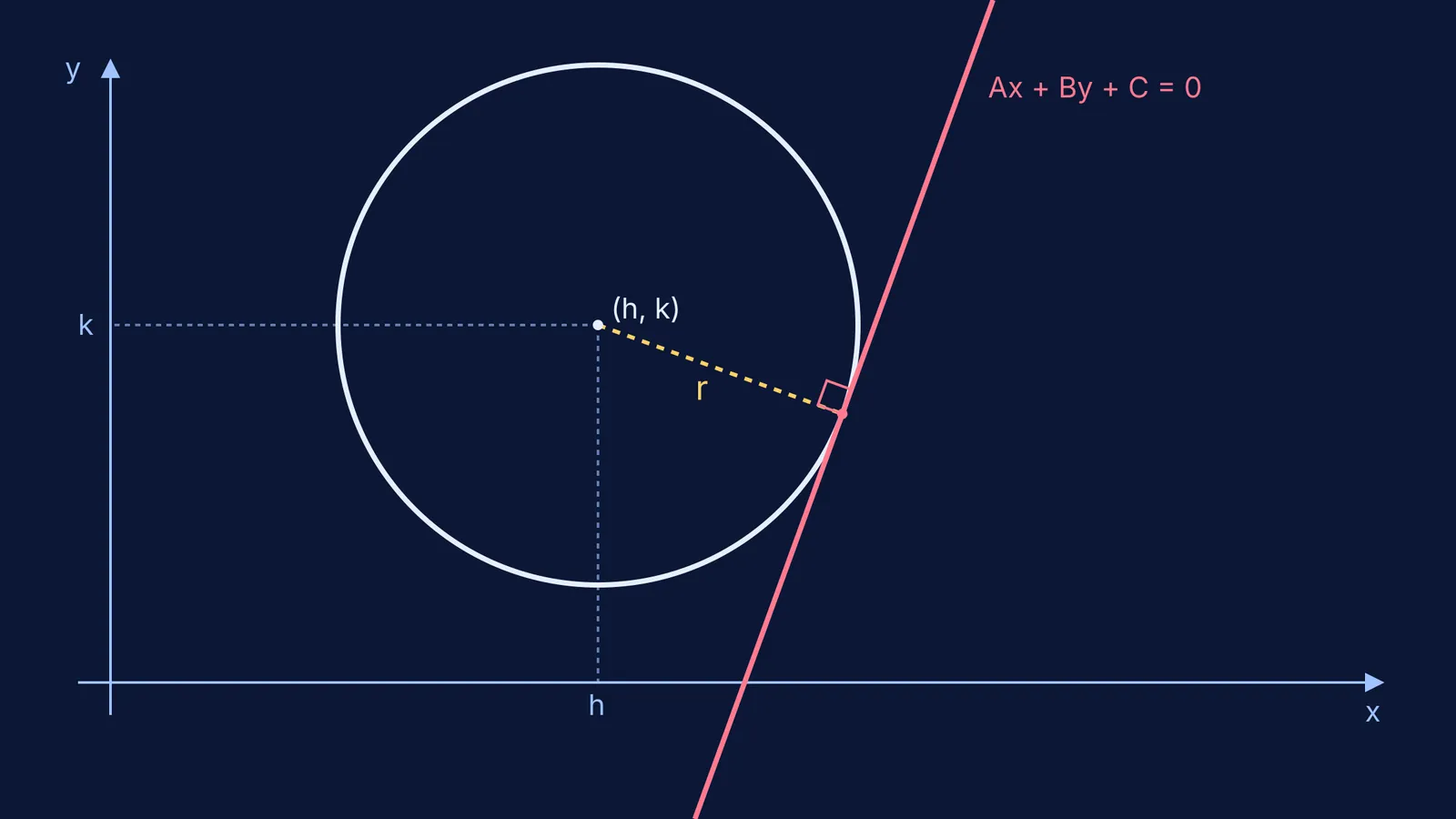
Because a tangent line is always perpendicular to the radius at the point of contact, the radius is exactly the shortest distance from the centre to that line.
What is the radius when a circle touches a line?
If you have a point (x₁, y₁) and a line with the equation Ax + By + C = 0, the shortest path between them is a perpendicular drop. The NCERT Class 11 Mathematics textbook provides the formula for this perpendicular distance d:
d = |Ax₁ + By₁ + C| / √(A² + B²)
When a line touches a circle, it acts as a tangent. The radius r is simply the perpendicular distance from the circle's centre (h, k) to this tangent line. Therefore, you swap the general point (x₁, y₁) for the centre coordinates (h, k) to find r.
How do you write the circle equation?
Once you have found the radius, you have everything you need. The standard form of a circle's equation is:
(x − h)² + (y − k)² = r²
Where:
(h, k) is the centre.
r is the radius you just calculated.
You can leave the equation in this standard form, or expand the brackets to write it in the general form x² + y² + 2gx + 2fy + c = 0.
How does it work for a circle touching 3x + 4y − 12 = 0?
Let's find the equation of a circle with its centre at (2, −1) that touches the line 3x + 4y − 12 = 0.
Identify the centre and line components.
Here, the centre is (h, k) = (2, −1). The line is in the form Ax + By + C = 0, so A = 3, B = 4 and C = −12.
Calculate the radius using the distance formula.
Substitute the values to find the perpendicular distance: r = |3(2) + 4(−1) − 12| / √(3² + 4²) r = |6 − 4 − 12| / √(9 + 16) r = |−10| / √25 r = 10 / 5 = 2
Write the standard equation.
Substitute the centre (2, −1) and the radius r = 2 into the standard form: (x − 2)² + (y − (−1))² = 2² (x − 2)² + (y + 1)² = 4
Expand to the general form (optional).
x² − 4x + 4 + y² + 2y + 1 = 4 x² + y² − 4x + 2y + 1 = 0
Checking your steps and next moves
It is remarkably easy to make a sign error when substituting coordinates into the distance formula. If you are practising these problems for JEE Main and keep reaching the wrong radius, the Fermi Problem Library provides a step-by-step solver that checks your arithmetic line by line. By tracking the values of A, B and C exactly as you enter them, Fermi's AI tutor points out exactly where a negative sign was dropped, teaching you to catch the mistake yourself next time.
When visualising the problem helps, you can sketch the line and the centre. If the line passes directly through the centre, the distance is zero — which means it is not a tangent and no circle can exist.
If you are facing more complex coordinate geometry scenarios, you might need to combine this technique with others. For instance, if you have to find a circle passing through specific points instead of touching a line, our guide to finding a circle's centre and radius covers the matrix and substitution methods. Meanwhile, if your tangent lines intersect with other boundaries, checking the condition for three lines to be concurrent can help simplify the geometry before you start calculating distances.
For a deeper intuition on why these formulas hold together, the Fermi Concept Library breaks down the proofs behind coordinate geometry, ensuring you rely on understanding rather than rote memorisation.


