

On this page
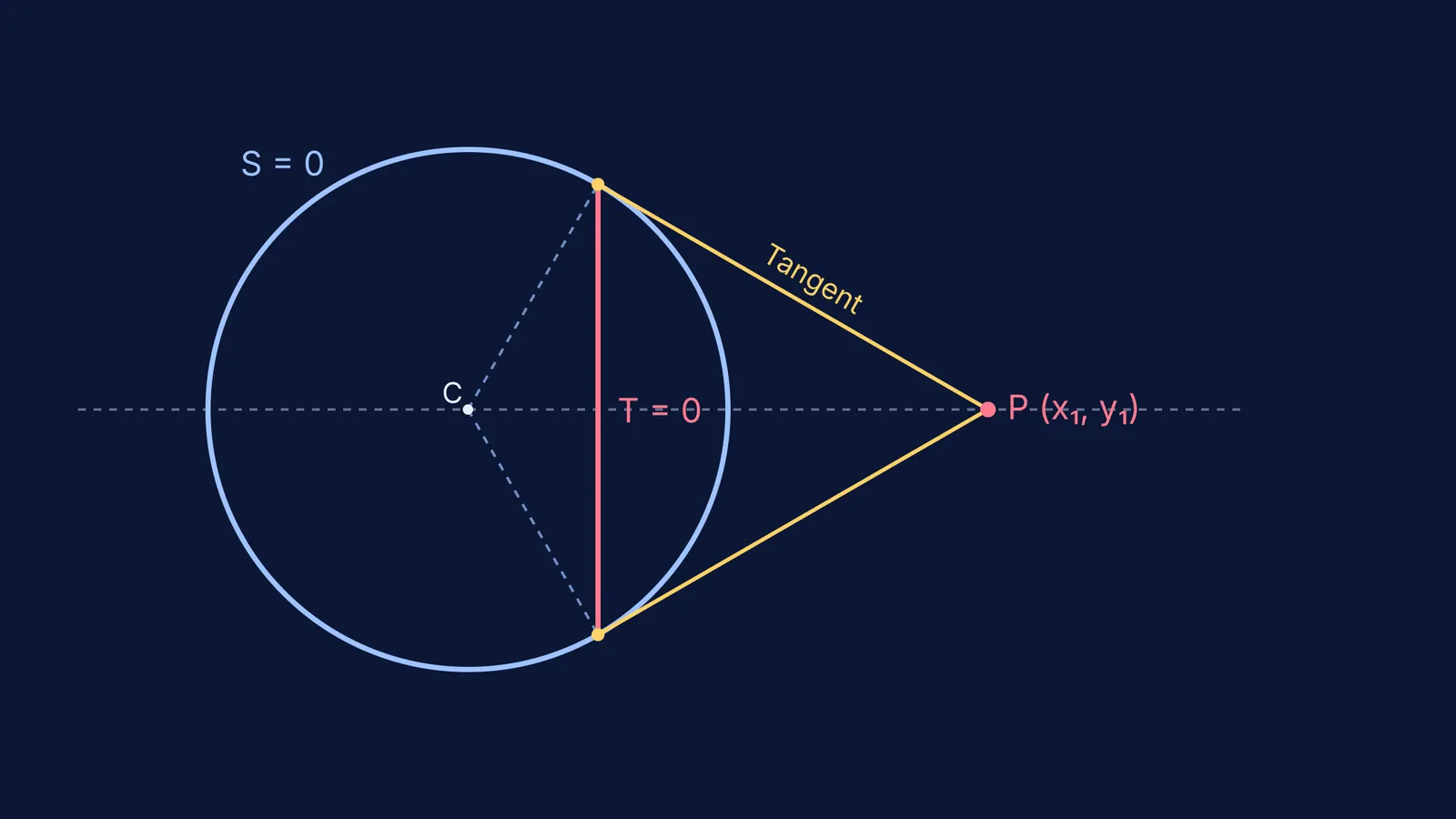
If you draw two tangent lines from a point outside a circle, they touch the circle at two distinct spots. The straight line connecting those two touchpoints is called the chord of contact.
For students preparing for engineering or maths exams, a fascinating coordinate geometry shortcut appears here: the equation for this chord is identical in form to the equation of a single tangent line. That equation is simply written as T = 0.
What is the chord of contact?
When a point P(x₁, y₁) lies completely outside a circle, it is physically possible to draw exactly two tangents to the curve from that point. Let us say these tangents touch the circle at points A and B. The line segment AB is the chord of contact.
According to Wikipedia's reference on poles and polars, the chord of contact is the polar line of an external point with respect to a conic section. This fundamental property dictates how the algebraic formula behaves.
How do you write the chord of contact equation of a circle?
In coordinate geometry, the expression "T = 0" refers to a systematic replacement of terms in a general equation.
If you have a circle with the equation x² + y² + 2gx + 2fy + c = 0, you write the T = 0 equation for a point (x₁, y₁) by making these substitutions:
Replace x² with xx₁
Replace y² with yy₁
Replace 2x with (x + x₁)
Replace 2y with (y + y₁)
Applying these rules, the equation for the chord of contact becomes: xx₁ + yy₁ + g(x + x₁) + f(y + y₁) + c = 0
For a circle simply centred at the origin (x² + y² = r²), the T = 0 equation shrinks neatly to xx₁ + yy₁ = r².
Why does the T = 0 equation look exactly like the tangent equation?
You might notice that xx₁ + yy₁ = r² is the exact formula taught for finding the tangent to a circle at a point. So how can one equation describe two different lines?
The geometry hinges completely on where your reference point P(x₁, y₁) is located:
On the circle: If P sits exactly on the boundary, the two tangent points merge into one. The T = 0 line just skims the circle at P, making it a tangent line.
Outside the circle: If P sits away from the circle, the T = 0 line cuts right through the circle, connecting the two points of tangency as the chord of contact.
Inside the circle: If P is inside, T = 0 still forms a straight line called the polar, though you cannot draw physical tangents from an internal point.
When you struggle to picture why the exact same algebraic formula moves from a tangent to a chord depending on the coordinate, the Fermi Concept Library has every concept in physics, chemistry, biology, mathematics and computing, each with its own lesson and its place in the map.
How do you find where the tangents meet?
Sometimes a problem hands you the equation of a chord (a line like lx + my + n = 0) and asks you to find the coordinates of the external point where its two tangents intersect. In geometry, this external point is called the "pole" of the given line.
To solve this, you compare the given line with the theoretical T = 0 equation of the chord of contact:
Write down T = 0 using unknown coordinates (x₁, y₁).
Write down your given line lx + my + n = 0.
Because both equations represent the exact same line, their coefficients must be proportional.
Set up the ratios (e.g., x₁/l = y₁/m = ...) and solve for x₁ and y₁.
This method relies heavily on comparing coefficients accurately. If you find yourself tangled up while solving simultaneous equations, the Fermi Problem Library has worked problems with a step-by-step solver that explains the reasoning rather than printing an answer, helping you find your algebraic mistakes.
A worked example: finding the chord
Let us find the chord of contact for the circle x² + y² = 25 from the external point (7, 1).
Here, the point is (x₁, y₁) = (7, 1) and r² = 25. Because the circle is centred at the origin, we use the simplified T = 0 rule: xx₁ + yy₁ = r²
Substitute the given coordinates: x(7) + y(1) = 25 7x + y = 25
The equation of the chord of contact is simply 7x + y - 25 = 0.
A worked example: finding the pole
Let us look at the reverse problem. Suppose you are given the chord of contact 6x + 8y = 25 for the circle x² + y² = 25, and you must find the coordinates of the external point P(x₁, y₁) where the two tangents intersect.
First, identify the theoretical T = 0 equation for this circle using the unknown external point P(x₁, y₁): xx₁ + yy₁ = 25
Next, write down the given equation of the chord: 6x + 8y = 25
Because both equations represent the exact same line, their coefficients are proportional: x₁ / 6 = y₁ / 8 = 25 / 25
Simplifying the constant ratio gives 1. Solve for the coordinates: x₁ / 6 = 1, so x₁ = 6 y₁ / 8 = 1, so y₁ = 8
The tangents that create the chord 6x + 8y = 25 must have been drawn from the external point (6, 8).
Building intuition in coordinate geometry requires seeing these patterns repeatedly. Whether you are studying how to find a circle through three given points or memorising latus rectum length formulas, visualising the interplay between algebraic expressions and geometric shapes is the key to mastery.


