

On this page
Two plane equations, clearly parallel, and the question asks how far apart they are. The one-line formula hides a condition that is easy to miss: both equations must have the same x, y and z coefficients before you subtract anything.
What is the formula for the distance between two parallel planes?
Start from the distance of a point from a plane. The distance from a point P(x₀, y₀, z₀) to the plane ax + by + cz + k = 0 is |ax₀ + by₀ + cz₀ + k| / √(a² + b² + c²), as stated in Theorem 2.14 of OpenStax Calculus Volume 3, section 2.5. Wolfram MathWorld describes this as the shortest distance from the point to the plane.
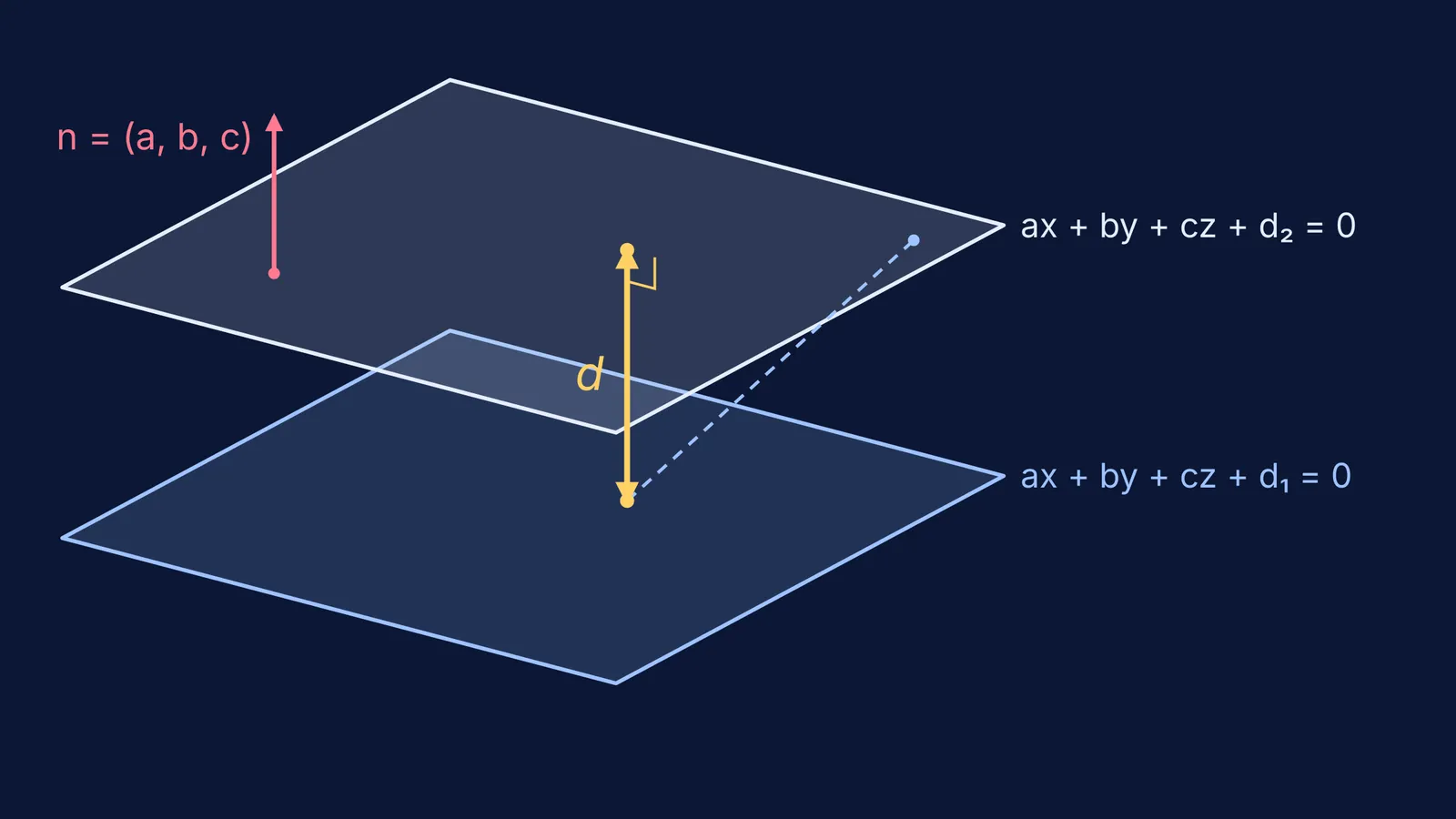
Two planes are parallel when their normal vectors are scalar multiples of each other. The OpenStax method for parallel planes is simple: pick a point in one plane and find its distance from the other. Do that with ax + by + cz + d₁ = 0 and ax + by + cz + d₂ = 0, and the algebra collapses:
Take a point (x₀, y₀, z₀) on the first plane, so ax₀ + by₀ + cz₀ = −d₁.
Put it into the distance formula for the second plane: |−d₁ + d₂| / √(a² + b² + c²).
So the distance between the parallel planes is |d₁ − d₂| / √(a² + b² + c²).
The numerator is the gap between the constant terms. The denominator is the length of the shared normal vector (a, b, c), which turns that gap into a perpendicular distance.
Why must the x, y, z coefficients match first?
The formula assumes both equations share exactly the same a, b and c. Parallel planes often arrive in disguise, with one equation a multiple of the other. Subtract the constants without fixing this and the answer is wrong, with nothing on the page to warn you.
The form matters too. Write both planes as ax + by + cz + d = 0 before reading off d₁ and d₂; mixing "= 2" with "− 8 = 0" flips a sign.
Worked example: coefficients that do not match
Find the distance between 2x − y + 2z + 3 = 0 and 4x − 2y + 4z + 5 = 0.
Check they are parallel: (4, −2, 4) is 2 × (2, −1, 2), so the normals are parallel.
Make the coefficients match: divide the second equation by 2 to get 2x − y + 2z + 5/2 = 0.
Read off d₁ = 3 and d₂ = 5/2, so |d₁ − d₂| = 1/2.
Find the length of the normal: √(2² + (−1)² + 2²) = √9 = 3.
Distance = (1/2) / 3 = 1/6.
The tempting wrong answer is |3 − 5| / 3 = 2/3. As a check, scale the first equation up instead: 4x − 2y + 4z + 6 = 0 against 4x − 2y + 4z + 5 = 0 gives 1/√36 = 1/6 again.
How do you find the distance from a line to a parallel plane?
A line is parallel to a plane when its direction vector is perpendicular to the plane's normal, so their dot product is zero. Every point on such a line is equally far from the plane, so one point is enough: use the point-to-plane formula from Theorem 2.14.
Example: find the distance from the line r = (î + k̂) + t(î + 2ĵ) to the plane 2x − y + 2z + 3 = 0.
Check parallel: direction (1, 2, 0) · normal (2, −1, 2) = 2 − 2 + 0 = 0.
Take the point on the line with t = 0, which is (1, 0, 1).
Substitute: |2(1) − 0 + 2(1) + 3| / 3 = 7/3.
If the dot product is not zero, the line meets the plane and the distance is 0.
A 30-second checklist before you write the answer
Are the normals proportional? If not, the planes meet and the distance is 0.
Are both equations in the form ax + by + cz + d = 0?
Are a, b and c identical in both? Scale one equation if not.
For a line, did you check direction · normal = 0 first?
If you keep slipping on the scaling step, work a few in a row in the Fermi Problem Library, where the step-by-step solver explains the reasoning rather than printing an answer. For the vectors underneath, the Fermi Concept Library gives each concept its own lesson and its place in the map.
Next, read our guide to 3D geometry for JEE: lines, planes and distances and the walkthrough on the foot of the perpendicular and image of a point in 3D.


