On this page
The internal section formula finds a point between A and B. External division asks for a point on the same straight line but outside the segment, whose distances from A and B are still in a given ratio. You learn the internal version in Class 10, in Section 7.3 of NCERT Class 10 Mathematics, Chapter 7 (Coordinate Geometry), and meet the external version in Class 12 vectors and JEE coordinate geometry.
What does dividing a line segment externally mean?
A point P divides AB externally in the ratio m : n when P lies on line AB extended, outside the segment, and PA : PB = m : n. NCERT's Class 12 textbook defines it the same way, for a point R dividing PQ externally with PR/QR = m/n, in Section 10.5.3 of Mathematics Part II, Chapter 10 (Vector Algebra).
Three things follow before any algebra:
If m > n, P is farther from A than from B, so it lies beyond B.
If m < n, P is closer to A, so it lies beyond A.
If m = n, no such point exists, because no point outside the segment is equally far from both ends. The formula shows this by dividing by zero.
How do you derive (mx₂ − nx₁)/(m − n)?
The NCERT Class 10 derivation of the internal formula uses similar right triangles to get PA/PB = (x − x₁)/(x₂ − x). Put P(x, y) on line AB beyond B and the same triangles give PA/PB = (x − x₁)/(x − x₂). Both differences now have the same sign, because P is on the same side of A as of B.
Set (x − x₁)/(x − x₂) = m/n.
Cross-multiply: n(x − x₁) = m(x − x₂).
Expand: nx − nx₁ = mx − mx₂.
Collect the x terms on one side: mx₂ − nx₁ = mx − nx = (m − n)x.
Divide: x = (mx₂ − nx₁)/(m − n).
The y-coordinate follows in the same way: y = (my₂ − ny₁)/(m − n). If P lies beyond A instead, both differences are negative, their ratio is still m/n, and the same five steps give the same answer. One formula covers both sides.
Why does the sign change from plus to minus?
The internal formula in NCERT Class 10, Section 7.3 is x = (mx₂ + nx₁)/(m + n). Replace n by −n and you get the external formula.
The reason is direction. For an internal point, the steps from A to P and from P to B point the same way along the line, so both parts of the ratio are positive. For an external point they point opposite ways, so the ratio is effectively m : −n. The vector form in NCERT Class 12, Section 10.5.3 follows the same rule, with position vector (mb + na)/(m + n) for internal division and (mb − na)/(m − n) for external division.
Worked example: dividing a segment externally in the ratio 2:3
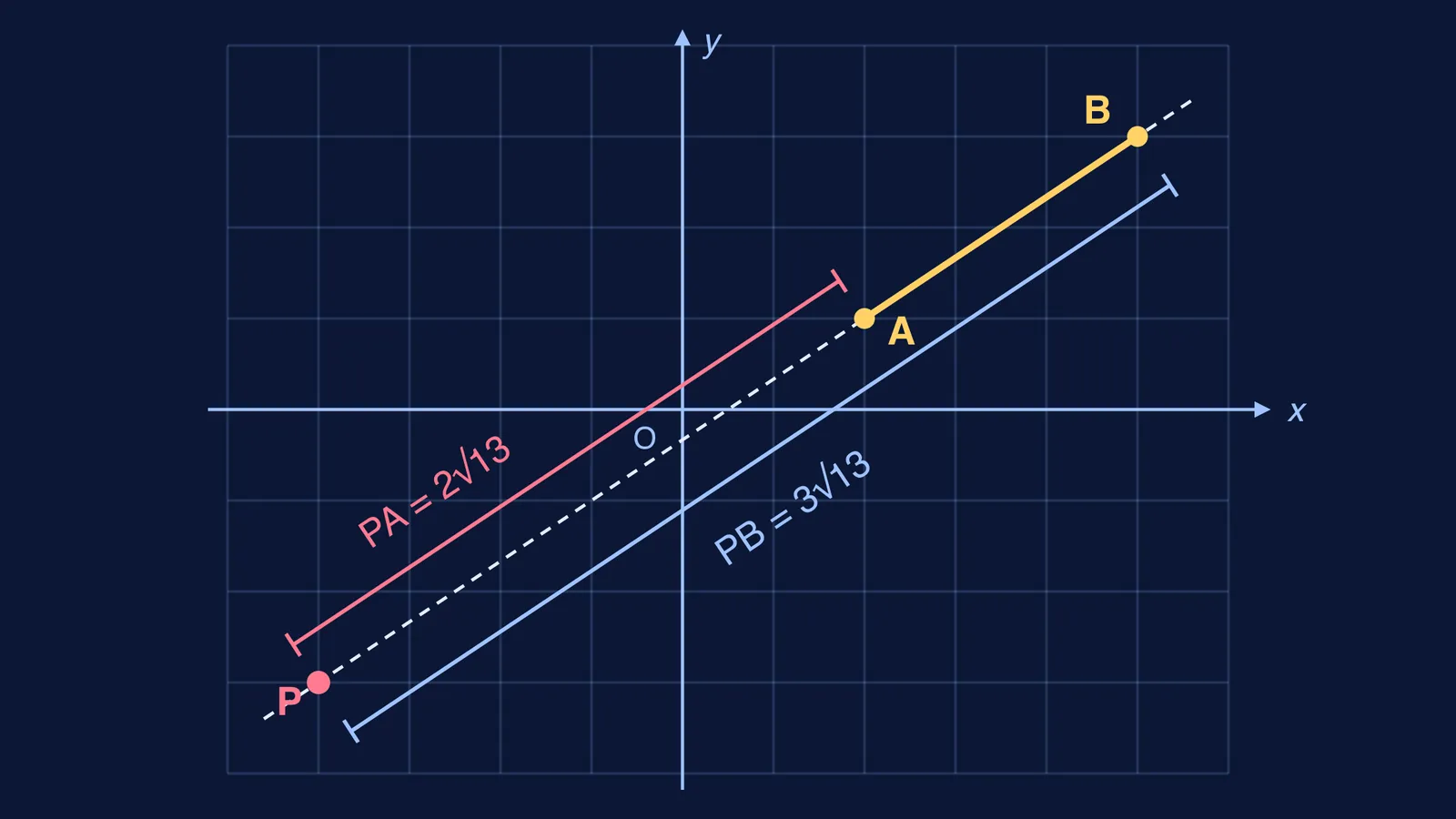
Find the point P that divides the segment joining A(2, 1) and B(5, 3) externally in the ratio 2 : 3.
Here m = 2, n = 3, x₁ = 2, y₁ = 1, x₂ = 5 and y₂ = 3. Before calculating, predict: m < n, so P must lie beyond A.
Denominator: m − n = 2 − 3 = −1.
x = (2 × 5 − 3 × 2)/(−1) = (10 − 6)/(−1) = −4.
y = (2 × 3 − 3 × 1)/(−1) = (6 − 3)/(−1) = −3.
So P = (−4, −3). Check it with the distance formula:
PA = √((2 + 4)² + (1 + 3)²) = √52 = 2√13.
PB = √((5 + 4)² + (3 + 3)²) = √117 = 3√13.
PA : PB = 2 : 3, as required. AB itself is √13 long, so P sits two AB-lengths behind A, on the side we predicted.
Where does external division come up in exams?
Vectors. NCERT's Example 11 in the Class 12 vector algebra chapter divides a join externally in the ratio 2 : 1 and gets the position vector 4b − a.
3D geometry. The same formula works with a z-coordinate added; see our guide to the section formula in 3D for internal and external division.
Finding the ratio. When you assume a ratio k : 1 and solve for k, a negative k means the division is external. Our post on the k:1 method for the ratio in which the x-axis divides a segment shows that method step by step.
If the internal formula is shaky, start with our guide to coordinate geometry in Class 10, with the distance and section formulae.
A common slip is the side, not the algebra. The Fermi Problem Library has worked problems with a step-by-step solver that explains the reasoning rather than printing an answer, so you can see where your method went wrong.
Try one now: divide the join of A(1, 2) and B(4, 8) externally in the ratio 2 : 3, predict the side first, then check your answer with the distance formula.