On this page
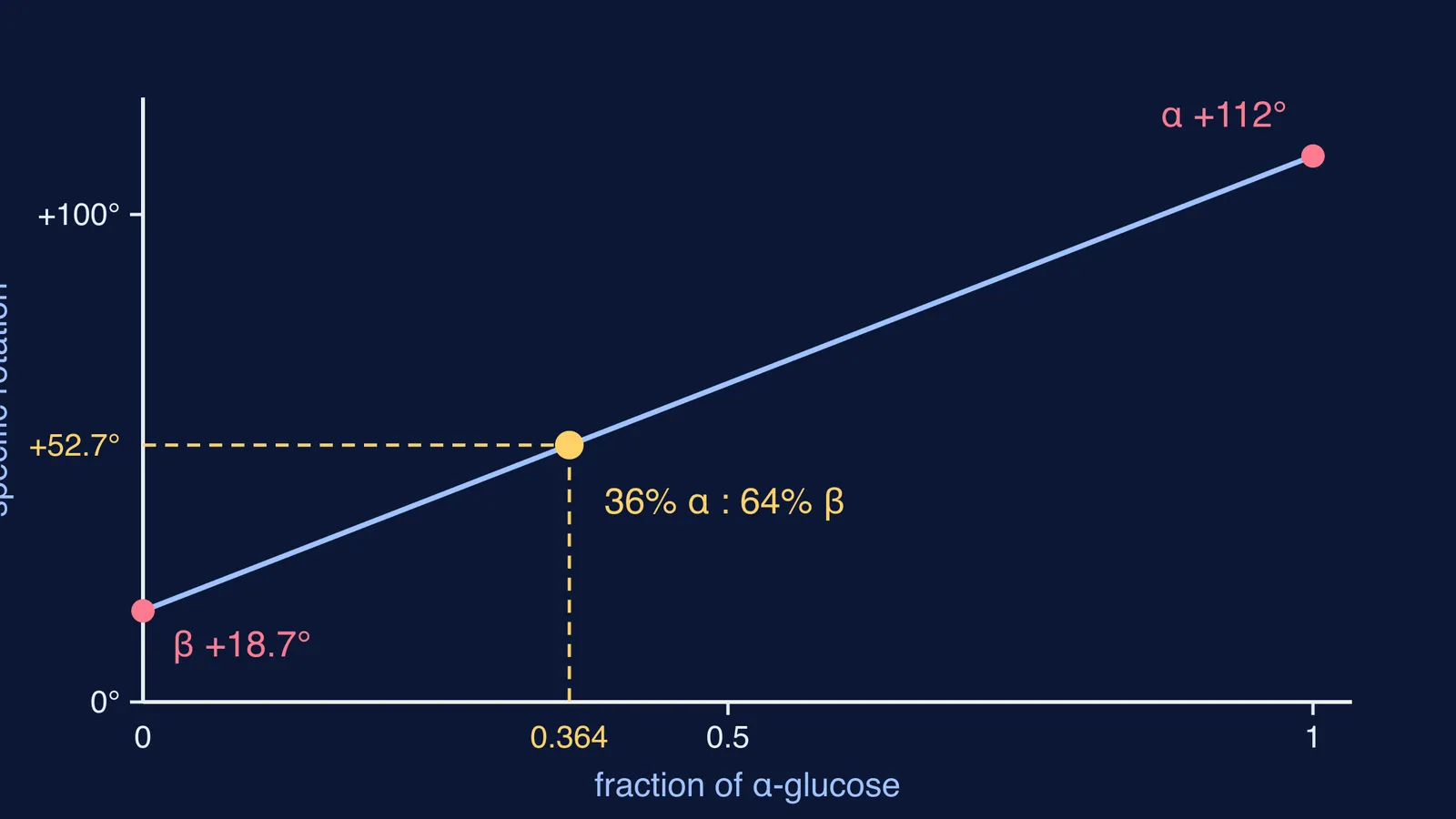
Dissolve α-D-glucose crystals in water and put the solution in a polarimeter. Its specific rotation starts at +112° and slowly falls until it stops at +52.7°. Start with β-glucose instead and it climbs from +18.7° to the same +52.7°. That drift is called mutarotation, and those three numbers are all you need to work out how much α and β glucose the final solution holds.
What is mutarotation?
Mutarotation is the change in optical rotation of a sugar solution as its two anomers turn into each other until they reach equilibrium (Wikipedia: Mutarotation). The same source says the French chemist Augustin-Pierre Dubrunfaut first noticed in 1844 that the rotation of a sugar solution changes with time.
Glucose in water is mostly a six-membered ring. When the chain closes into a ring, carbon 1 becomes a new stereocentre, and its –OH can point one of two ways. That gives two anomers, α and β. If the ring itself is hazy for you, read glucose structure: open chain, cyclic forms and anomers first, and the difference between epimers and anomers if those two words keep getting mixed up.
In solution the ring keeps opening into the open-chain aldehyde and closing again, and each time it can close as either anomer. As Chemistry LibreTexts/25:_Biomolecules-_Carbohydrates/25.05:_Cyclic_Structures_of_Monosaccharides_-_Anomers) puts it, "the opening and closing repeats continuously".
What are the specific rotations of alpha and beta glucose?
These three values come from Chemistry LibreTexts/25:_Biomolecules-_Carbohydrates/25.05:_Cyclic_Structures_of_Monosaccharides_-_Anomers):
α-D-glucopyranose has a specific rotation of +112°.
β-D-glucopyranose has a specific rotation of +18.7°.
The equilibrium mixture has a specific rotation of +52.7°.
Some sources, including Wikipedia, give α as +112.2°, which barely changes the answer. For what a polarimeter measures, see how a polarimeter measures optical rotation, step by step.
How do you calculate the percentage of alpha and beta glucose?
The key idea is that optical rotation adds up. The rotation of a mixture is the average of its parts, weighted by how much of each part there is. The open chain is less than 0.02% of the mixture (Chemistry LibreTexts/25:_Biomolecules-_Carbohydrates/25.05:_Cyclic_Structures_of_Monosaccharides_-_Anomers)), so you can treat the solution as just α plus β.
Let x be the fraction of α-glucose. The fraction of β-glucose is then 1 − x.
Write the weighted average: 112x + 18.7(1 − x) = 52.7
Expand the bracket: 112x + 18.7 − 18.7x = 52.7
Collect the x terms: 93.3x = 52.7 − 18.7 = 34.0
Solve: x = 34.0 ÷ 93.3 = 0.364
Convert: α = 36.4% and β = 100 − 36.4 = 63.6%
Check: 0.364 × 112 + 0.636 × 18.7 = 40.8 + 11.9 = 52.7. It works.
So the α:β ratio at equilibrium is about 36.4 : 63.6, or roughly 1 : 1.75. That matches the textbook figure of about 36% α and 64% β (Chemistry LibreTexts/25:_Biomolecules-_Carbohydrates/25.05:_Cyclic_Structures_of_Monosaccharides_-_Anomers)). If a question asks for the equilibrium constant of α ⇌ β, it is K = 63.6 ÷ 36.4 ≈ 1.75.
What if the question gives a reading part-way through?
The same shortcut works at any moment, not just at equilibrium. Suppose a fresh α-glucose solution reads +80° a few minutes after mixing. The fraction of α is (80 − 18.7) ÷ 93.3 = 61.3 ÷ 93.3 = 0.657. So at that moment the solution is about 65.7% α and 34.3% β, and it is still heading down towards +52.7°.
Why is there more beta than alpha glucose?
You might expect 50:50. Here is a quick sanity check: the plain average of +112° and +18.7° is +65.35°. The real equilibrium reading, +52.7°, sits closer to the β value, so β must be the bigger share. Chemistry LibreTexts/25:_Biomolecules-_Carbohydrates/25.05:_Cyclic_Structures_of_Monosaccharides_-_Anomers) explains why: β-D-glucopyranose is the only aldohexose that can be drawn with all its bulky groups (–OH and –CH2OH) in equatorial positions, which makes it the most stable of the eight D-aldohexoses.
Which mistakes cost marks on this question?
Pairing x with the wrong rotation. Whatever you call x, its rotation goes next to it.
Writing 18.7x instead of 18.7(1 − x), so the two fractions no longer add up to 1.
Rounding 93.3 to 93 or 90 too early. Keep the exact numbers until the last step.
Saying mutarotation needs a lot of open-chain glucose. It needs only a trace, because that trace is constantly being made and used up.
If your answer keeps coming out different, the Fermi Problem Library has worked problems with a step-by-step solver that explains the reasoning rather than printing an answer, so you can find the exact line where your working went off track. If the real gap is anomers or optical activity themselves, each has its own lesson in the Fermi Concept Library.
Try the same three steps on any sugar whose two anomer rotations and equilibrium reading you are given.