

On this page
You fill a glass tube with sugar solution, look into an eyepiece and turn a dial until the view goes dark again. The number on that dial is the optical rotation. Here is what happens to the light, how to tell dextro from laevo, and how to turn one reading into a specific rotation. If you want the history first, read who discovered optical activity and Biot's 1815 sugar test.
What happens inside a polarimeter?
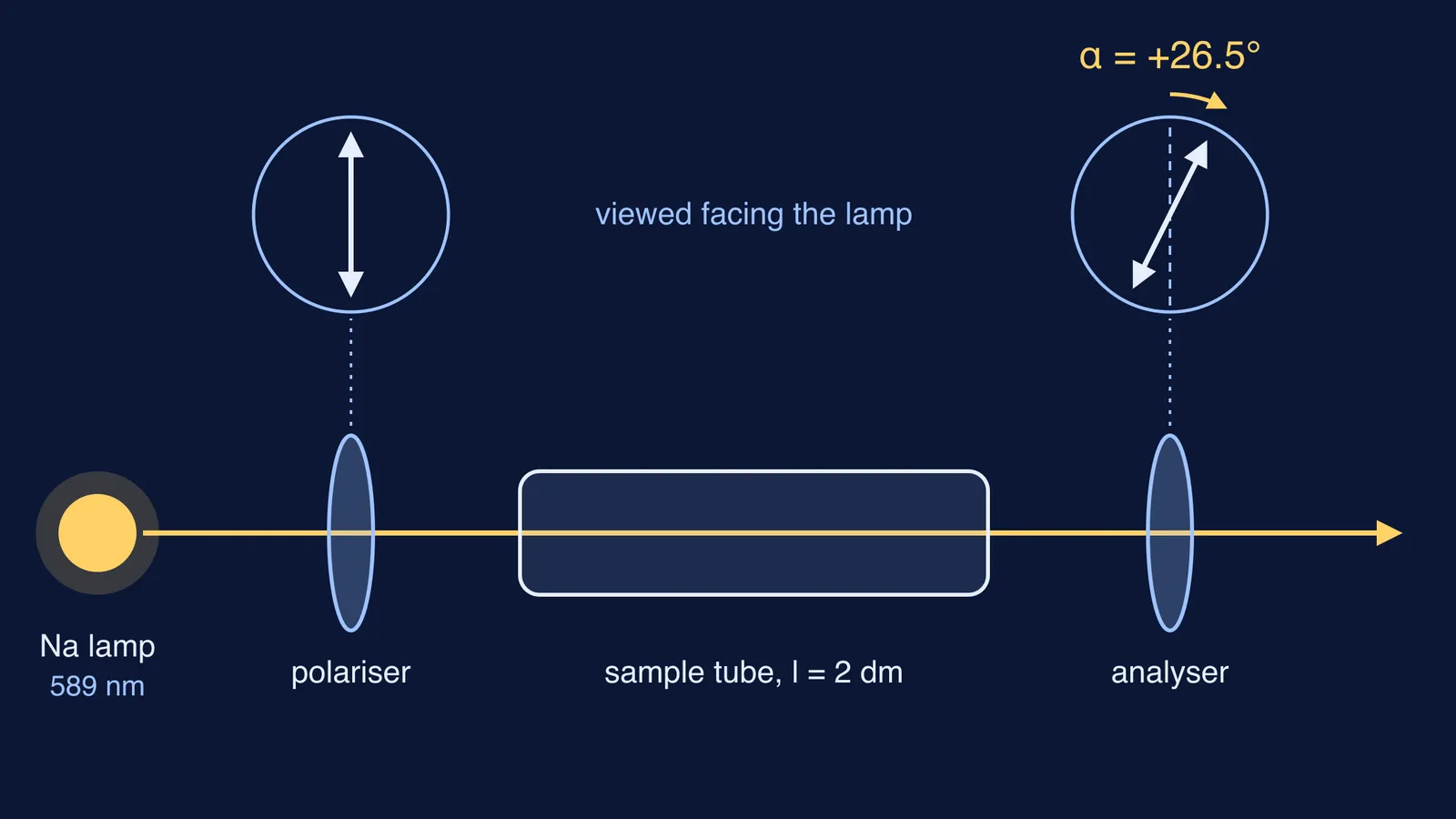
The main parts of a polarimeter sit in a line: a light source, a polariser, a sample tube and an analyser, with your eye or a detector at the end (Wikipedia: Polarimeter).
Light source: one wavelength, usually the sodium D line at 589 nm (LibreTexts, Optical Activity/03:_Conformations_and_Stereochemistry/3.06:_Optical_Activity)).
Polariser: a fixed filter that lets through only light vibrating in one plane.
Sample tube: a chiral compound in the tube turns that plane, a property called optical activity (LibreTexts/03:_Conformations_and_Stereochemistry/3.06:_Optical_Activity)).
Analyser: a second polariser that you can rotate; the angle you turn it through equals the angle of rotation (Wikipedia: Polarimeter).
You first set the zero with the tube full of pure solvent. Then you fill it with the sample and turn the analyser until the view returns to the same darkness. Many instruments use a half-shade device that splits the field into two halves, and you turn the analyser until both halves are equally dark (Wikipedia: Polarimeter).
Dextro or laevo: clockwise from where?
When you look at the source of light, dextrorotation is clockwise rotation (+) and laevorotation is anticlockwise rotation (−) (Wikipedia: Optical rotation). At the eyepiece you are that observer, so a clockwise turn of the analyser as you see it means a dextrorotatory (+) sample, and an anticlockwise turn means laevorotatory (−) (LibreTexts, Optical Activity/Chirality/Optical_Activity)).
Two enantiomers rotate light by the same amount in opposite directions: (S)-ibuprofen is +54.5° in methanol and (R)-ibuprofen is −54.5°, and a 50:50 racemic mixture shows no rotation at all (LibreTexts/03:_Conformations_and_Stereochemistry/3.06:_Optical_Activity)). If shapes that cannot be turned into each other still feel abstract, see why cis and trans but-2-ene can't twist into each other.
How do you calculate specific rotation from the reading?
Specific rotation is the observed rotation divided by path length in decimetres and concentration in g/mL: [α] = α / (l × c) (Wikipedia: Specific rotation). Some textbooks write c in g per 100 mL and multiply by 100, so check which unit your book uses before you divide. At the D line and 20 °C, sucrose is +66.37°, glucose is +52.7° and fructose is −92° (Wikipedia: Specific rotation).
Worked example: a sucrose solution
Dissolve 20.0 g of sucrose and make it up to 100 mL, so c = 0.200 g/mL.
Use a 2 dm tube, so l = 2.
Predicted rotation: α = 66.37 × 2 × 0.200 = +26.5°.
At the eyepiece you turn the analyser 26.5° clockwise to restore the match. That is the angle in the diagram above.
Now run it backwards. An unknown sugar at 0.100 g/mL in a 1 dm tube reads −9.2°. Then [α] = −9.2 / (1 × 0.100) = −92°, which matches fructose.
If you can follow the formula but keep slipping on units, the Fermi Problem Library has worked problems with a step-by-step solver that explains the reasoning rather than printing an answer.
Why measure a second concentration?
The analyser gives the same view every 180°, so a reading of +26.5° could also be −153.5°. A single polarimeter measurement cannot tell when the true rotation is larger than 180°; the fix is to measure at more than one concentration or a shorter path length (Wikipedia: Specific rotation).
In the sucrose example, dilute to 0.100 g/mL. A true +26.5° should halve to +13.3°. A true −153.5° would halve to −76.8°, which looks nothing like it. One extra reading settles the question.
The sign flip on hydrolysis is the origin of the name invert sugar (Wikipedia: Optical rotation).
A checklist for the practical and the viva
Zero the instrument with a tube of pure solvent.
Fill the tube with no air bubble in the light path.
Turn the analyser until both halves of the field are equally dark, and approach from both sides.
Write the sign as seen facing the lamp: clockwise is (+).
Note the wavelength, temperature, solvent and concentration with the result, for example [α]D20 = +66.4° (c 0.200 g/mL, water).
Repeat at half the concentration to rule out the 180° trap.
Before a viva, practise saying why the half-shade is there and why you need the blank; our guide on practising a lab viva with AI in physics and chemistry shows how. For chirality, enantiomers and the rest of stereochemistry, the Fermi Concept Library covers every concept in physics, chemistry, biology, mathematics and computing, each with its own lesson and its place in the map.


