
On this page
But-2-ene, CH3CH=CHCH3, comes in two forms. In cis but-2-ene the two methyl groups sit on the same side of the double bond. In trans but-2-ene they sit on opposite sides. Same atoms, same bonds, yet two different compounds. The quickest way to see why is to build one and try to turn it into the other.
Why can't cis and trans isomers rotate into each other?
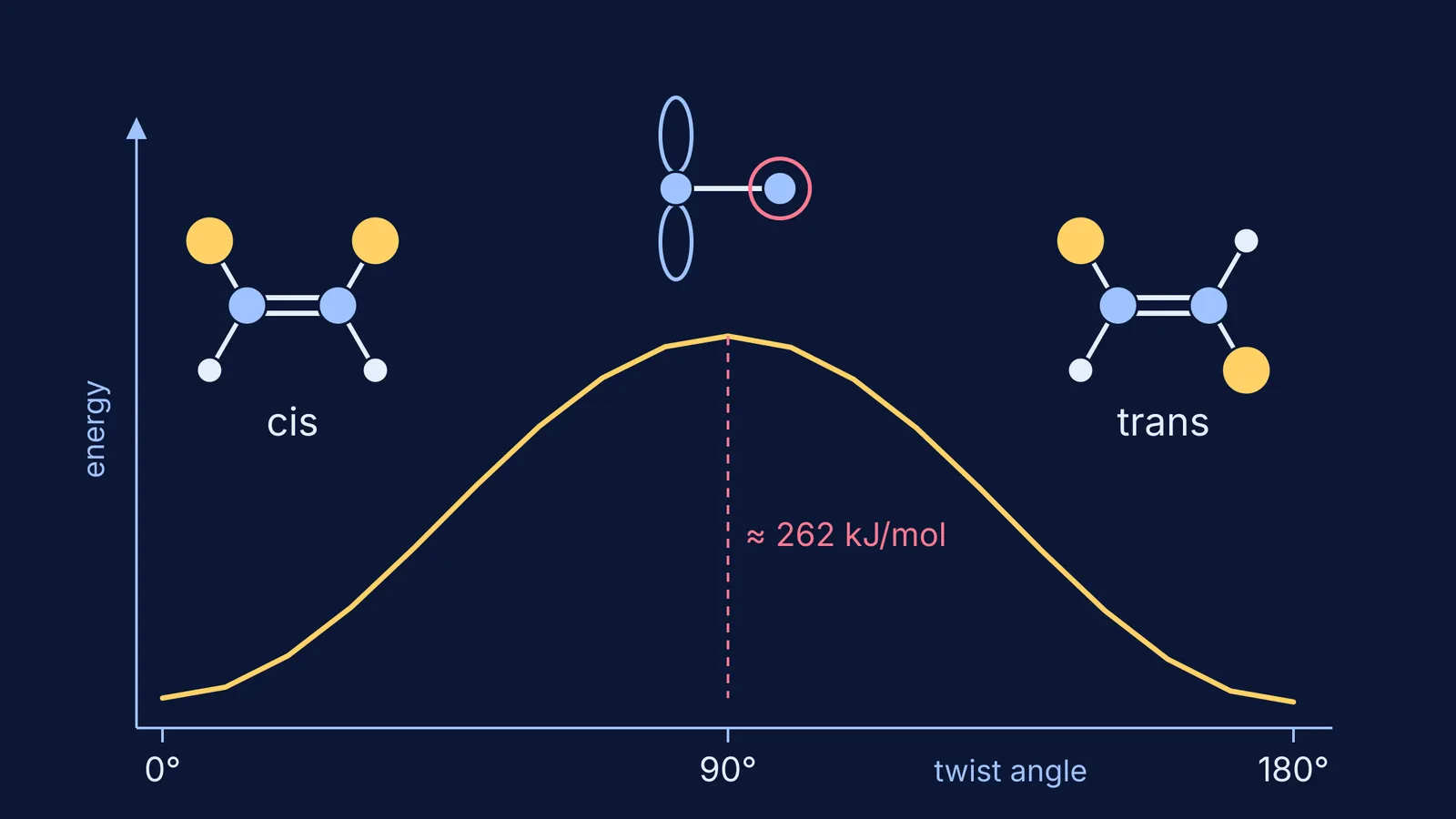
A double bond is one σ bond plus one π bond, and the π bond only exists while the p orbitals on the two carbons stay parallel and overlap. The OpenStax organic chemistry text puts it plainly: for rotation to occur around a double bond, the π bond must break and re-form/07%3A_Alkenes-_Structure_and_Reactivity/7.04%3A_Cis-Trans_Isomerism_in_Alkenes). Twist one end by 90° and the p orbitals point at right angles to each other, so the overlap, and the π bond, is gone.
That costs a lot of energy. For but-2-ene, the 90° twisted form is 262 kJ/mol higher in energy than the flat molecule/18%3A_Chemical_Kinetics/18.05%3A_Unimolecular_Processes), and at room temperature only a tiny fraction of molecules have that much energy. Compare a single bond: the same OpenStax chapter gives the barrier to rotation in ethane as only 12 kJ/mol/07%3A_Alkenes-_Structure_and_Reactivity/7.04%3A_Cis-Trans_Isomerism_in_Alkenes). The double-bond barrier is roughly 20 times higher, which is why single-bond shapes interconvert constantly and cis and trans alkenes can be bottled separately.
What does the twist look like in a 3D model?
Use a ball-and-stick kit, or two pencils and some clay. Predict before each step.
Build ethane. Hold one carbon still and spin the other. It turns freely: that is a single bond.
Build cis but-2-ene with two links between the central carbons. Keep the six atoms around the double bond flat in one plane.
Try to rotate one end. It will not turn without bending or pulling out a link. That resistance is your model's π bond.
Pull out one link and turn one end by 90°. The two halves now sit in perpendicular planes: the high-energy peak in the diagram above.
Keep turning to 180° and put the link back. You now hold trans but-2-ene. You broke a bond to get there, so this was a reaction, not a change of shape.
No kit? Our piece on using 3D molecule visualisation to study chemistry covers other ways to see shapes in three dimensions. The Fermi Simulation Lab has interactive simulations for ideas that are easier to see than to read, so you can test a prediction and watch what happens.
Which has the higher boiling point, cis or trans but-2-ene?
Predict first. In cis, both C–CH3 bond dipoles point to the same side, so they add up. In trans they point opposite ways and cancel. That makes a guess: cis is slightly polar, trans is not, so cis should stick to its neighbours a little more and boil higher.
The data agree. The NIST Computational Chemistry Comparison and Benchmark Database lists the dipole moment of cis but-2-ene as 0.257 D and trans as 0 D by symmetry. The NIST Chemistry WebBook gives cis but-2-ene a boiling point of 276.84 K, about 3.7 °C, and trans but-2-ene a boiling point of 274.2 K, about 1.0 °C. The gap is small because the dipole is small, but it points the way you predicted. For a refresher on adding bond dipoles as vectors, see our guide to dipole moment and molecular polarity.
Why does trans melt higher if cis boils higher?
Here is the twist that catches students out. The same NIST pages give trans but-2-ene a melting point of 167.35 K, about −106 °C, and cis but-2-ene 133.85 K, about −139 °C. Melting depends heavily on how well molecules pack into a solid, and the straighter, more symmetric trans shape packs better. Boiling depends more on attractions between molecules in the liquid, where the cis dipole helps.
Trans is also the more stable isomer: OpenStax reports that trans but-2-ene is more stable than cis by 2.8 kJ/mol/07%3A_Alkenes-_Structure_and_Reactivity/7.06%3A_Stability_of_Alkenes), because the two methyl groups crowd each other on the cis side. Notice how tiny that is next to the 262 kJ/mol barrier. Trans is lower in energy, but cis still cannot slide downhill to it at room temperature.
How do you write this answer in an exam?
Use this four-line frame:
Structure: the C=C bond is a σ bond plus a π bond made by sideways overlap of parallel p orbitals.
Rotation: rotating one carbon by 90° makes the p orbitals perpendicular and breaks the π bond.
Energy: that costs far more energy than molecules have at room temperature, so the isomers do not interconvert.
Consequence: they are separate compounds with different physical properties, such as dipole moment and boiling point.
To see how cis-trans isomers fit beside optical isomers, read our overview of stereoisomerism in organic chemistry.