On this page
In organic chemistry, students often confuse epimers and anomers when studying the structure of carbohydrates. Both terms describe pairs of molecules that are almost identical, but the difference between them lies in where the variation occurs and how the molecules behave in solution.
What is the difference between epimers and anomers?
The difference between epimers and anomers depends on the scope of the rule and the exact location of the changed carbon atom.
An epimer is a stereoisomer that differs in configuration at exactly one chiral centre out of two or more 1. This is a broad, general term that applies to both open-chain molecules and cyclic molecules across all of organic chemistry.
An anomer is a specific type of epimer found only in cyclic saccharides (sugars), where the single difference occurs strictly at the anomeric carbon—the carbon atom that closes the ring 2.
This relationship is often tested in exams: all anomers are epimers, but not all epimers are anomers.
What is an epimer?
When two molecules share the exact same chemical formula and atom connectivity but differ in the three-dimensional arrangement of atoms at just one chiral carbon, they are called epimers.
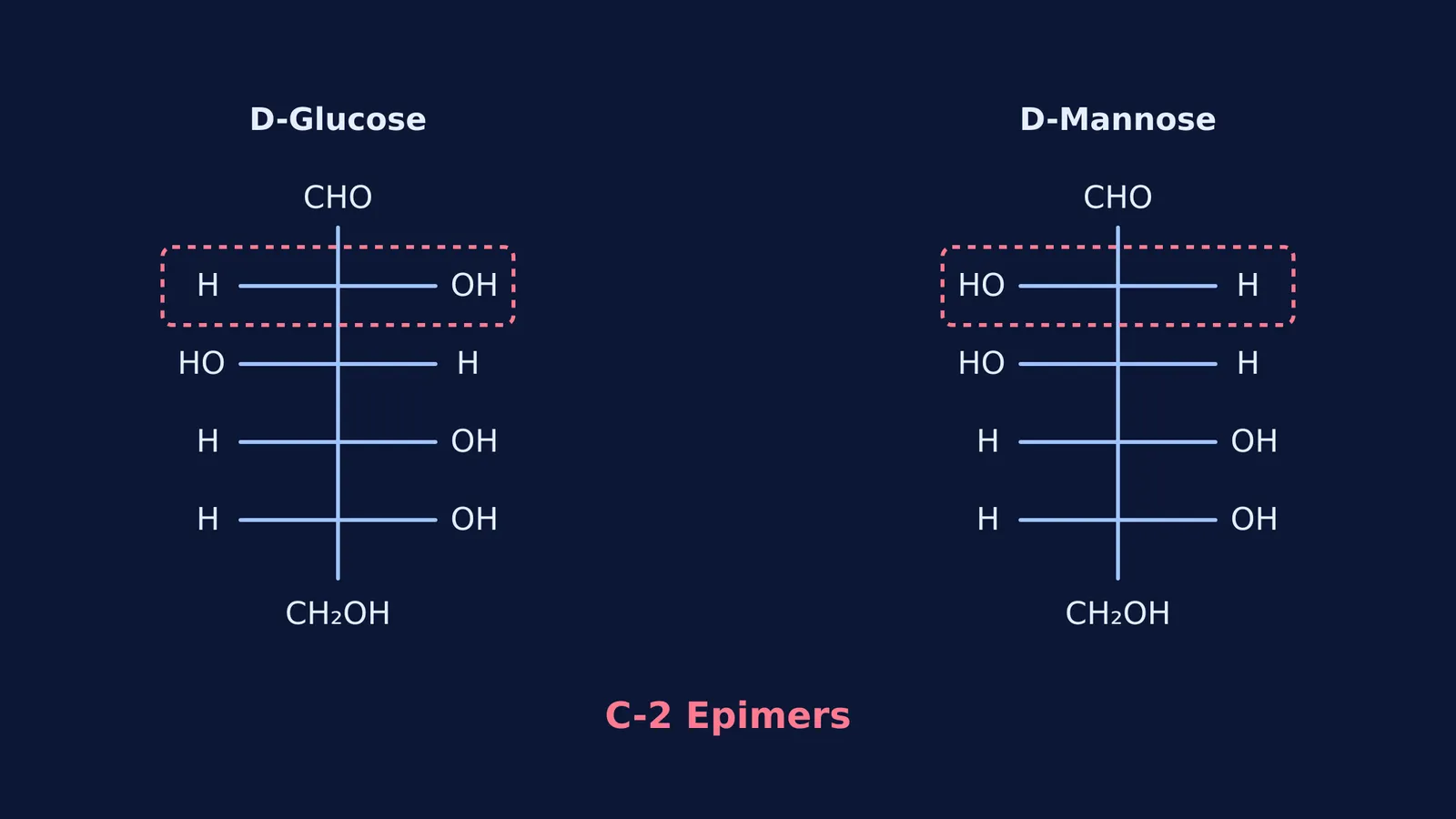
For example, D-glucose and D-mannose are epimers 1. If you draw their open-chain Fischer projections side by side, their structures are completely identical at carbon-3, carbon-4 and carbon-5. The only difference is at carbon-2 (C-2), where the hydroxyl (-OH) group points to the right in glucose and to the left in mannose. Because the variation happens specifically at C-2, they are called C-2 epimers.
Another common example is the relationship between D-glucose and D-galactose. In this pair, the molecules are identical everywhere except at carbon-4 (C-4), making them C-4 epimers.
Changing one epimer into another is called epimerisation 1. This process involves breaking and reforming chemical bonds, which usually requires a specific enzyme or a strong chemical reaction.
If you are struggling to visualise these structural variations while revising, the Fermi Concept Library organises every concept in chemistry, each with its own lesson and its place in the map.
What is an anomer?
An anomer is a highly specific epimer where the single point of difference is the hemiacetal or hemiketal carbon, which is formed when an open-chain sugar closes into a ring 2. This specific carbon is called the anomeric carbon. In aldoses like glucose, the anomeric carbon is C-1, while in ketoses like fructose, it is C-2.
When an open-chain sugar like D-glucose folds into its cyclic form in water, the carbonyl oxygen becomes a hydroxyl group. This new hydroxyl group at C-1 can point in one of two directions, creating two new cyclic molecules: α-D-glucopyranose and β-D-glucopyranose. Because these two molecules differ only at the C-1 anomeric carbon, they are anomers of each other 2.
In the alpha (α) anomer, the C-1 hydroxyl group typically points down (trans to the CH₂OH group on the ring), while in the beta (β) anomer, it points up (cis to the CH₂OH group).
Unlike epimerisation, changing one anomer into another happens spontaneously in water through a process called mutarotation 2. The sugar ring briefly opens up and then closes again, allowing the alpha and beta forms to reach an equilibrium mixture.
Count the differences: Do the molecules differ at exactly one chiral centre? If no, they are not epimers. If yes, move to step 2.
Check the shape: Is the molecule a closed ring? If it is an open-chain Fischer projection, it cannot be an anomer.
Locate the difference: If the single variation is at the carbon that formed the ring (C-1 in glucose, C-2 in fructose), they are anomers. If the variation is anywhere else (like C-2 or C-4 in an aldohexose), they are epimers but not anomers.
How do you solve carbohydrate structure problems?
Identifying epimers and anomers is a common hurdle in competitive chemistry exams. Multiple-choice questions often present four Haworth projections and ask you to identify the relationship between them, testing your ability to spot small stereochemical differences quickly.
When you practice these questions, simply looking up the answer key is rarely helpful for long-term retention. The Fermi Problem Library has worked problems with a step-by-step solver that explains the reasoning rather than printing an answer, helping you understand exactly why a molecule is classified as an epimer rather than an anomer.
For more help with organic chemistry structures, you can review how stereocentres behave during reactions in our guide to SN1 and SN2 stereochemistry, or explore IUPAC numbering for enynes to strengthen your naming rules.