

On this page
Colour blindness and haemophilia questions look like ordinary Punnett squares, but one detail changes everything: a boy has only one X chromosome. Write genotypes the X-linked way and every question follows the same steps.
Why are colour blindness and haemophilia more common in boys?
Red-green colour blindness occurs in about 8 per cent of males and about 0.4 per cent of females, according to the NCERT Class 12 Biology chapter on Principles of Inheritance and Variation. NCERT explains that the genes involved sit on the X chromosome, and males have one X while females have two.
MedlinePlus Genetics, from the US National Library of Medicine, gives similar figures for people of Northern European ancestry: red-green colour vision deficiency occurs in about 1 in 12 men and 1 in 200 women. The genes involved, OPN1LW and OPN1MW, sit on the X chromosome (MedlinePlus Genetics).
Haemophilia follows the same X-linked recessive pattern. About 1 in 4,000 to 1 in 5,000 males worldwide are born with haemophilia A, and about 1 in 20,000 newborn males have haemophilia B (MedlinePlus Genetics on hemophilia). The reason is the same for both: in a male, one altered copy of the gene is enough to cause the condition, while a female usually needs two.
How do you write X-linked genotypes?
Use C for normal vision and c for colour blindness (or H and h for haemophilia), and always attach the letter to the X.
Normal female: XC XC
Carrier female: XC Xc (normal vision, carries the allele)
Colour-blind female: Xc Xc
Normal male: XC Y
Colour-blind male: Xc Y
The Y gets no letter because it carries no copy of the gene. So there is no carrier male: a boy either has the allele and shows the trait, or does not.
What is criss-cross inheritance?
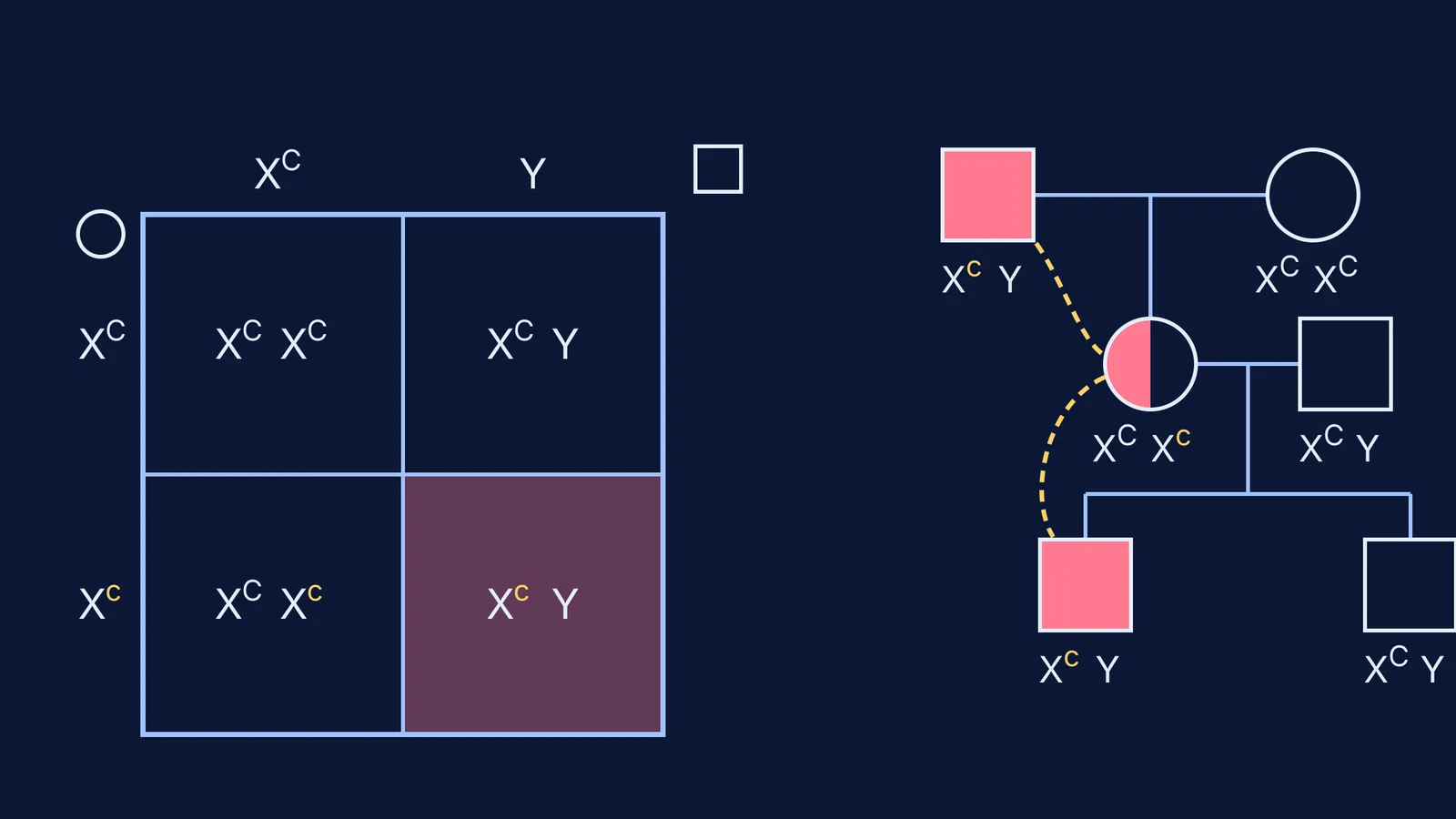
Criss-cross inheritance is the zig-zag path an X-linked recessive trait takes across generations: from an affected grandfather, through his carrier daughter, to her son. It happens because fathers cannot pass X-linked traits to their sons, as MedlinePlus explains: a father gives his son a Y, and gives his X to every daughter.
If the vocabulary of sex chromosomes still feels shaky, the Fermi Concept Library covers every concept in biology, each with its own lesson and its place in the map.
How do you solve carrier-mother and affected-father questions step by step?
Write both parents' genotypes with the allele on the X.
List the gametes: a carrier mother makes two kinds of egg; a father makes X sperm and Y sperm.
Fill a 2 by 2 Punnett square.
Split the offspring into daughters and sons before counting.
Check whether the question asks about all children or only sons.
Example 1: carrier mother and normal father
XC Xc crossed with XC Y gives XC XC, XC Xc, XC Y and Xc Y. All daughters have normal vision and half are carriers. Half the sons are colour blind. NCERT states the same rule: the son of a woman who carries the gene has a 50 per cent chance of being colour blind (NCERT).
Example 2: haemophilic father and normal mother
XH XH crossed with Xh Y gives XH Xh daughters and XH Y sons. Every daughter is a carrier and every son is unaffected. This is the first step of criss-cross inheritance: the trait skips his sons and waits in his daughters.
Example 3: carrier mother and colour-blind father
XC Xc crossed with Xc Y gives XC Xc, Xc Xc, XC Y and Xc Y. Half the daughters and half the sons are colour blind. NCERT notes that a daughter will not normally be colour blind unless her mother is a carrier and her father is colour blind, which is exactly this cross (NCERT). The same chapter calls a haemophilic female extremely rare, because her mother must be at least a carrier and her father haemophilic.
How do you check an X-linked answer?
Run three checks before you move on.
Every son's X came from his mother. If a son is affected, his mother has at least one recessive allele.
Every daughter carries her father's X. An affected father means every daughter is at least a carrier.
An affected daughter needs an affected father. If your answer breaks this, recheck the gametes.
To decide whether a family tree is X-linked at all, see how to tell if a pedigree chart is dominant or recessive. The X-linked colour blindness simulation shows why real families rarely give neat ratios, and genotypic versus phenotypic ratios helps when a question asks for a ratio.
If you keep landing on the wrong fraction, the Fermi Problem Library has worked problems with a step-by-step solver that explains the reasoning rather than printing an answer. These are textbook crosses; for a real family question, ask a doctor or genetic counsellor.


