

On this page
Pedigree analysis is a puzzle of logic. By tracking a trait across a family tree, geneticists can deduce the hidden alleles behind the phenotypes you see. The most common question in exams and biology homework is working out whether a trait is dominant or recessive, and whether it sits on an autosome or a sex chromosome.
The basic symbols of a pedigree chart
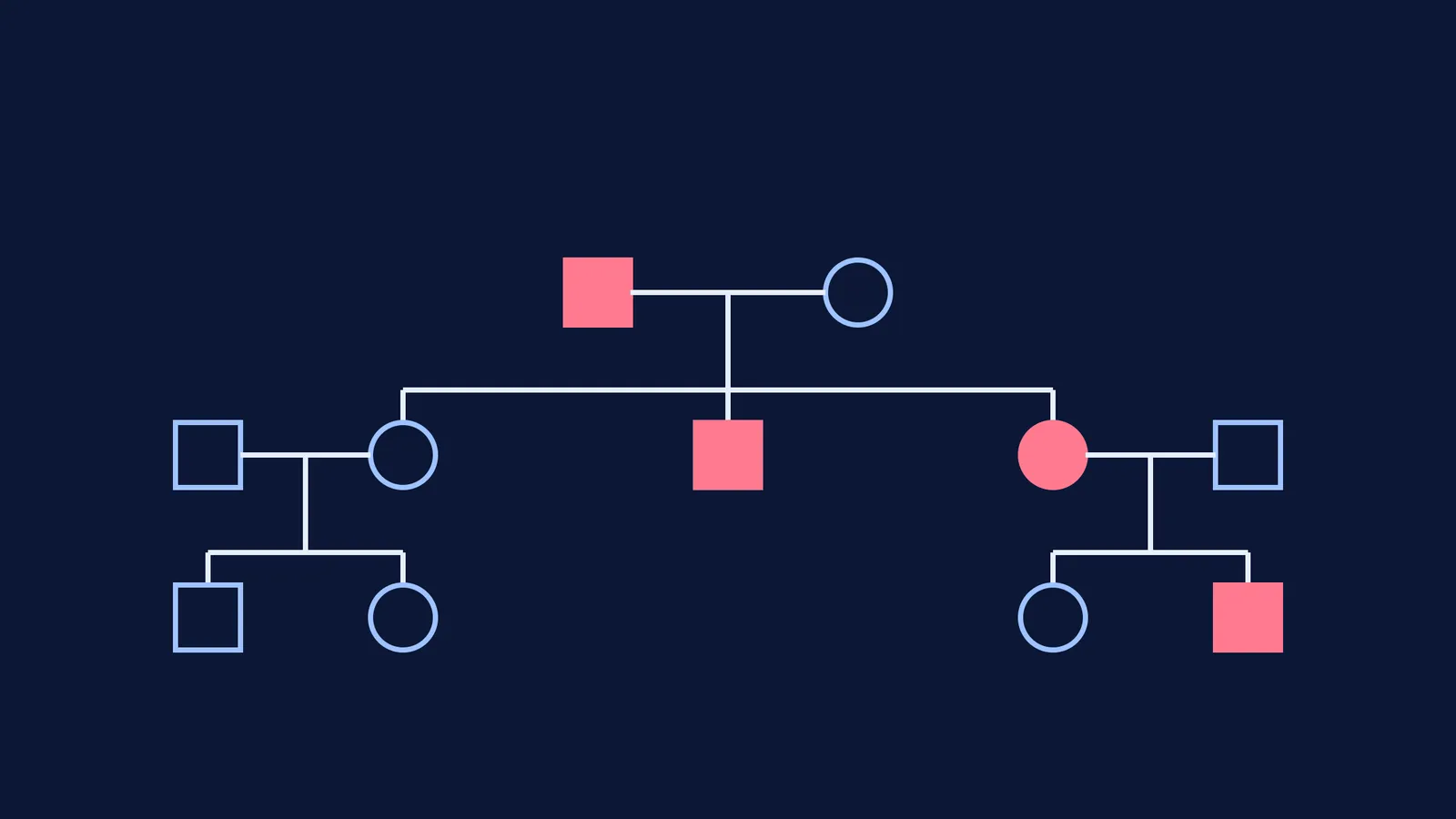
Before you can read the genetic logic, you need to be fluent in the visual language. In a standard pedigree chart:
Squares represent males.
Circles represent females.
Shaded shapes represent individuals who express the trait being studied (affected individuals).
Unshaded shapes represent individuals who do not express the trait (unaffected individuals).
Horizontal lines between a square and a circle denote mating, while vertical lines drop down to their offspring.
What makes a trait dominant or recessive?
According to the National Institutes of Health, dominant inheritance requires only one altered gene copy to express a trait, while recessive inheritance requires two (MedlinePlus, 2020). This biological rule translates into predictable visual patterns on a pedigree chart.
A dominant allele cannot hide. If a child inherits it, they will show the trait, which means one of their parents must also show it. Conversely, a recessive allele can be masked by a dominant one. This creates "carriers"—people who have one copy of the recessive gene but do not show the trait themselves.
How can you spot a dominant trait?
A dominant trait leaves a continuous trail. You are looking for a vertical pattern of inheritance.
No skipped generations: The trait usually appears in every single generation of the family tree.
Affected parents, affected children: Every affected person has at least one affected parent.
The decisive proof: If two affected parents have an unaffected child, the trait must be dominant. Both parents must be heterozygous carriers of the normal recessive allele, passing it down to the child. If the trait were recessive, two affected parents could only pass on the recessive alleles, meaning all of their children would be affected.
How do you identify a recessive trait?
Recessive traits often look like they appear out of nowhere. Because they can be masked by dominant alleles, the trait can pass silently through a family line.
Skipping generations: The trait can remain hidden in carriers for several generations before resurfacing.
The decisive proof: Two unaffected parents can have an affected child if the trait is recessive, meaning both parents are heterozygous carriers (MedlinePlus, 2020).
This logic is crucial when tracking common Mendelian disorders: sickle-cell anaemia, thalassemia and PKU, which are frequently inherited in an autosomal recessive pattern.
Is the trait autosomal or sex-linked?
Once you know if the allele is dominant or recessive, the next step is locating it. Autosomal traits sit on the 22 non-sex chromosomes, meaning males and females are affected equally. X-linked traits sit on the X chromosome and show a sex bias.
X-linked recessive: These conditions are far more common in males. Because males only have one X chromosome, a single recessive allele will cause them to express the trait. An affected mother will always pass the trait to all of her sons, because they inherit her only X chromosomes.
X-linked dominant: An affected father will pass the trait to all of his daughters (who inherit his only X chromosome) and none of his sons (who inherit his Y chromosome).
The autosomal proof: If an affected father passes a trait to his son, it rules out X-linked inheritance, confirming it is autosomal (MedlinePlus, 2020). Fathers pass a Y chromosome to their sons, so any trait passed from father to son cannot be on the X chromosome.
If you are trying to deduce a specific genotype from a pedigree, you are effectively applying the same logical deduction used in a Test cross vs back cross: identifying an unknown genotype, but using family history instead of a breeding experiment.
A step-by-step checklist for pedigree problems
When faced with a complex chart in an exam, ask these questions in order to quickly eliminate incorrect patterns:
Do unaffected parents have an affected child?
Yes: It must be recessive.
Do affected parents have an unaffected child?
Yes: It must be dominant.
Does every affected son have an affected mother?
No: It cannot be X-linked recessive.
Does an affected father have an affected son?
Yes: It is autosomal (not X-linked).
Memorising the rules is helpful, but seeing them in action builds intuition. The Fermi Simulation Lab has interactive pedigree charts where you can change the genotypes of the parents and watch how the inheritance probabilities shift across the offspring. If you get stuck on a particularly tricky chart, Fermi's AI tutor works out what you already know, builds a plan for the session, and teaches through it—drawing the figure and checking your understanding as it goes.


