

On this page
Color vision deficiency, often referred to as colour blindness, alters how a person perceives shades of red, green, or blue. According to the US National Library of Medicine, colour vision deficiency affects about 2.5% of individuals worldwide. The condition is famous in biology and exam preparation not just because it is common, but because it perfectly illustrates a pattern called X-linked recessive inheritance.
If you are studying genetics for a board exam or NEET-UG, X-linked inheritance is a key topic. Tracing a trait through a family tree requires you to track the X and Y chromosomes across generations.
How does X-linked inheritance work?
Human cells typically contain two sex chromosomes. Females inherit two X chromosomes (XX), while males inherit one X and one Y chromosome (XY).
Red-green colour blindness, the most common form of the condition, is linked to variants in the *OPN1LW* and *OPN1MW* genes. Because these genes are located on the X chromosome, the trait follows an X-linked recessive pattern. "Recessive" means that if a person has a normal copy of the gene, it will mask the effects of the altered copy.
Fathers pass their Y chromosome to their sons and their X chromosome to their daughters. Mothers pass one of their two X chromosomes to all their children, regardless of sex. This creates a hard rule in genetics: a father cannot pass an X-linked trait to his son.
Why are men more likely to be colour blind?
The prevalence of colour blindness is heavily skewed by biological sex. Among populations with Northern European ancestry, red-green colour vision deficiency occurs in about 1 in 12 men, but only 1 in 200 women.
This dramatic difference is a direct result of X-linked inheritance. Because males have only one X chromosome, inheriting a single altered gene from their mother is enough to cause the condition. They do not have a second X chromosome to provide a healthy backup copy.
Females, on the other hand, have two X chromosomes. To be colour blind, a female must inherit two altered copies of the gene—one from her mother and one from her father. If she inherits only one altered copy, she will have normal colour vision but will be a "carrier" who can pass the trait to her children.
Running the simulation: The carrier mother cross
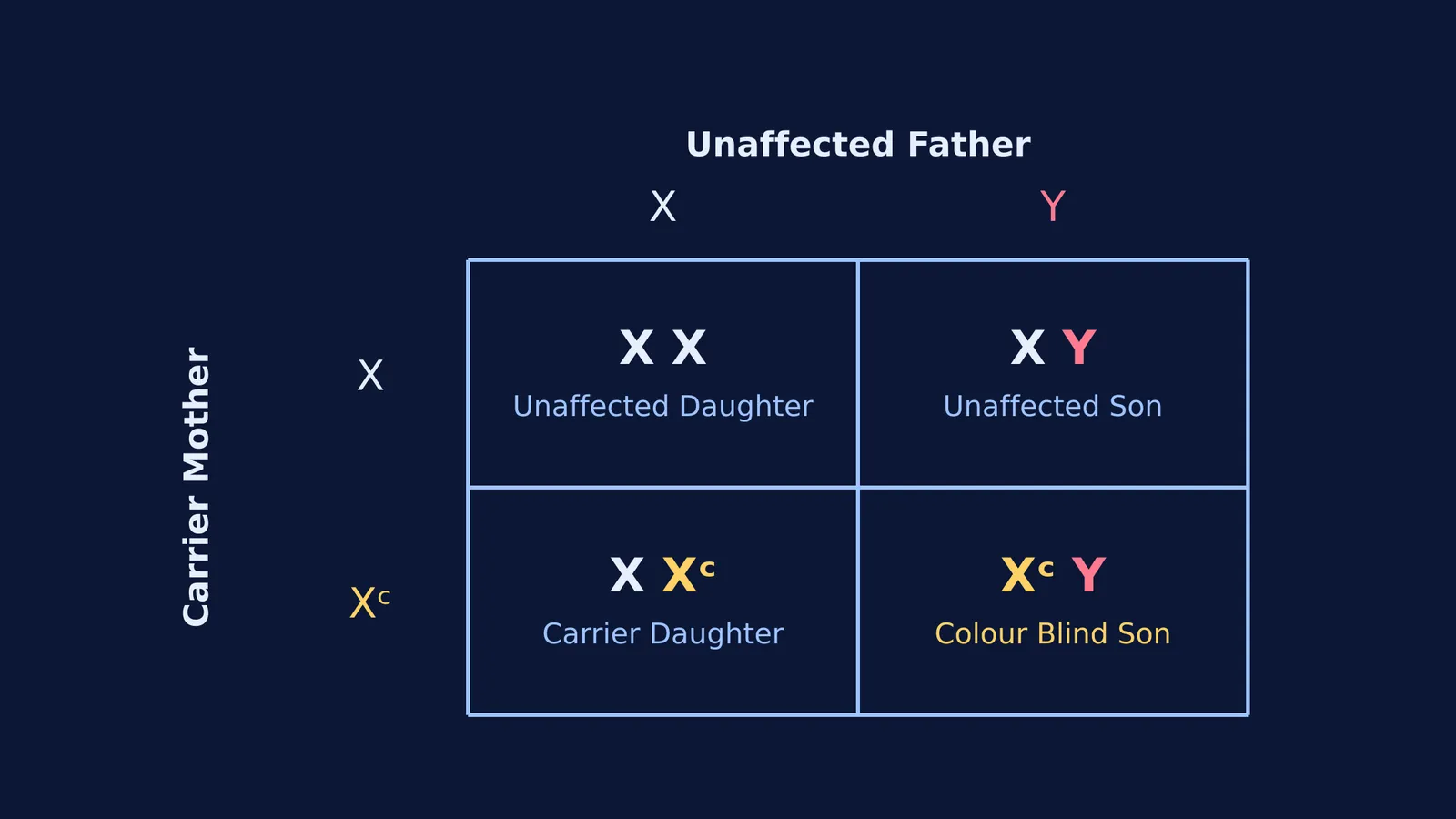
To predict the outcomes of genetic crosses, biologists use a grid called a Punnett square. The diagram above simulates a cross between a carrier mother (with one normal X and one altered X, denoted as Xᶜ) and an unaffected father (XY).
By combining the alleles, we see four equally likely outcomes for each child:
XX: A daughter who is unaffected and not a carrier.
XY: A son who is unaffected.
XXᶜ: A daughter who has normal vision but is a carrier.
XᶜY: A son who is colour blind.
In this scenario, none of the daughters will be colour blind, because they all receive a normal X chromosome from their father. However, half of the sons will be colour blind, depending entirely on which X chromosome they receive from their mother.
If you struggle to picture how alleles move through multiple generations, interactive tools can help bridge the gap between abstract rules and visible outcomes. The Fermi Simulation Lab provides interactive simulations for the ideas that are easier to see than to read, allowing you to run genetic crosses and instantly see the statistical results.
A step-by-step checklist for pedigree problems
Exam questions often present a family tree (a pedigree) and ask you to determine if a disease is X-linked recessive. Use this framework to test the chart:
Look at the affected females: If a daughter has an X-linked recessive condition (XᶜXᶜ), her father must also have the condition (XᶜY). If the chart shows an affected daughter with an unaffected father, the disease cannot be X-linked recessive.
Trace from mother to son: A carrier mother will pass the trait to half of her sons on average. An affected mother (XᶜXᶜ) will pass the altered gene to all of her sons.
Trace from father to son: An affected father never passes the disease to his sons, because he gives them his Y chromosome.
Check the daughters of affected fathers: An affected father will pass his altered X chromosome to all of his daughters. They will all be at least carriers.
For more practice on deducing genotypes from offspring ratios, reviewing how a test cross vs back cross works can solidify your understanding of Mendelian inheritance patterns.


